


Tooth Replacement Options for Seniors: Prices, Lifespans and Coverage

Reviewed by Russell Noga, Licensed Insurance Broker — Last updated November 18, 2026

The main tooth replacement options are a dental implant, an implant-supported bridge, a traditional or Maryland bridge, a removable partial, a temporary flipper, a complete denture and an implant-held denture, with national average prices running from about $605 for a flipper to more than $15,000 per arch for All-on-4 implants. Most senior dental plans treat all of them as major care, and Original Medicare pays for none of them in routine cases.

2027 by the Numbers

12.9%

of adults 65 and older have lost all their natural teeth (CDC, NCHS 2015-2018 data)

$605-$15,176

national average range, flipper to All-on-4 arch (2024 Synchrony cost study via CareCredit)

98%

of individual Medicare Advantage plans offer some dental benefit in 2026 (KFF)

Losing a tooth after 65 rarely leaves just one choice. A dentist may lay out four or five ways to fill the space, each with its own price, visit count, health demands and claim rules, and most guides list them without the numbers.

This page puts the whole menu in one place. For two of the most common head-to-head decisions, see dental bridge vs implant and dentures vs implants cost.
Compare Senior Dental Plans That Pay for Major Care

Every Option on One Chart: Price, Lifespan, Visits and Plan Category

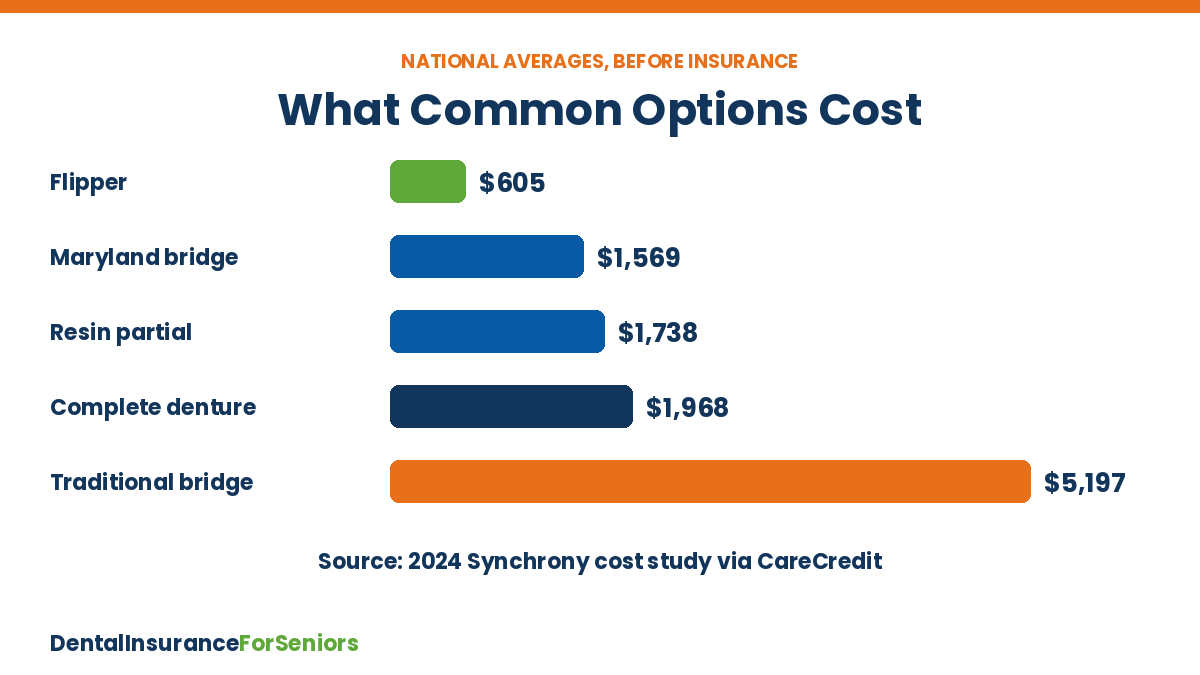
Tooth replacement options average national prices from flipper to traditional bridge

Each figure below comes from a named source, lined up so the trade-offs show at a glance. Local quotes can land well above or below these national figures.

OptionTypical or average priceHow long it often lastsVisits and timeHow dental plans usually class it
Single implant with crownAbout $3,000 to $6,000 per tooth (MetLife)MetLife cites 97% success at 10 years, 75% at 20Several visits over about 3 to 6 monthsMajor on some plans; excluded on others
Implant-supported bridgeAbout $5,000 to $15,000 for 3 or 4 teeth (Humana)Varies with the implants and the bridge on topSeveral visits plus surgery; 3 to 6 months of healingMajor or implant benefit, if covered at all
Traditional fixed bridge$5,197 average (Synchrony 2024)5 to 15 years (Cleveland Clinic)Two visits about 2 to 4 weeks apartMajor, often around 50%
Maryland (resin-bonded) bridge$1,569 average (Synchrony 2024)12 to 21 years on front teeth in research cited by ColgateUsually two visitsMajor
Removable partial$1,738 resin, $2,229 resin and metal (Synchrony 2024)5 to 15 years (Polident)Several fittingsMajor or prosthodontic
Flipper (temporary)$605 average (Synchrony 2024)Short term, until the final toothOften ready at or near the extractionMajor if listed; some plans skip it
Complete denture$1,968 average (Synchrony 2024)7 to 10 years, relined every 1 to 2 years (Cleveland Clinic)Several fittingsMajor or prosthodontic
Implant-held denture or full arch$3,500 to $7,500 per arch for a two-implant snap-in; $15,176 average for All-on-4Implants long term; the denture part wears and is remadeSurgery, healing, then fittingsOften limited or excluded
Leaving the gap$0 nowNot applicableNoneNot a claim, but later fixes may need grafting

Sources: 2024 Synchrony Average Procedural Cost Study via CareCredit, MetLife, Humana, Cleveland Clinic, Colgate, Polident, RealDentalCosts. Fees vary by dentist and area.

Reading the chart: The cheapest option up front is not always the cheapest over 15 years. A denture or partial that is remade twice can approach the price of a fixed tooth.

Senior Dental Insurance Quotes

Call a Licensed Agent Now

Compare dental plans for seniors and people on Medicare from several insurance companies in one call.

☎ 1-855-425-2095

TTY users 711  |  Mon–Fri: 8am–9pm ET

No obligation to enroll

Matching the Choice to How Many Teeth Are Gone

The count and position of the missing teeth narrow the menu faster than anything else.

One tooth, healthy teeth on each side. An implant, a traditional bridge or, for a front tooth, a Maryland bridge. A flipper can bridge the wait. Our dental implant cost guide breaks down the per-tooth price.

Two or three teeth in a row. A longer fixed bridge, an implant-supported bridge, or a partial if the neighbor teeth are weak.

Scattered gaps across one arch. A single removable partial can fill several spaces at once, which is usually far cheaper than fixing each gap separately.

No teeth left in an arch. A complete denture, a denture that snaps onto two or more implants, or a fixed full-arch bridge on four or more implants.

Price detail for fixed options sits on our dental bridge cost page, and the short-term plastic tooth is covered under flipper tooth cost.

What Each Option Demands From Your Mouth and Your Health

OptionNeedsOften a poor fit when
Implant or implant bridgeEnough jawbone, gums free of active disease, ability to have minor surgeryBone has shrunk, or health conditions or some medicines slow healing
Traditional bridgeStrong teeth on both sides of the gap to hold crownsThe neighbor teeth are weak, or healthy and worth leaving alone
Maryland bridgeHealthy neighbor teeth with enough enamel to bond to; light biting forceThe gap is a back molar that takes heavy chewing
Partial or complete dentureGums and remaining teeth that can support or clasp it; hands able to remove and clean itGagging, dry mouth or a flat ridge keep it from staying put

General guidance only. A dentist decides after an exam and X-rays.

Doing nothing is also on the menu, and it is common when money is tight. Its costs arrive later.

Bone shrinks. Dear Doctor magazine reports about a 25% loss in bone width during the first year after a tooth comes out, followed by loss of height over the next few years.

The bite can shift. When back teeth are missing, the front teeth can be pushed out of place and chewing and speech can suffer.

Later repairs cost more. An implant placed years after the loss may need bone rebuilt first. The same Synchrony study puts a socket graft at $558 and a ridge expansion at $2,511 on average.

How Dental Plans and Medicare Treat Each Choice

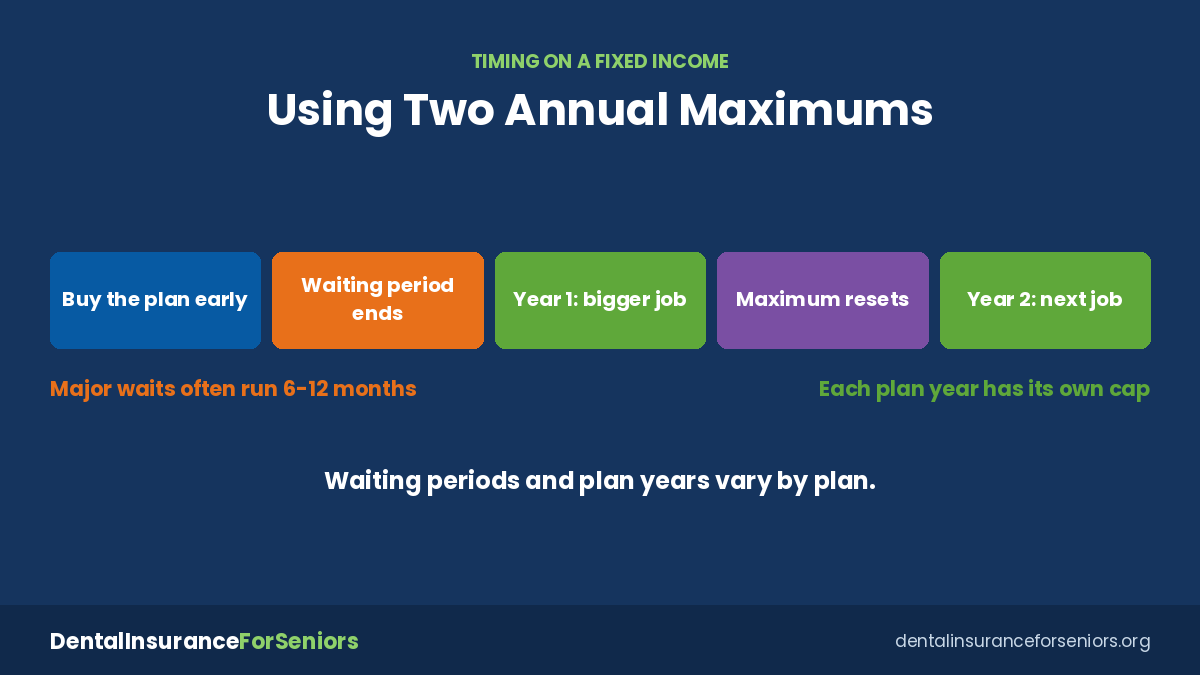
Timeline for timing tooth replacement options around dental plan waiting periods and two annual maximums

Nearly every option above lands in one claim bucket: major or prosthodontic care, which usually brings the lowest payment level and the longest wait.

Where your coverage comes fromWhat it usually does for tooth replacementFine print to check
Stand-alone senior dental PPOOften pays around 50% for bridges, partials and dentures; implants varyWaiting period, annual maximum, missing-tooth clause, least-costly-option rule
Original Medicare (Parts A and B)Does not pay for routine bridges, implants or denturesRare exceptions tied to covered medical treatment
Medicare Supplement (Medigap)No dental benefitPair it with a separate dental policy
Medicare Advantage with dentalSome plans help with dentures or bridges, fewer with implants; varies by plan and areaYearly dental dollar cap, in-network rules, prior approval
Dental discount planNot insurance; lowers fees at participating dentistsMembership fee; you pay the reduced price yourself

KFF reports that Medicare Advantage dental benefits often carry an annual dollar cap. Confirm your own plan’s Evidence of Coverage or certificate.

The missing-tooth clause. Many individual plans will not pay to replace a tooth that was already gone when coverage started. Ask about it before you buy.

The least-costly rule. Some plans pay only what a cheaper option would cost, such as a partial instead of an implant, and leave the rest to you.

Find & Compare Plans Online

Speak with a licensed insurance agent

1-855-425-2095TTY 711

Mon-Fri: 8am-9pm ET

Timing Plan Purchase and Splitting Work Across Two Plan Years

Two calendar habits stretch a fixed income. Buy the dental plan early, since major care often carries a 6 to 12 month waiting period. And when there are two separate jobs, put one in each plan year so each draws on its own annual maximum.

Treatment planPlan paysYou pay
Upper bridge ($5,197) and lower resin partial ($1,738), same plan year$1,500 (maximum reached)$5,435
Bridge in year one$1,500 (maximum reached)$3,697
Partial in year two$844$894
Split total$2,344$4,591

Our illustration, not a quote: a plan paying 50% for major care after a $50 deductible per year, $1,500 annual maximum, waiting period already met, missing-tooth clause not triggered. Prices are 2024 Synchrony national averages. Partial math: ($1,738 – $50) x 50% = $844. Premiums not included.

Splitting saved $844 here, the full value of the second claim, but only if your dentist agrees the second job can wait. See how the yearly cap resets in annual maximums in dental insurance.

Putting Together a Plan You Can Afford

1

Ask for every realistic option in writing. Request an itemized quote for at least two choices, with procedure codes listed, so you can compare apples to apples.

2

Send the quotes for a pre-treatment estimate. The plan’s reply shows what it will pay and whether a waiting period or missing-tooth rule blocks the claim.

3

Sort jobs by urgency. Pain, infection and front teeth usually go first. A back gap that is not hurting may be able to wait for the next plan year.

4

Weigh years of use against price. A fixed tooth that lasts 15 years can cost less per year than a denture remade twice, though speed and fewer visits matter more for some.

For family members helping out: Ask how many surgeries, visits and months each option involves, and whether daily cleaning will be manageable if hand strength or memory declines.

Bottom Line

Tooth replacement options range from a $605 flipper to more than $15,000 per arch for fixed implant teeth, and most dental plans pay for them as major care with caps and waits. Match the option to how many teeth are missing and to the health of your bone and neighbor teeth, buy coverage before you need it, and spread separate jobs over two plan years when you can.

See dental plans for bridges, partials and implants in your ZIP code

Tooth Replacement Options — Frequently Asked Questions

➤ What is the cheapest way to replace a missing tooth?

A flipper, at about $605 on average nationally, but it is temporary. Among long-term choices, a resin partial or a Maryland bridge often costs least.

➤ Which tooth replacement lasts the longest?

Implants tend to last longest, with MetLife citing studies showing 97% success at 10 years. The crown on top may need replacing sooner than the post.

➤ Can I replace a tooth without surgery?

Yes. Traditional bridges, Maryland bridges, partials, flippers and complete dentures all avoid surgery. Implants and implant-held dentures need it.

➤ Is it okay to leave a back tooth gap empty?

Some people do, but the bone under it shrinks and nearby teeth can shift, which can make a later implant harder and costlier.

➤ Will a dental plan pay if my tooth was missing before I enrolled?

Maybe not. Many individual plans have a missing-tooth clause that blocks payment for teeth lost before coverage began, so read the policy before buying.

➤ Does Medicare Advantage pay for tooth replacement?

Some Medicare Advantage plans include dental benefits that may help with dentures or bridges, and fewer cover implants. Coverage, caps and networks vary by plan and area.

➤ How many visits does each option take?

A fixed bridge usually takes two visits a few weeks apart, and a denture often needs several fittings. Implants take several visits spread over months of healing.

➤ Can I start with a cheaper option and upgrade later?

Often, yes. Many people wear a flipper or partial first and move to a bridge or implant later, though an old gap may need grafting.

Senior Dental Insurance Quotes

Call a Licensed Agent Now

Compare dental plans for seniors and people on Medicare from several insurance companies in one call.

☎ 1-855-425-2095

TTY users 711  |  Mon–Fri: 8am–9pm ET

No obligation to enroll

Find & Compare Plans Online

Speak with a licensed insurance agent

1-855-425-2095TTY 711

Mon-Fri: 8am-9pm ET

ZRN Health & Financial Services, LLC, a Texas limited liability company