



Cost of a Dental Bridge for Seniors: Prices by Type and What Plans Pay

Reviewed by Russell Noga, Licensed Insurance Broker — Last updated November 9, 2026

The cost of a dental bridge is usually about $2,000 to $5,000 for a traditional or cantilever bridge, $1,500 to $2,500 for a Maryland bridge and $5,000 to $15,000 for an implant-supported bridge, before insurance. A senior dental plan often pays around half after a waiting period, but only up to its annual maximum, which one 3-unit bridge can use up in a single visit.

2027 by the Numbers

$5,197

average traditional bridge before insurance (CareCredit 2024 cost study)

$1,500-$2,500

typical Maryland bridge for one missing tooth (Humana)

$5,000-$15,000

implant-supported bridge spanning 3 or 4 teeth (Humana)

A bridge fills a gap by anchoring false teeth to the teeth, or implants, on each side. For many retirees it is the middle road between a removable partial and an implant, in price as well. The surprise for most families is how little of the fee a typical senior plan pays in one year.

This page covers price only. Whether a plan covers bridges at all is explained in dental insurance for bridges.
Compare Senior Dental Plans That Cover Bridges

Bridge Prices by Type, Before Any Insurance

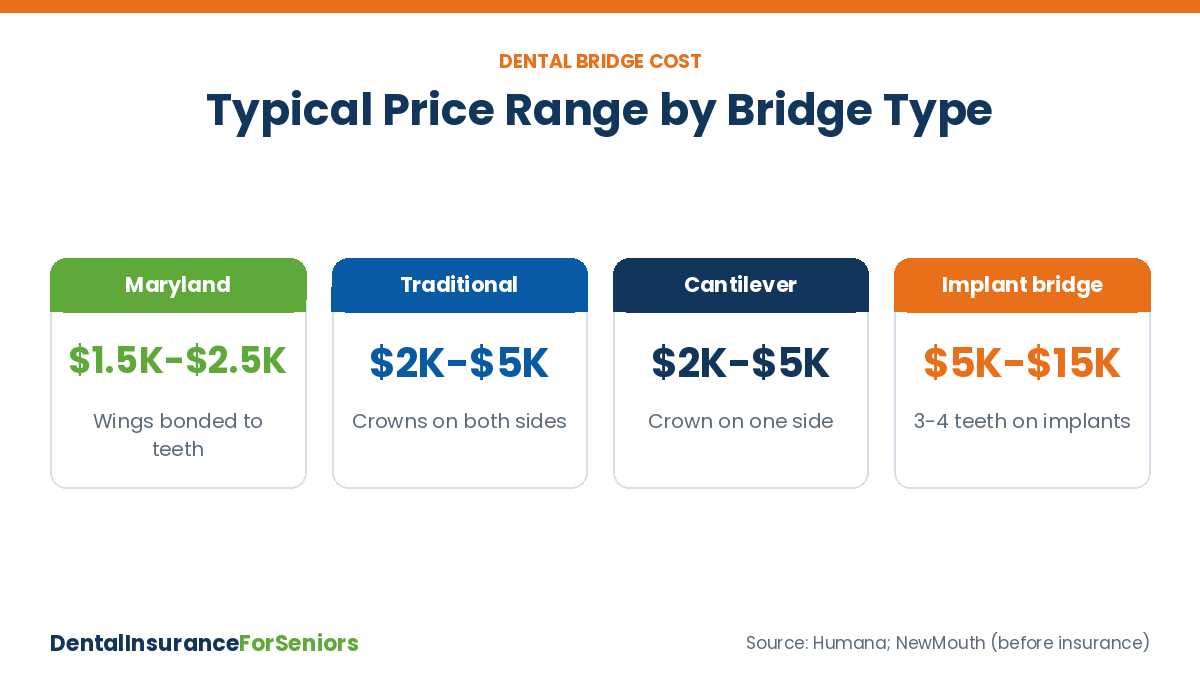
Cost of dental bridge by type: traditional, cantilever, Maryland and implant-supported price ranges

Four designs cover nearly every bridge a dentist will suggest, and the design sets the price because it decides how many crowns, wings or implants hold the false tooth.

Bridge typeWhat holds it in placeTypical rangeCareCredit 2024 average
TraditionalA crown on the natural tooth at each side of the gap$2,000 to $5,000$5,197
CantileverA crown on one side only, used when just one neighbor tooth is available$2,000 to $5,000$1,041
Maryland (resin-bonded)Metal or porcelain wings glued to the backs of the neighbor teeth$1,500 to $2,500$1,569
Implant-supportedTwo or more dental implants instead of natural teeth$5,000 to $15,000$5,195

Ranges: Humana and NewMouth (2026), for one false tooth, or 3 to 4 teeth on implants. Averages: CareCredit 2024 cost study, which may count units differently. Fees vary by dentist and area.

A Maryland bridge costs less because the neighbor teeth are not crowned, but it suits front teeth where biting force is lighter. An implant bridge costs the most yet does not rely on the natural teeth beside the gap.

Senior Dental Insurance Quotes

Call a Licensed Agent Now

Compare dental plans for seniors and people on Medicare from several insurance companies in one call.

☎ 1-855-425-2095

TTY users 711  |  Mon–Fri: 8am–9pm ET

No obligation to enroll

How the Number of Units Changes the Quote

Dentists price a bridge by the unit. Each anchoring crown (abutment) and each false tooth (pontic) is one unit, so a single missing tooth usually means a 3-unit bridge.

3 units, one missing tooth. Two abutment crowns plus one pontic; Real Dental Costs puts the national average at about $3,965.

Each added unit. Roughly $1,000 to $2,500 more, about $1,500 typical, per the same 2026 fee data.

4 units, two missing teeth. Often about $3,000 to $7,500 in total.

Material choice. Porcelain fused to metal runs about $1,000 to $1,800 per unit; zirconia about $1,500 to $3,000.

Quote checklist: An itemized quote should list each unit with its CDT code, plus any extraction, buildup, root canal or temporary bridge, which are often billed separately.

Senior Dental Plan Rules for Bridges, Side by Side

Senior plans almost always file bridges under major services. These four individual plans, open to people on Medicare, treat the same bridge very differently in their own documents.

Plan (document checked)Wait for major workWhat it paysYearly capTooth lost before coverage
Humana Extend 5000 (Georgia summary)6 months, may be waived with proof of prior coverage50% in year 1, 60% from year 2, after a $75 deductible$5,000 per personNot covered
Mutual of Omaha individual dental PPO (outline of coverage)1 year, applied once per policy50% after a $50 deductible$1,500 per calendar yearFirst bridge excluded if the tooth was lost while not covered
Aetna Dental Direct Preferred PPO (brochure)12 months, waived with coverage in the past 90 days50% in network after a $50 deductible$1,250 in networkFirst bridge covered only for teeth removed while insured
Physicians Mutual (covered-procedures schedule and FAQ)12 monthsSet dollar amount per unit: $180, $290 or $400 by option; 70% on PremierNo annual maximum on cash benefitsCovered only if the tooth was pulled while insured

Compiled from each carrier’s plan documents, checked November 2026. Humana’s summary lists crowns and dentures as major but does not name bridges; confirm on the full covered-service list. Terms vary by state.

Fine print to find first: The missing tooth clause comes first. If the gap existed before the policy started, a plan with this clause pays nothing toward the first bridge, however long the policy has been in force.

Worked Example: One 3-Unit Bridge Under Four Rule Sets

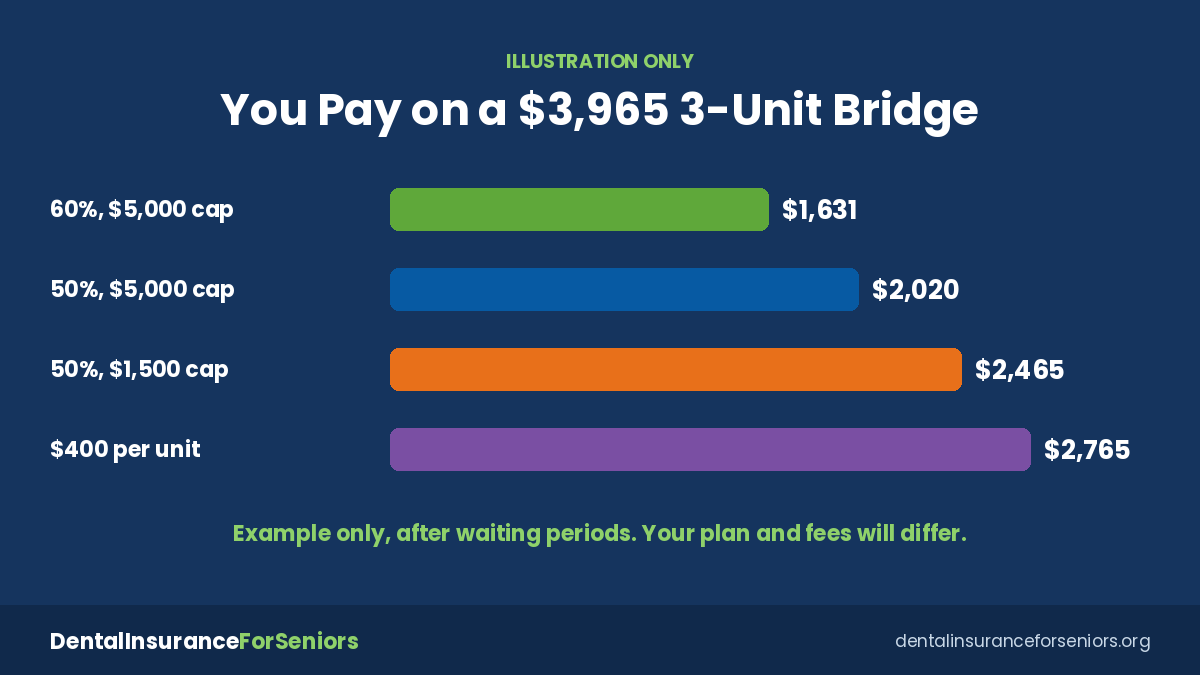
Cost of a dental bridge with insurance: what a patient pays on a $3,965 3-unit bridge under four plan rule sets

Take a $3,965 traditional 3-unit bridge, the Real Dental Costs national average, for a tooth pulled after enrollment and after any waiting period. This is an illustration, not a quote.

Rule setPlan paysPatient pays
Humana Extend 5000, year 2 (60%, $75 deductible)$2,334$1,631
Humana Extend 5000, year 1 (50%, $75 deductible)$1,945$2,020
50% plan with a $1,500 cap and $50 deductible$1,500 (cap reached)$2,465
Physicians Mutual top dollar schedule (3 units at $400)$1,200$2,765

Assumes nothing else was claimed that year. In-network discounts often lower the fee itself.

On a bridge, the yearly cap matters more than the percentage. A 50% plan with a $1,500 cap stops paying at about $3,050 of fees, so one 3-unit bridge often hits the ceiling. See annual maximums in dental insurance.

1

Ask for a pre-treatment estimate. The plan’s share is then in writing before any tooth is prepared.

2

Ask which date the plan uses. Many carriers date a bridge claim to the cementation day, some to the prep day. A bridge prepped in December and seated in January can land in the new plan year.

3

Split the related work, not the bridge. An extraction or root canal done in one plan year and the bridge in the next uses two annual maximums.

Find & Compare Plans Online

Speak with a licensed insurance agent

1-855-425-2095TTY 711

Mon-Fri: 8am-9pm ET

What Medicare and Medicare Advantage Pay Toward a Bridge

Medicare.gov states that Original Medicare does not cover most dental services, including dentures and implants, and routine bridgework falls in the same group. Details are in does Medicare pay for dental bridges.

Medicare Advantage. Some plans include dental benefits that can help with a bridge, but coverage, dollar limits and networks vary by plan and area. Check whether a 3-unit bridge fits under the plan’s yearly dental limit.

Medicare Supplement. Medigap only helps with costs Original Medicare approves, so it adds nothing toward bridgework.

Medicaid. Adult dental coverage is optional for states, so bridge coverage ranges from included to emergency-only.

Bridge, Partial or Implant on a Fixed Income

For one missing tooth, the three common fixes sit at very different price points, and each wears out on its own schedule.

OptionTypical upfront costCommon plan replacement rule
Cast metal partial denture, one archAbout $1,250 to $3,280Often once every 5 years
Traditional 3-unit bridgeAbout $2,000 to $5,000Often once every 5 years; Physicians Mutual lists 5
Single implant with abutment and crownAbout $3,000 to $6,000Varies; many plans also cap implants with a separate maximum

Partial: Pearl (ADA fee survey data). Bridge: Humana, NewMouth. Implant: MetLife cost guide.

Bridges commonly last about 5 to 15 years. A replacement limit, often five years, means a bridge that fails early may be an out-of-pocket repeat. Compare partial dentures cost and how much dental implants cost.

Worth weighing: A bridge means crowning two neighbor teeth. If they already have large fillings, crowns can protect them; if they are untouched, an implant or partial avoids reshaping them.

Bottom Line

A traditional dental bridge usually costs $2,000 to $5,000 before insurance, with Maryland bridges lower and implant-supported bridges far higher. Senior dental plans often pay about half after a waiting period, but the annual maximum and the missing tooth clause decide the real out-of-pocket cost. Get a pre-treatment estimate and plan the timing before the work begins.

Related: dental bridge vs implant How the two compare on price, plan coverage, lifespan and cost per year at 65, 75 and 85.

Check bridge coverage and plan prices in your ZIP code

Cost of a Dental Bridge — Frequently Asked Questions

➤ What is the average cost of a dental bridge?

CareCredit’s 2024 cost study puts the average traditional bridge at $5,197, and Real Dental Costs puts a traditional 3-unit bridge at about $3,965. Most ranges run $2,000 to $5,000.

➤ How much does a 3-unit bridge cost with a senior dental plan?

On a $3,965 bridge, a 50% plan with a $1,500 annual maximum leaves about $2,465 to pay. A 60% plan with a $5,000 maximum could leave about $1,600.

➤ Is a Maryland bridge cheaper than a traditional bridge?

Usually. Humana lists about $1,500 to $2,500 for a Maryland bridge versus $2,000 to $5,000 for a traditional one, because the neighbor teeth are not crowned.

➤ Will my plan pay for a bridge if the tooth was missing before I enrolled?

Often not. Humana Extend 5000, Aetna Dental Direct and Physicians Mutual, among others, cover a first bridge only for teeth lost while the policy was in force.

➤ Can a dental bridge be split across two plan years?

The bridge itself is usually one claim, dated the prep day or the cementation day depending on the carrier. Related work like an extraction can often go in the earlier year.

➤ Does Original Medicare pay anything toward a bridge?

Not for routine bridgework. Some Medicare Advantage plans include dental benefits, but what they pay varies by plan and area.

➤ How often will insurance pay to replace a bridge?

Many plans allow one replacement every five years, and Physicians Mutual lists one per five years for bridge units. An earlier failure may be fully out of pocket.

➤ Why does each extra tooth raise the bridge cost so much?

Each false tooth is a separate lab-made unit, roughly $1,000 to $2,500 each in 2026 fee data, so a 4-unit bridge often costs about $3,000 to $7,500.

Senior Dental Insurance Quotes

Call a Licensed Agent Now

Compare dental plans for seniors and people on Medicare from several insurance companies in one call.

☎ 1-855-425-2095

TTY users 711  |  Mon–Fri: 8am–9pm ET

No obligation to enroll

Find & Compare Plans Online

Speak with a licensed insurance agent

1-855-425-2095TTY 711

Mon-Fri: 8am-9pm ET

ZRN Health & Financial Services, LLC, a Texas limited liability company