



Dental Bridge vs Implant for Seniors: Cost, Coverage and Years of Use

Reviewed by Russell Noga, Licensed Insurance Broker — Last updated November 13, 2026

A 3-unit dental bridge usually costs about $2,000 to $5,000, while a single implant with its crown usually costs about $3,000 to $6,000, so the bridge is cheaper up front and more often covered by dental insurance as major care. The implant spares the neighbor teeth and tends to last longer, which pays off most in your 60s; past 80, the bridge is often the better value per year of use.

2027 by the Numbers

89.1%

of tooth-supported bridges still in place after 10 years (Tan et al., 2004 review)

95.2%

of single implants still in place after 10 years (Jung et al., 2012 review)

19.4 yrs

average remaining life at 65, men and women combined (SSA 2023 period life table)

When one back tooth or two side-by-side teeth are gone, a dentist will usually offer two fixed choices. A bridge hangs a false tooth between two crowned neighbor teeth. An implant puts a small post in the jawbone and tops it with its own crown.

This guide weighs them the way a retiree or an adult child should: price, what a senior plan and Medicare send back, health after 65, and years of use per dollar at different ages. Full price breakdowns are in dental bridge cost and how much dental implants cost.
Compare Senior Dental Plans for Bridges and Implants

Side by Side: How a Bridge and an Implant Differ

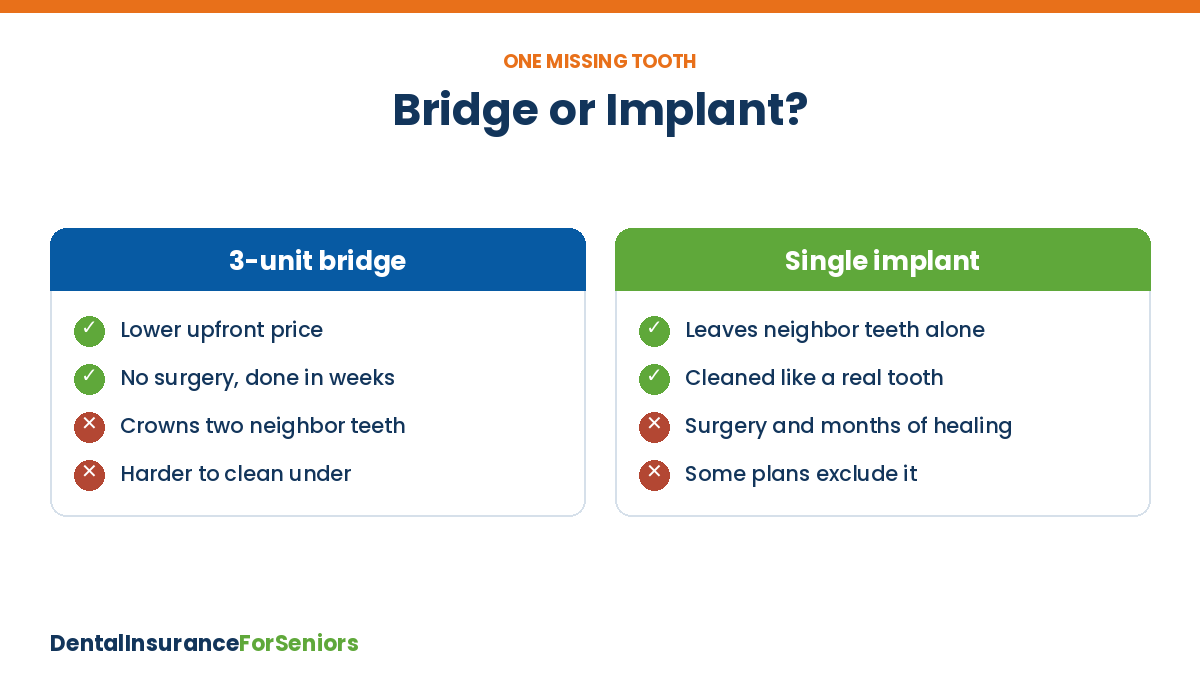
Dental bridge vs implant pros and cons for seniors replacing one missing tooth

The two options fill the same gap in very different ways.

Factor3-unit bridgeSingle implant with crown
Typical price before insuranceAbout $2,000 to $5,000About $3,000 to $6,000, plus any graft
Surgery neededNo; the neighbor teeth are shaved for crownsYes; a post is placed in the jawbone
Time to finishOften two visits a couple of weeks apartOften three to six months while the post fuses with bone
Effect on neighbor teethBoth are filed down and crownedLeft alone
Daily cleaningFloss must be threaded under the false toothBrushed and flossed much like a natural tooth
How dental plans usually class itMajor care, often paid around 50%Major care on some plans; excluded or capped on others

Price ranges: Humana and NewMouth (bridge), MetLife cost guide (implant). Fees vary by dentist and area.

Worth knowing: If one tooth holding a bridge later cracks or decays, the whole bridge often has to be redone.

Senior Dental Insurance Quotes

Call a Licensed Agent Now

Compare dental plans for seniors and people on Medicare from several insurance companies in one call.

☎ 1-855-425-2095

TTY users 711  |  Mon–Fri: 8am–9pm ET

No obligation to enroll

How Long Each One Lasts, Based on the Research

Clinic websites quote lifespans loosely. Large reviews of published studies give firmer numbers for the first 10 years.

Bridges: 89.1% at 10 years. A 2004 review by Tan and colleagues in Clinical Oral Implants Research found that share of tooth-supported bridges still in place. Only 71.1% had gone 10 years with no problem at all.

Why bridges fail. The same review put the 10-year risk of a bridge coming loose at 6.4% and of losing it to decay under the crowns at 2.6%.

Implants: 95.2% at 10 years. A 2012 review by Jung and colleagues found that share of single implant posts still in place, while 89.4% of the crowns on top were still in service.

The crown is the weak point. When an implant tooth needs work, it is usually the crown, not the post, and a new crown costs far less.

Health Factors That Weigh More After 65

Age alone does not rule out an implant. These factors often decide the choice for older adults.

Bone where the tooth was. Bone shrinks after a tooth is lost. An old gap may need a bone graft before an implant, adding cost and months. A bridge needs no bone under the false tooth.

Health conditions and medicines. Uncontrolled diabetes, smoking, recent cancer treatment and some osteoporosis drugs can slow healing or raise surgical risk. Bring a full medicine list.

Hands and eyesight. Cleaning under a bridge takes a floss threader or water flosser. With arthritis or weak eyesight, an implant is often easier to keep clean.

The neighbor teeth. If the teeth beside the gap already have large fillings or crowns, a bridge can protect them. If they are healthy and untouched, an implant spares them.

For adult children: Ask how many surgeries and visits each option needs, and what happens if daily cleaning becomes hard to keep up.

Our Math: Cost Per Year of Use at 65, 75 and 85

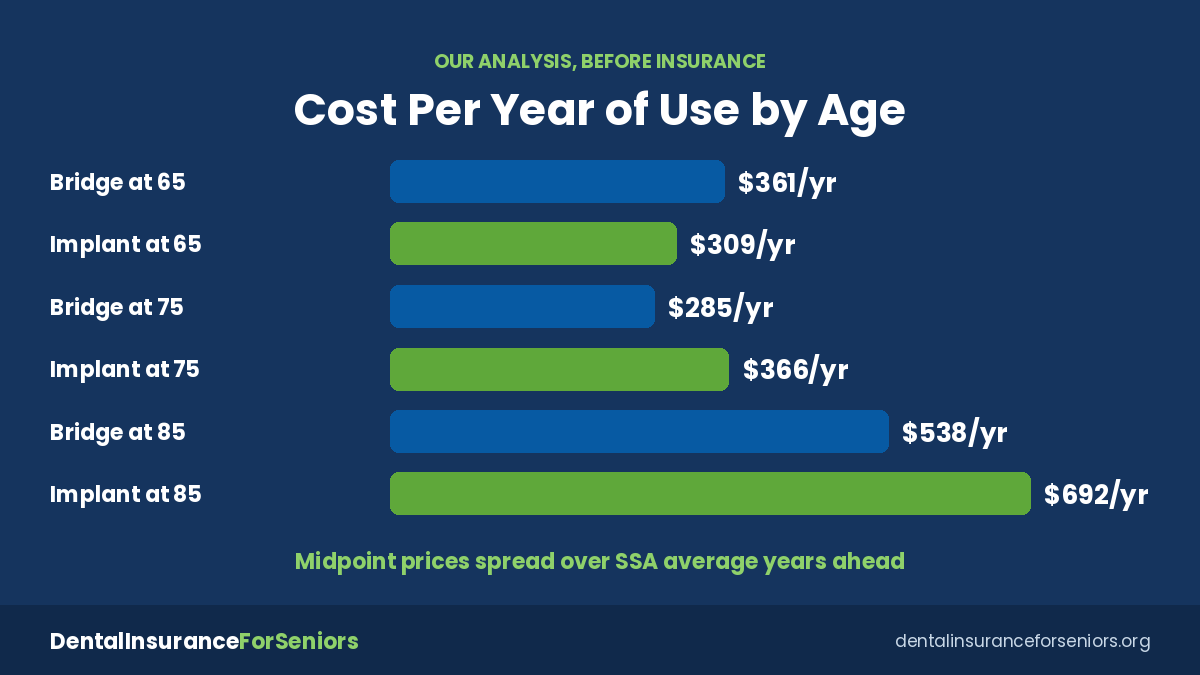
Dental bridge vs implant cost per year of use at ages 65, 75 and 85

An implant that lasts 25 years is a bargain only if you use it for most of them. We spread each price over the average remaining lifetime from the Social Security life table.

Age at treatmentAverage years aheadBridge: total costBridge: per yearImplant: total costImplant: per year
6519.4$7,000 (one remake)$361$6,000 (one new crown)$309
7512.3$3,500$285$4,500$366
856.5$3,500$538$4,500$692

Our analysis, before insurance. Midpoint prices: $3,500 bridge, $4,500 implant, $1,500 replacement implant crown. Assumes a bridge is remade after about 12 years (at 75 that remake falls right at the average, so it is left out) and an implant crown after about 15. Years ahead: SSA 2023 period life table, men and women averaged. Half of people live longer than the average.

At 65 the implant wins, because the bridge will likely be redone once. By 75 the two are close, and at 85 the bridge costs less per year. The gap shrinks or flips if the bridge fails early, so treat this as a starting point, not a rule.

Reading the math: Life expectancy is an average. A healthy 78-year-old with long-lived parents can plan like a younger person.

Find & Compare Plans Online

Speak with a licensed insurance agent

1-855-425-2095TTY 711

Mon-Fri: 8am-9pm ET

How a Senior Dental Plan Pays a Bridge vs an Implant

Take a plan that pays 50% for major care after a $50 deductible, with a $1,500 annual maximum and the waiting period already met. Illustration only, not a quote.

ScenarioPlan paysYou pay
$3,500 bridge, one plan year$1,500 (maximum reached)$2,000
$4,500 implant, all in one plan year, implants covered$1,500 (maximum reached)$3,000
Same implant: $2,000 post in year one, $2,500 abutment and crown in year two$975 + $1,225 = $2,200$2,300
Same implant on a plan that excludes implants$0$4,500

Math: ($2,000 – $50) x 50% = $975; ($2,500 – $50) x 50% = $1,225. One deductible per plan year. Premiums not included.

Implant stages fall months apart, so they can land in two plan years and use two annual maximums. A bridge is usually one claim with one year’s maximum. See annual maximums in dental insurance.

The alternate benefit rule. Many plans pay only for the least costly option that would work. Delta Dental tells dentists its standard plans pay an allowance toward implant teeth based on the fee for a bridge’s false tooth; the patient pays the rest.

The missing tooth clause. Many plans will not pay to replace a tooth lost before coverage began. This can block a bridge and an implant alike.

Waiting periods. Both are usually major care, and many senior plans make you wait 6 to 12 months before paying for it.

Medicare, Medicare Advantage and Your Next Steps

Medicare.gov says Original Medicare does not cover most dental care, including dentures and other dental devices, and routine bridges and implants fall in that group. Rare exceptions involve dental work needed for a covered medical treatment. See does Medicare pay for dental bridges. Medigap adds no dental coverage.

Some Medicare Advantage plans include dental benefits that may help with a bridge, and fewer list implants. Limits, networks and covered services vary by plan and area, so check the Evidence of Coverage. For stand-alone policies, see does dental insurance cover implants.

1

Get both options priced in writing. Ask for itemized quotes for both, with each procedure code listed.

2

Send both quotes for a pre-treatment estimate. The reply shows whether the plan pays the implant as an implant or at the lower bridge rate.

3

Ask about the gap’s history. When the tooth came out decides whether a missing tooth clause applies.

4

Match the choice to your time horizon. Use the cost-per-year table with your own health and family history in mind.

Bottom Line

A bridge costs less, finishes faster and is more often paid as major care, but it uses two neighbor teeth and usually needs remaking sooner. An implant costs more and needs surgery, yet often lasts longer and is easier to clean. In your 60s the implant often wins per year of use; past 80 the bridge often does.

See which dental plans in your ZIP code cover bridges or implants

Dental Bridge vs Implant — Frequently Asked Questions

➤ Is a bridge or an implant cheaper for one missing tooth?

A bridge, at about $2,000 to $5,000 versus about $3,000 to $6,000 for an implant with its crown. Over 20 years the implant can cost less, since bridges often need remaking.

➤ Which lasts longer, a bridge or an implant?

Reviews found about 89% of bridges and about 95% of implant posts still in place after 10 years. Implant crowns can wear out, but a new crown is far cheaper than a new implant.

➤ Am I too old for an implant at 80?

Age alone usually is not the barrier; health, bone, medicines and healing matter more. If your time horizon is short, a bridge may be the better value.

➤ Will my plan pay the implant price or only the bridge price?

Plans with an alternate benefit rule may pay only what a less costly option would cost and leave the difference to you. A pre-treatment estimate shows which applies.

➤ Can I switch from a bridge to an implant later?

Often yes, if there is enough bone. A graft may be needed if the gap has been empty a long time.

➤ Does Original Medicare pay for either one?

No, not for routine tooth replacement. Some Medicare Advantage plans include dental benefits that may help, but what they pay varies by plan and area.

➤ Which is easier to keep clean with arthritis?

Usually an implant, since it is brushed and flossed like a natural tooth. A bridge needs floss threaded under the false tooth, though a water flosser helps.

➤ Is a bridge or an implant better for two missing teeth in a row?

Either can work. Two gaps in a row often mean a 4-unit bridge or an implant-supported bridge, and prices rise with each added tooth.

Senior Dental Insurance Quotes

Call a Licensed Agent Now

Compare dental plans for seniors and people on Medicare from several insurance companies in one call.

☎ 1-855-425-2095

TTY users 711  |  Mon–Fri: 8am–9pm ET

No obligation to enroll

Find & Compare Plans Online

Speak with a licensed insurance agent

1-855-425-2095TTY 711

Mon-Fri: 8am-9pm ET

ZRN Health & Financial Services, LLC, a Texas limited liability company