


Partial Dentures Cost With Insurance: A Guide for Seniors

Reviewed by Russell Noga, Licensed Insurance Broker — Last updated October 27, 2026

Partial dentures often cost about $300 to $3,300 per arch before insurance, depending on the type. Many dental plans treat them as major care and pay around 50% after the deductible and any waiting period, up to the plan’s annual maximum.

Losing a few teeth is common after 65, and a partial denture is one of the most affordable ways to fill the gaps. It clips onto your natural teeth, helps you chew and speak, and keeps your other teeth from drifting. But prices vary a lot, and many seniors are surprised by how little their coverage pays.

This guide explains how much partial dentures cost, how much a dental plan may pick up, what Medicare and Medicaid do and do not cover, and smart ways to lower the bill. If you need a full set instead, see our guide to dental plans covering dentures for seniors.
Compare Dental Plans That Cover Dentures

Types of Partial Dentures

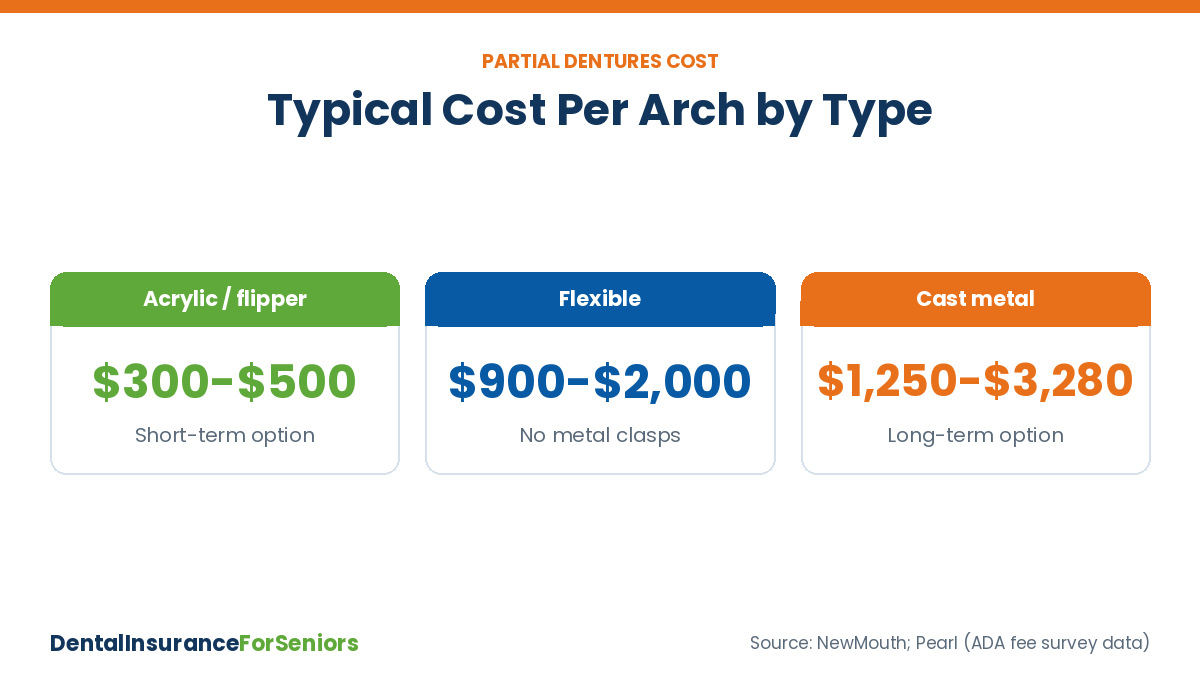
Partial dentures cost by type: acrylic flipper, flexible and cast metal partials

A partial denture replaces one or more missing teeth in an arch when you still have some natural teeth. There are three main types, and the material you choose is the biggest driver of the price.

Cast metal partial. A thin metal frame with clasps that grip your natural teeth, topped with gum-colored acrylic and false teeth. It is sturdy, and dentists often recommend it as a long-term option.

Acrylic partial or flipper. A plastic base with one or more false teeth. It is the lowest-cost choice, but it is bulkier and is usually meant as a short-term or temporary fix, for example while gums heal after an extraction.

Flexible partial. Made from a bendable nylon-type resin with gum-colored clasps, so no metal shows. Many people find it comfortable, but it can be hard or impossible to repair or adjust if it cracks.

Your dentist will suggest a type based on how many teeth are missing, the health of the teeth that will hold the partial, and your budget. Extractions, X-rays and later relines are usually billed separately.

Senior Dental Insurance Quotes

Call a Licensed Agent Now

Compare dental plans for seniors and people on Medicare from several insurance companies in one call.

☎ 1-855-425-2095

TTY users 711  |  Mon–Fri: 8am–9pm ET

No obligation to enroll

How Much Do Partial Dentures Cost Without Insurance?

Prices change by city, dentist and lab. The ranges below are typical for one arch (upper or lower) and give you a starting point before you get a written quote.

TypeTypical cost per archBest for
Acrylic partial / flipperAbout $300 to $500Short-term or temporary use
Flexible partialAbout $900 to $2,000Comfort and no visible metal
Cast metal partialAbout $1,250 to $3,280 (national average about $1,920)Long-term, everyday use

Acrylic and flexible ranges: NewMouth. Cast metal range and average: Pearl national cost data based on ADA fee survey data (CDT D5213), updated 2026. Your dentist’s fees may be higher or lower.

Expect extra charges for extractions, an exam and X-rays, and relines or adjustments down the road. Ask for a full treatment plan so there are no surprises. For a wider look at what seniors spend on dental work, see out-of-pocket dental costs for seniors.

How Dental Insurance Covers Partial Dentures

Most stand-alone dental plans for seniors group partial dentures with major services. That matters, because major services usually have the lowest coverage and the most rules. Here is what to look for in any plan.

Coverage is often about 50%. Many plans pay around half of the cost of major care after the deductible. Some pay less, especially in the first year or two.

Waiting periods are common. Many plans make you wait, often up to 12 months, before major work like dentures is covered. Learn more about dental plan waiting periods.

Replacement limits apply. Plans often pay for a new partial only once every five years or so; some limits run five to eight years. Check your plan’s exact rule.

Missing tooth clause. Some plans will not pay to replace a tooth that was already missing before your coverage began. Not every plan has this clause, so read the policy before you buy.

Broker tip: Ask your dentist for a pre-treatment estimate. The office sends your plan to the insurer before work starts, and you get a written figure for what the plan should pay.

Partial Dentures Cost With Insurance: An Example

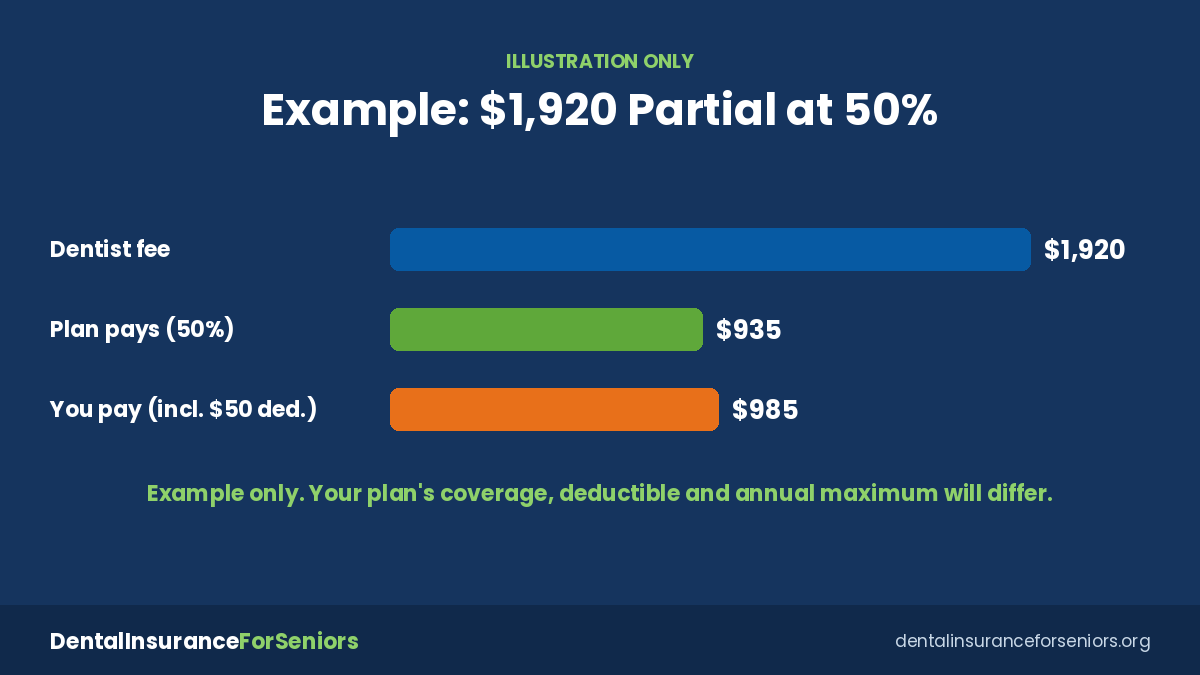
Partial dentures cost with insurance example showing what the plan pays and what you pay

Your annual maximum caps what the plan pays in a year, and many senior plans set it at about $1,000 to $2,000. Here is how the math can work. This is an illustration only, not a quote; your plan’s numbers will differ.

1

Start with the fee. Say your dentist charges $1,920 for a cast metal partial.

2

Subtract the deductible. With a $50 deductible, $1,870 is left for the plan to share.

3

Apply the coverage. At 50% for major care, the plan pays $935 and you pay $935 plus the $50 deductible, or $985.

4

Check your annual maximum. If your maximum is $1,000 and you already used $400 on fillings this year, the plan can only pay $600. Your share rises to $1,320.

Timing matters. Scheduling the partial early in a new benefit year, before other work uses up the maximum, can help. See how annual maximums in dental insurance work.

Find & Compare Plans Online

Speak with a licensed insurance agent

1-855-425-2095TTY 711

Mon-Fri: 8am-9pm ET

Does Medicare or Medicaid Pay for Partial Dentures?

According to Medicare.gov, Original Medicare (Parts A and B) does not cover most dental care, including items like dentures. A Medicare Supplement plan does not add dental coverage either, because it only helps with costs Medicare approves.

Medicare Advantage. Some Medicare Advantage plans include dental benefits that may help with dentures. Coverage, annual limits and networks vary by plan and area, and not every plan covers dentures. See does Medicare Advantage cover dentures.

Medicaid. Adult dental coverage is optional for states, so it varies widely. Some states cover dentures, while others offer only emergency care or none at all. Check with your state Medicaid office.

Stand-alone dental plan. If your Medicare coverage does not help with dentures, a separate senior dental plan may. Compare waiting periods and annual maximums closely.

Ways to Save on Partial Dentures

1

Get a plan before you need it. Because of waiting periods, buying coverage after you learn you need a partial may mean paying the full price for months.

2

Stay in network. In-network dentists agree to set fees, which can lower both the plan’s share and yours.

3

Look at a dental discount plan. Discount plans are not insurance, but they offer reduced fees at member dentists and usually have no waiting period.

4

Try a dental school. Many dental schools offer care at lower prices, supervised by licensed dentists. Visits can take longer.

5

Ask about payment plans. Many offices offer monthly payment options or third-party financing. Read the interest terms carefully.

Good to know: A cheaper acrylic flipper may cost more over time if it needs frequent replacement. Ask your dentist which type will last best for your mouth.

Bottom Line

Partial dentures often cost a few hundred dollars for a simple flipper and up to about $3,300 for a cast metal partial. Dental insurance may cover around half after the deductible, but waiting periods, replacement limits, the missing tooth clause and your annual maximum all affect what you pay. Compare plans before you need the work.

Related: flexible partial dentures cost Per-arch prices, CDT codes and how plans pay for flexible partials.

Related: flipper tooth cost Single-tooth flipper prices, codes D5820/D5821 and how senior dental plans pay.

See senior dental plans & rates in your ZIP code

Partial Dentures Cost — Frequently Asked Questions

➤ How much are partial dentures with insurance?

It depends on your plan. Many plans pay about 50% of major care after the deductible, so on a $1,920 partial you might pay roughly $985, as long as you have met any waiting period and have enough annual maximum left.

➤ How much are partial dentures without insurance?

Typical prices run about $300 to $500 for an acrylic flipper, $900 to $2,000 for a flexible partial, and about $1,250 to $3,280 for a cast metal partial per arch. Fees vary by dentist and location.

➤ Does dental insurance cover partial dentures?

Many dental plans cover partial dentures as a major service, often at about 50%. Coverage may start only after a waiting period and is limited by your annual maximum.

➤ Is there a waiting period for partial dentures?

Often, yes. Many plans have a waiting period for major services, sometimes up to 12 months. Some plans have shorter or no waiting periods but may pay less at first.

➤ How often will insurance replace a partial denture?

Many plans pay for a replacement only once every five years or so, and some limits are longer. Check your plan’s replacement rule before you buy.

➤ Does Medicare pay for partial dentures?

Original Medicare does not cover dentures. Some Medicare Advantage plans include dental benefits that may help, but coverage varies by plan and area.

➤ Does Medicaid cover partial dentures for seniors?

It depends on your state. Adult dental coverage under Medicaid is optional, so some states cover dentures and others offer limited or emergency-only care.

➤ What is the cheapest type of partial denture?

An acrylic partial or flipper is usually the least expensive, often about $300 to $500. It is mainly meant for short-term use, so it may not be the best value over many years.

Senior Dental Insurance Quotes

Call a Licensed Agent Now

Compare dental plans for seniors and people on Medicare from several insurance companies in one call.

☎ 1-855-425-2095

TTY users 711  |  Mon–Fri: 8am–9pm ET

No obligation to enroll

Find & Compare Plans Online

Speak with a licensed insurance agent

1-855-425-2095TTY 711

Mon-Fri: 8am-9pm ET

ZRN Health & Financial Services, LLC, a Texas limited liability company