



Dentures vs Implants Cost: The 10- and 20-Year Math for Seniors

Reviewed by Russell Noga, Licensed Insurance Broker — Last updated November 2, 2026

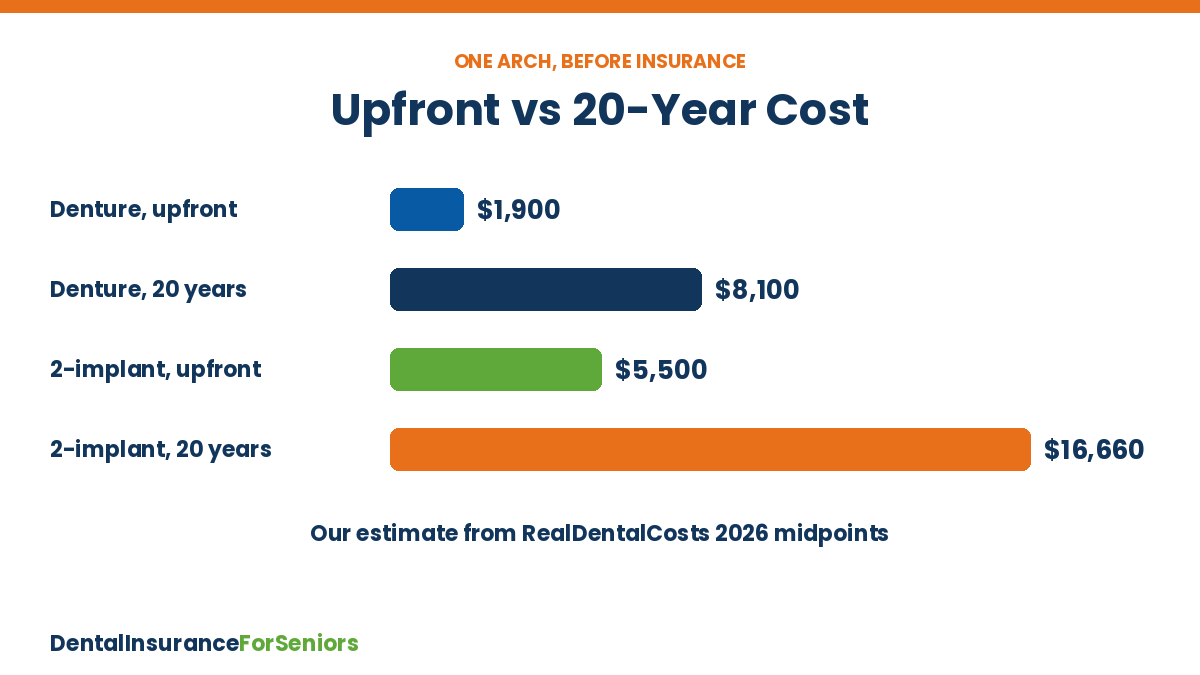
A regular full denture costs about $500 to $3,000 per arch, while a snap-in denture held by two implants costs about $3,500 to $7,500 per arch, so implants cost roughly two to three times more up front. In our 20-year estimate the implant option still costs about twice as much per arch. The extra money buys grip, chewing and less bone loss, not long-term savings.

2027 by the Numbers

$1,900

average conventional full denture, per arch (RealDentalCosts)

$3,500-$7,500

two-implant snap-in denture, per arch, all-in (RealDentalCosts)

91.2%

10-year implant survival in people 65 and older (Srinivasan et al., 2017 review)

Up to 25%

of bone may be lost in the first year after an extraction (study cited by Colgate)

Most comparisons stop at the sticker price, or claim implants pay for themselves. For someone choosing at 66, 74 or 82, the better question is how many years you will wear this, what it costs across those years, and what a dental plan sends back.

This guide puts the two side by side over a 10- and 20-year span using published price ranges, then shows how a typical senior plan treats each. For full price lists by type, see how much dentures cost and how much dental implants cost.
Compare Senior Dental Plans for Dentures and Implants

Upfront Price Per Arch: Three Ways to Replace a Full Arch

Dentures vs implants cost per arch, upfront and over 20 years

When every tooth in an upper or lower arch is gone, there are three common paths, and the price gap between them is wide.

Option for one full archPublished price rangeHow it stays in
Regular (conventional) full dentureAbout $500 to $3,000; average about $1,900Suction on the gums, often with adhesive
Snap-in denture on two implantsAbout $3,500 to $7,500Clips onto two implant posts; you remove it daily
Fixed implant bridge (four to six implants)About $15,000 to $28,000Screwed in place; only a dentist removes it

Before insurance. Regular and two-implant ranges: RealDentalCosts 2026. Fixed bridge: NewMouth estimate. Extractions, bone grafts and scans can add to any implant option.

The middle option gets less attention than it deserves. Details on the fixed version are on our permanent dentures cost page, and attachment styles are covered under snap-in dentures cost.

Senior Dental Insurance Quotes

Call a Licensed Agent Now

Compare dental plans for seniors and people on Medicare from several insurance companies in one call.

☎ 1-855-425-2095

TTY users 711  |  Mon–Fri: 8am–9pm ET

No obligation to enroll

Our 10-Year and 20-Year Cost Estimate, One Arch

Many clinic websites say implants are cheaper in the long run. We tested that with midpoint figures for one lower arch, where a loose denture causes the most trouble for many wearers.

Cost itemRegular denture: 10 yrsRegular denture: 20 yrsTwo-implant snap-in: 10 yrsTwo-implant snap-in: 20 yrs
First appliance$1,900$1,900$5,500$5,500
Remakes of the denture$1,900 (1)$3,800 (2)$2,480 (1)$4,960 (2)
Hard relines$1,200 (3)$2,400 (6)$1,200 (3)$2,400 (6)
Attachment insert serviceNoneNone$1,900 (10)$3,800 (20)
Total per arch$5,000$8,100$11,080$16,660
Cost per year of wear$500$405$1,108$833

Our math, before insurance, from RealDentalCosts 2026 midpoints. Assumes a new denture about every 7 years, a $400 hard reline every 3 years for both options, a $190 insert service yearly, a $2,480 denture-only remake on the implants, and posts that last 20 years. Adhesive, cleanings, repairs and implant failure not included.

The implant option never catches up: the gap is about $6,080 at 10 years and $8,560 at 20 years. Its yearly cost falls faster as the $5,500 spreads out, but not enough to cross over.

Math check: The result flips only under different assumptions, such as a regular denture remade every 5 years while the snap-in denture lasts 10. Ask your dentist which schedule fits your mouth before trusting any long-run savings claim.

What the Extra Money Buys

If implants cost more over 20 years, the reason to choose them is function, not the bill. Research points to three real differences.

Bone stays where the posts are. A study cited by Colgate found up to 25% of bone may be lost in the first year after an extraction, and dentures may speed the shrinking. Implants load the bone around them, which helps keep that area.

A firmer lower denture. A 2002 consensus statement from McGill University experts named the two-implant lower overdenture as the first-choice standard of care for people with no lower teeth.

Good survival at older ages. A 2017 review in Clinical Oral Implants Research found about 91% of implants placed in people 65 and older were still in place after 10 years.

Which Option Fits Which Senior

Regular denture vs two-implant snap-in denture trade-offs for seniors

The right choice depends less on age than on health, how long you expect to wear the appliance, and how a loose denture affects your eating.

A regular denture often fits when the budget is tight, an upper denture already holds well, or surgery is not advisable right now.

Two implants often fit when a lower denture floats or hurts, eating is limited, and you are healthy enough for minor oral surgery.

A fixed bridge often fits when you want teeth that never come out and can absorb the highest price.

Health matters more than birthdays. Implant guidelines from the Foundation for Oral Rehabilitation list uncontrolled diabetes, a heart attack or stroke in the past year, current cancer treatment and serious immune problems as risk factors. Age is not on that list.

For families: An adult child helping a parent choose can ask the dentist how many years this choice should last before major rework, and what the total estimate is for that span, not just the first visit.

Find & Compare Plans Online

Speak with a licensed insurance agent

1-855-425-2095TTY 711

Mon-Fri: 8am-9pm ET

How a Senior Dental Plan Pays for Each Option

Here is the same comparison through a sample plan that pays 50% for major care after a $50 deductible, with a $1,500 annual maximum and the waiting period already served.

Scenario (illustration only)Plan paysYou pay
Regular denture, $1,900$925$975
Two-implant snap-in, $5,500, all in one plan year$1,500 (cap reached)$4,000
Same snap-in, plan pays only what a regular denture would cost$925$4,575
Same snap-in, implants ($3,020) one year and denture ($2,480) the next$1,485 + $1,215 = $2,700$2,800

Math: ($1,900 – $50) x 50% = $925. ($3,020 – $50) x 50% = $1,485. ($2,480 – $50) x 50% = $1,215. One deductible per plan year assumed. Premiums not included.

The alternate benefit rule. Some plans pay for the least expensive treatment that would work, so an implant claim may be paid at the regular denture rate.

The missing tooth clause. Most plans will not pay to replace teeth pulled before coverage began, which can block implant payment for long-gone teeth.

Waiting periods. Dentures and implants are usually major care, and many plans make you wait 6 to 12 months for it. The annual maximum still caps every payout.

Medicare, Medicare Advantage and Questions to Settle First

Medicare.gov says Original Medicare does not cover items like dentures and implants in most cases, and Medigap does not add dental coverage. Some Medicare Advantage plans include dental benefits, but coverage, yearly limits and whether implants are included vary by plan and area. Read the Evidence of Coverage or see does Medicare Advantage cover dental implants. Low-income seniors may also qualify for state Medicaid dental help, which differs by state.

1

Ask for a written estimate for both paths. One for a regular denture and one for the implant option, with each procedure code listed.

2

Send both for a pre-treatment estimate. The plan’s reply shows whether it pays implants as implants or at the denture rate.

3

Check when the teeth came out. If extractions happen while you are covered, the missing tooth clause usually does not apply.

4

Pick your time horizon. Use the 10- and 20-year totals above to compare cost per year against how long you expect to wear it.

Bottom Line

On cost alone, a regular denture stays cheaper over 10 and even 20 years in our estimate. Two implants under a lower denture cost about twice as much over time but buy a firmer fit and less bone loss near the posts. Price both paths in writing and check how your plan pays implants first.

Related: tooth replacement options Every way to fill a gap, with prices, lifespans, visits and how dental plans pay.

Check dental plans & rates in your ZIP code

Dentures vs Implants Cost — Frequently Asked Questions

➤ Are implants cheaper than dentures in the long run?

Not usually. Our one-arch estimate is about $8,100 over 20 years for a regular denture and about $16,660 for a two-implant snap-in denture. Implants come out ahead only if a regular denture needs remaking far more often than average.

➤ What is the lowest-cost way to get implant grip?

Two implants under a lower snap-in denture, at about $3,500 to $7,500 per arch in published estimates. Experts at a 2002 McGill consensus meeting called it the first-choice standard of care for a toothless lower jaw.

➤ Is 80 too old to choose implants over dentures?

Age alone is not a listed risk factor in major implant guidelines; health problems such as uncontrolled diabetes or current cancer treatment matter more. A 2017 review found about 91% of implants in people 65 and older survived 10 years.

➤ Will my dental plan pay the implant rate or the denture rate?

It depends on whether the policy has an alternate benefit rule. Some plans pay only what a regular denture would cost, even when you choose implants. A pre-treatment estimate shows which rate applies before you commit.

➤ Can I start with a denture and add implants later?

Often, yes. A dentist can sometimes adapt a well-fitting denture to clip onto implants placed later, though years of bone loss may mean grafting first.

➤ Do implants stop bone loss under a denture?

They help keep bone around each post because chewing forces reach the jaw through them. Areas without implants can still shrink, so snap-in dentures still need occasional relines.

➤ Does Medicare Advantage treat dentures and implants differently?

It can. Some plans that include dental cover dentures but limit or leave out implants, and dollar caps differ. Benefits vary by plan and area, so check the Evidence of Coverage.

➤ How long does each option take from start to finish?

A regular denture usually takes several appointments over a few weeks once the gums are ready. Implants often need several months to fuse with the bone, so you may wear a temporary denture in between.

Senior Dental Insurance Quotes

Call a Licensed Agent Now

Compare dental plans for seniors and people on Medicare from several insurance companies in one call.

☎ 1-855-425-2095

TTY users 711  |  Mon–Fri: 8am–9pm ET

No obligation to enroll

Find & Compare Plans Online

Speak with a licensed insurance agent

1-855-425-2095TTY 711

Mon-Fri: 8am-9pm ET

ZRN Health & Financial Services, LLC, a Texas limited liability company