



Tooth Extraction Cost for Seniors: Simple, Surgical and Impacted Prices

Reviewed by Russell Noga, Licensed Insurance Broker — Last updated November 5, 2026

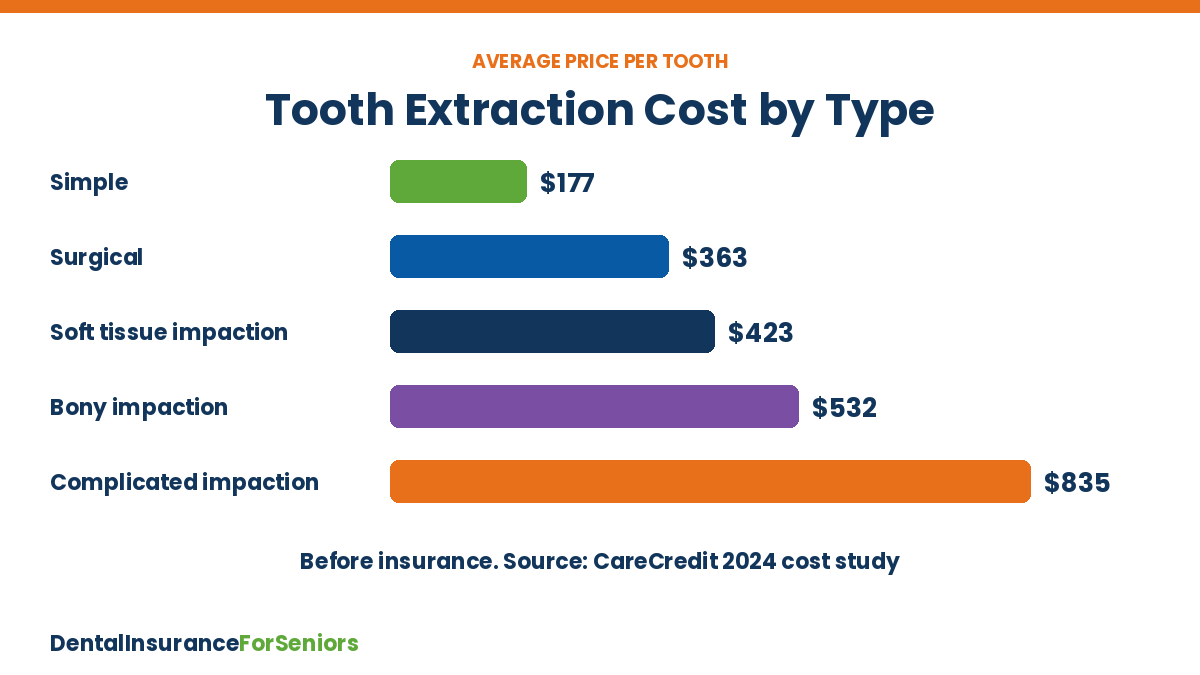
A tooth extraction costs about $177 on average for a simple pull and $363 for a surgical one before insurance, while an impacted tooth averages $423 to $835, according to CareCredit’s 2024 cost study. With a dental plan, a senior often pays roughly $75 to $450 per tooth once the deductible, coverage tier and any waiting period are counted, and sedation can add a few hundred dollars more.

2027 by the Numbers

$177

average simple extraction, before insurance (CareCredit 2024)

$363

average surgical extraction, before insurance (CareCredit 2024)

$151-$294

state range for a simple extraction, Iowa to Hawaii (CareCredit 2024)

Pulling a tooth is one of the cheaper things a dentist does, yet the final bill often surprises people. The base fee depends on whether the tooth needs surgery, and the exam, X-ray and sedation are often billed on top. Older teeth with past root canals, large fillings or brittle roots more often need the surgical approach.

This page is about the price. Whether Medicare will step in is covered in detail on does Medicare pay for dental extractions; here you will find what one pulled tooth tends to cost a retiree, with and without coverage.
Compare Senior Dental Plans That Cover Extractions

What One Pulled Tooth Costs: Three Price Sources Compared

Tooth extraction cost by type before insurance: simple, surgical, soft tissue impaction, bony impaction and complicated impaction averages

No single fee guide tells the whole story, so we lined up three published sources side by side. All prices are per tooth, before insurance, and they do not include the exam or X-ray.

Type of extraction (code)CareCredit 2024 averageReal Dental Costs 2026Forbes Advisor range
Simple: tooth is above the gum and lifts out (D7140)$177$75 to $400; about $200 typical$75 to $250
Surgical: broken tooth or roots that need cutting (D7210)$363$180 to $650; about $400 typical$180 to $550
Impacted, soft tissue covering (D7220)$423Not listed separatelyNot listed separately
Impacted, fully in bone (D7240)$532Not listed separatelyNot listed separately
Complicated impaction, often a wisdom tooth$835Not listed separatelyNot listed separately

Compiled by us from CareCredit’s 2024 ASQ360 cost study, Real Dental Costs (reviewed September 2026) and Forbes Advisor. Fees vary by provider and area; an oral surgeon often charges more than a general dentist.

Where you live matters too. CareCredit’s state data puts an average simple extraction at $151 in Iowa and $294 in Hawaii, so the same tooth can cost nearly twice as much depending on the ZIP code.

Senior Dental Insurance Quotes

Call a Licensed Agent Now

Compare dental plans for seniors and people on Medicare from several insurance companies in one call.

☎ 1-855-425-2095

TTY users 711  |  Mon–Fri: 8am–9pm ET

No obligation to enroll

The Extra Line Items on an Extraction Bill

The extraction fee covers removing the tooth with local numbing. Everything else is its own charge.

Add-onTypical priceSource
Consultation or examAbout $114 on averageForbes Advisor
Panoramic X-rayAbout $125 on averageForbes Advisor
Nitrous oxide (laughing gas)About $76 on averageForbes Advisor
IV or oral sedationAbout $349 on averageCareCredit 2024
General anesthesiaAbout $639 on averageCareCredit 2024

Local anesthetic is usually included in the extraction fee.

Watch the add-ons: Many dental plans pay toward X-rays as preventive or diagnostic care, but sedation is often covered only for surgical or impacted extractions, or not at all. Ask for each line to be listed with its code before the visit.

Tooth Extraction Cost With Insurance: Basic or Major Tier

Senior dental plans usually put a simple extraction in the basic tier, often paid at 70% to 80%. Surgical and impacted extractions may be basic on one plan and major on another, and major work is often paid at 50%. Here is what that means at CareCredit’s average prices with a $50 deductible.

Extraction (average price)You pay at 80%You pay at 50%
Simple ($177)About $75About $114
Surgical ($363)About $113About $207
Bony impaction ($532)About $146About $291
Complicated impaction ($835)About $207About $443

Our math: the deductible is paid first, then your coinsurance on the rest. Example: $363 minus $50 leaves $313; at 80% the plan pays $250.40 and you pay $112.60. Assumes the waiting period is met and the annual maximum is not used up.

The waiting period. Basic and major services often have a wait on a new individual plan, sometimes up to 12 months for surgical work. A tooth that hurts now may not be covered yet; see dental plan waiting periods.

The annual maximum. One extraction rarely reaches a $1,000 to $2,000 yearly cap, but an extraction plus a bridge or implant in the same year can.

Tooth Extraction Cost Without Insurance: Ways to Pay Less

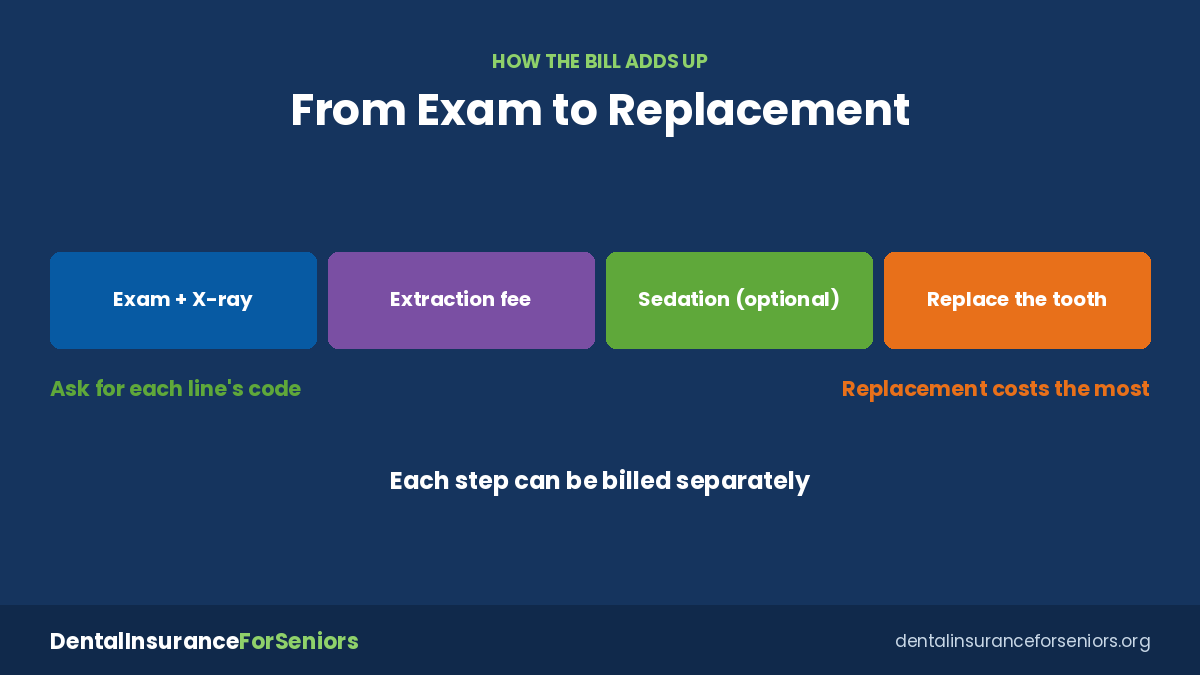
Tooth extraction cost from start to finish: exam and X-ray, the extraction, optional sedation, then replacing the tooth

Without coverage you pay the office’s full fee, anywhere from under $100 to over $800 for one tooth. These moves can lower it.

1

Ask whether the tooth can come out simply. If the tooth is intact and above the gum, a general dentist may do a simple extraction instead of referring you to a surgeon.

2

Price a dental school. CareCredit notes dental schools may charge about 60% to 70% less than private offices, though visits take longer.

3

Use a discount plan. A dental discount plan is not insurance, but member dentists take reduced fees, usually with no waiting period. Compare discount dental plans for seniors.

4

Spend HSA money you already saved. You cannot add to an HSA once you are on Medicare, but an existing balance can pay for an extraction tax free.

Find & Compare Plans Online

Speak with a licensed insurance agent

1-855-425-2095TTY 711

Mon-Fri: 8am-9pm ET

What Medicare Covers, and What You Would Still Owe

Original Medicare does not pay for routine extractions, such as pulling a decayed or cracked tooth. CMS rules, expanded each year since 2023, let Part B pay for dental care tied to certain covered medical treatment, and Medicare.gov’s own example is removing a tooth to treat a mouth infection before chemotherapy.

Before radiation. Pulling teeth to prepare the jaw for radiation treatment of cancer is on CMS’s list of covered dental services.

Before transplant or heart valve surgery. Clearing a mouth infection before an organ transplant, heart valve replacement or valvuloplasty can qualify, and that can include an extraction.

Cancer and dialysis care. Since 2024 the list includes clearing infection before chemotherapy, CAR-T therapy or head and neck cancer treatment, and since 2025 before or during dialysis for kidney failure.

Medicare billing rule: Even when an extraction qualifies, Part B pays 80% of the Medicare-approved amount after the Part B deductible ($283 in 2026), so you still owe 20%, plus a facility copay in a hospital outpatient setting. The dentist must bill Medicare, document coordination with your medical team and, for claims since July 1, 2025, add the KX modifier to each dental line.

Many Medicare Advantage plans include dental benefits that may cover extractions, but copays, yearly dental limits and network rules vary by plan and area. Check the plan’s Evidence of Coverage for oral surgery before you book.

After the Pull: Budgeting for the Gap

Replacing a pulled tooth usually costs far more than the extraction did, so it helps to know the options before the visit.

Leave the space. No added cost today, but nearby teeth can drift and the jawbone in that spot shrinks over time.

A partial denture. Usually the lower-cost way to fill one or more gaps. See partial dentures cost.

An implant or bridge. These last longer but cost much more, and an implant may need a bone graft first. See how much dental implants cost.

If every remaining tooth needs to come out for a full denture, the per-tooth math above no longer fits. That case is priced on the cost of full dentures with extractions.

Bottom Line

One pulled tooth usually costs a senior under $200 for a simple extraction and a few hundred dollars for a surgical or impacted one, before sedation and X-rays. A plan that pays extractions as basic care cuts that to about $75 to $210, and Medicare helps only in the narrow cases tied to cancer, transplant, heart valve or dialysis care.

Related: sedation dentistry cost Nitrous, oral, IV and general anesthesia prices for seniors, with 15-minute billing math and Medicare rules.

Related: emergency dentist cost What an urgent visit for tooth pain costs a senior, how plans classify emergency codes, and what Medicare pays at the ER.

See extraction coverage and plan prices in your ZIP code

Tooth Extraction Cost — Frequently Asked Questions

➤ How much does it cost to have one tooth pulled at the dentist?

A simple extraction averages about $177 before insurance in CareCredit’s 2024 study. An exam and X-ray are often billed separately, which can add $100 to $250.

➤ Why is a surgical extraction more expensive than a simple one?

The dentist has to cut the gum, remove some bone or split the tooth to get it out. That takes more time and skill, so CareCredit’s average is $363 instead of $177.

➤ Is a tooth extraction basic or major dental care?

A simple extraction is usually basic care, often paid at 70% to 80%. Surgical and impacted extractions may be basic or major depending on the plan, so check the plan’s list of services.

➤ Does my dental plan pay for sedation during an extraction?

Sometimes. Many plans pay for sedation only with surgical or impacted extractions, and some do not cover it at all. Ask the office for a pre-treatment estimate.

➤ Will Medicare pay to pull a tooth before my cancer treatment?

It may. Part B can cover extractions needed before radiation to the jaw or to clear infection before chemotherapy, with your 20% share after the deductible.

➤ Can I get a tooth pulled right after buying a new dental plan?

Preventive care often starts right away, but extractions may have a waiting period on a new individual plan. A discount plan usually has no wait and can lower the fee now.

➤ Is it cheaper to pull a tooth than to save it with a root canal?

The extraction is cheaper on the day, but replacing the tooth later with a partial denture, bridge or implant can cost much more than the root canal would have.

➤ Do I need an oral surgeon, or can my dentist pull the tooth?

Most general dentists handle simple extractions. Deeply impacted teeth or complicated roots are often referred to an oral surgeon, whose fees tend to be higher.

Senior Dental Insurance Quotes

Call a Licensed Agent Now

Compare dental plans for seniors and people on Medicare from several insurance companies in one call.

☎ 1-855-425-2095

TTY users 711  |  Mon–Fri: 8am–9pm ET

No obligation to enroll

Find & Compare Plans Online

Speak with a licensed insurance agent

1-855-425-2095TTY 711

Mon-Fri: 8am-9pm ET

ZRN Health & Financial Services, LLC, a Texas limited liability company