



Cost of Full Dentures With Extractions: A Guide for Seniors

Reviewed by Russell Noga, Licensed Insurance Broker — Last updated October 28, 2026

The cost of full dentures with extractions often runs from a few thousand dollars to well over $10,000, depending on how many teeth come out and the denture quality you choose. Extractions often cost about $75 to $650 per tooth, and a mid-range full denture often costs about $1,000 to $3,000 per arch. Dental insurance may help, but the annual maximum usually caps what it pays.

Many seniors reach a point where the remaining teeth are too weak, loose or decayed to save. The usual answer is to remove them and replace them with full (complete) dentures. It can restore your smile and your ability to chew, but the bill comes in two parts, and the total surprises many families.

This guide breaks down what extractions and full dentures cost, what a dental plan may pay, what Medicare and Medicaid do and do not cover, and practical ways to lower your share. To compare coverage options first, see our guide to dental plans covering dentures for seniors.
Compare Dental Plans That Cover Dentures

What Goes Into the Total Bill

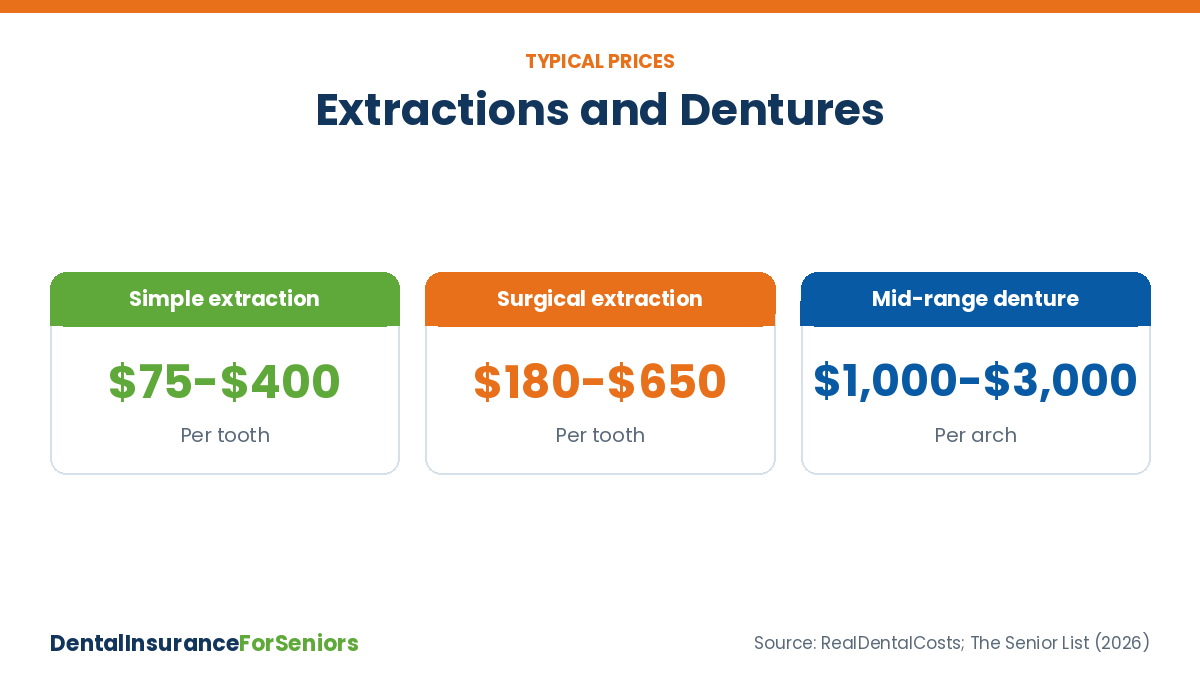
Cost of full dentures with extractions: typical prices for simple and surgical extractions and full dentures per arch

When a dentist quotes full dentures with extractions, the price is really several services added together. Knowing the pieces helps you read a treatment plan and spot where you can save.

Exam and X-rays. The dentist checks your mouth and jaw before planning treatment. This is usually billed on its own.

Extractions. Each tooth is usually priced separately. A simple extraction removes a visible tooth; a surgical extraction is for broken, rooted or impacted teeth and costs more.

Sedation or anesthesia. Local numbing is often included, but IV sedation or general anesthesia for removing many teeth at once can add a separate fee.

The dentures and follow-up. Dentures are priced per arch. Adjustments, relines and any temporary denture can add to the total.

Senior Dental Insurance Quotes

Call a Licensed Agent Now

Compare dental plans for seniors and people on Medicare from several insurance companies in one call.

☎ 1-855-425-2095

TTY users 711  |  Mon–Fri: 8am–9pm ET

No obligation to enroll

Typical Prices for Extractions and Full Dentures

Prices vary by city, dentist and lab. These national ranges are a starting point, not a quote. Denture prices are per arch, so a full set is roughly double.

ServiceTypical cost before insuranceNotes
Simple extractionAbout $75 to $400 per toothVisible, erupted tooth
Surgical extractionAbout $180 to $650 per toothBroken or rooted tooth
Economy full dentureAbout $348 to $883 per archBasic materials, fewer fittings
Mid-range full dentureAbout $1,000 to $3,000 per archCommon choice for daily wear
Premium full dentureAbout $5,000 to $12,438 per archCustom fit and look
Immediate dentureAbout $1,700 to $3,500+ per archPlaced the day teeth are removed

Extraction ranges: RealDentalCosts national fee data (2026). Denture ranges: The Senior List (2026). Your dentist’s fees may be higher or lower.

An immediate denture lets you leave the office with teeth, but it usually needs relines as your gums heal. Some people later get a conventional denture for a better long-term fit, which can mean paying for two.

How Dental Insurance Pays for Extractions and Dentures

Stand-alone senior dental plans usually treat the two parts of this work differently.

Extractions are often basic care. Many plans group simple extractions with basic services, often paid at about 70% to 80% after the deductible. Some plans list surgical extractions as oral surgery or major care, which may pay less.

Dentures are usually major care. Many plans pay about 50% for full dentures after the deductible, and some pay less in the first year or two.

Waiting periods are common. Many plans make you wait, often 6 to 12 months, before basic or major care is covered. Learn more about dental plan waiting periods.

The annual maximum caps the payout. Many senior plans pay only about $1,000 to $2,000 per year in total. Once that is used, you pay the rest.

Broker tip: Check for a missing tooth clause and a replacement limit. Some plans will not pay to replace teeth lost before coverage began, and many cover a new denture only once every five years or so.

Cost of Full Dentures With Extractions: An Insurance Example

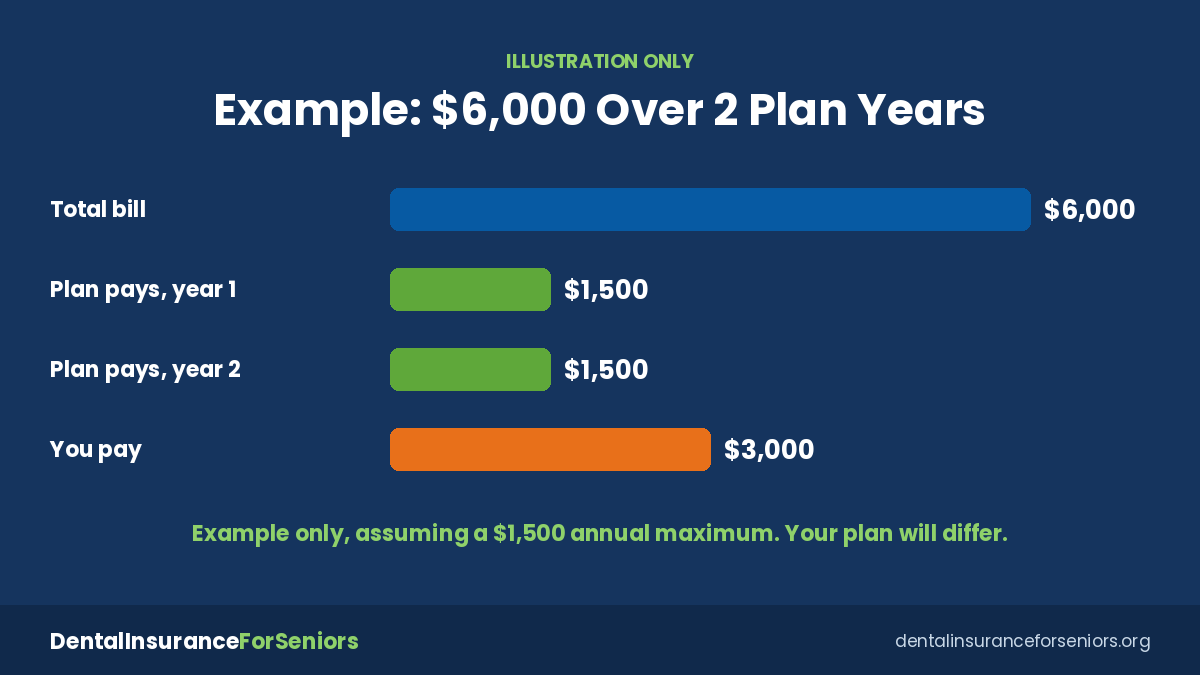
Cost of full dentures with extractions insurance example split across two plan years

Here is how the math can work for a senior with ten remaining teeth. This is an illustration only, not a quote. Real fees, coverage levels and maximums differ by plan and dentist.

1

Add up the bill. Eight simple extractions at $200 ($1,600), two surgical extractions at $400 ($800), and upper and lower mid-range dentures at $1,800 each ($3,600). Total: $6,000.

2

Apply coverage to the extractions. At 80% after a $50 deductible, the plan’s share would be $1,880. But with a $1,500 annual maximum, the plan pays only $1,500 this year.

3

Apply coverage to the dentures. At 50%, the plan’s share would be $1,800. If the maximum is already used up, it pays nothing more this year.

4

Split across plan years. If the dentures are made in a new benefit year, a fresh $1,500 maximum applies. The plan pays about $3,000 in total, and you pay about $3,000 instead of $4,500.

The annual maximum often matters more than the coverage percentage on a big job like this. See how annual maximums in dental insurance work before you schedule.

Find & Compare Plans Online

Speak with a licensed insurance agent

1-855-425-2095TTY 711

Mon-Fri: 8am-9pm ET

What Medicare, Medicare Advantage and Medicaid Cover

Original Medicare (Parts A and B) does not cover dentures and does not cover most routine extractions. It may pay for an extraction only in narrow cases tied to covered medical care, such as preparing the jaw for radiation treatment of head and neck cancer, or certain dental work needed before an organ transplant or heart valve surgery. Read more in does Medicare pay for dental extractions.

Medicare Advantage. Many Medicare Advantage plans include some dental benefits, and some help with extractions and dentures. Coverage, yearly dollar limits and networks vary by plan and area. See does Medicare Advantage cover dentures.

Medicare Supplement. Medigap plans do not add dental coverage, because they only help with costs Original Medicare approves.

Medicaid. Adult dental coverage is optional for states, so it varies widely. Some states cover extractions and dentures, while others cover only emergency care. Check with your state Medicaid office.

Ways to Lower the Cost of Full Dentures With Extractions

1

Get coverage before treatment. Because of waiting periods, buying a plan after you learn you need dentures may mean paying full price for months.

2

Split treatment across plan years. Doing extractions late in one benefit year and the final dentures early in the next can let you use two annual maximums. Your gums often need weeks to months to heal anyway. Ask your dentist if this timing is safe for you.

3

Try a dental school. Many dental schools offer care at lower prices, supervised by licensed dentists. Visits can take longer.

4

Look at a dental discount plan. Discount plans are not insurance, but they offer reduced fees at member dentists and usually have no waiting period or annual maximum.

5

Compare quotes and ask about payment plans. Fees for the same work can differ a lot between offices, and many offer monthly payments. Read any interest terms carefully.

Good to know: Never delay removing an infected or painful tooth just to save money. Ask your dentist which steps can wait.

Bottom Line

The cost of full dentures with extractions depends mostly on how many teeth come out, whether they need surgical removal, and the denture quality you pick. Dental insurance often pays a share of both parts, but waiting periods and the annual maximum limit the payout. Getting coverage early and spreading treatment across plan years can lower what you pay.

See senior dental plans & rates in your ZIP code

Cost of Full Dentures With Extractions — Frequently Asked Questions

➤ How much do full dentures with extractions cost?

It varies widely. Extractions often run about $75 to $650 per tooth, and mid-range full dentures about $1,000 to $3,000 per arch, so many people face several thousand dollars or more before insurance.

➤ How much does it cost to pull a tooth?

A simple extraction often costs about $75 to $400 per tooth, and a surgical extraction about $180 to $650. Sedation, the exam and X-rays are usually extra.

➤ Does dental insurance cover extractions and dentures?

Many plans do. Extractions are often covered as basic care at about 70% to 80%, and dentures as major care at about 50%, after the deductible and any waiting period, up to the annual maximum.

➤ Does Medicare pay for extractions and dentures?

Original Medicare does not cover dentures and covers extractions only in narrow cases tied to covered medical treatment. Some Medicare Advantage plans include dental benefits that may help, but coverage varies by plan and area.

➤ Are immediate dentures more expensive?

Often, yes. They commonly cost about $1,700 to $3,500 or more per arch and usually need relines as the gums heal.

➤ Will Medicaid pay for dentures for seniors?

It depends on your state. Adult dental coverage under Medicaid is optional, so some states cover extractions and dentures and others offer limited or emergency-only care.

➤ Can I use two years of dental benefits for dentures?

Often you can. Having extractions in one benefit year and the final dentures in the next may let you use two annual maximums, as long as the timing is safe for your health and your plan’s rules allow it.

➤ What is the cheapest way to get full dentures?

Economy dentures, dental schools and dental discount plans are common lower-cost routes. Cheaper dentures may fit less well or wear out sooner.

Senior Dental Insurance Quotes

Call a Licensed Agent Now

Compare dental plans for seniors and people on Medicare from several insurance companies in one call.

☎ 1-855-425-2095

TTY users 711  |  Mon–Fri: 8am–9pm ET

No obligation to enroll

Find & Compare Plans Online

Speak with a licensed insurance agent

1-855-425-2095TTY 711

Mon-Fri: 8am-9pm ET

ZRN Health & Financial Services, LLC, a Texas limited liability company