

Sedation Dentistry Cost for Seniors: Laughing Gas to General Anesthesia

Reviewed by Russell Noga, Licensed Insurance Broker — Last updated November 19, 2026

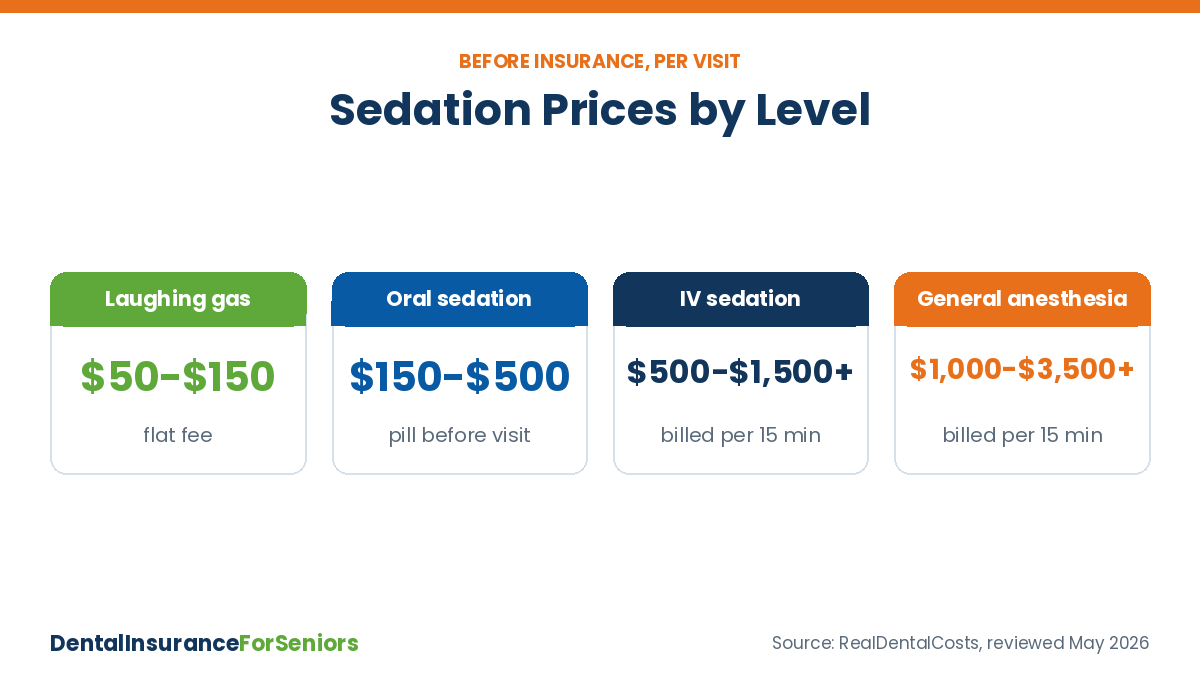
Sedation dentistry costs about $50 to $150 for nitrous oxide, $150 to $500 for oral conscious sedation, $500 to $1,500 or more for IV sedation and $1,000 to $3,500 or more for general anesthesia, before insurance, according to RealDentalCosts’ 2026 price guide. IV sedation and general anesthesia are billed in 15-minute blocks, so a long implant or full-mouth extraction visit costs more, and most dental plans pay only when the sedation goes with covered oral surgery.

2027 by the Numbers

$349

average sedation fee, before insurance (Synchrony 2024 cost study, via CareCredit)

$639

average anesthesia fee, before insurance (same study)

$91

median insurer-negotiated rate for each added 15 minutes of IV sedation, code D9243 (CMS price-transparency files, via PayorMap)

8

time codes on the claim for two hours of IV moderate sedation (our count under CDT rules)

For many older adults, the hard part of a big dental job is getting through a long appointment with a strong gag reflex, a stiff jaw or years of dental fear. Sedation helps, but it is its own line on the bill, priced by type and, for the deeper levels, by the minute.

Below, each level is priced, the time codes are added up for a long surgical visit, and the rules for dental plans and Medicare are laid out. For a single pulled tooth, see tooth extraction cost.
Compare Senior Dental Plans That Pay Toward Sedation

Price by Sedation Level, From Two National Fee Guides

Sedation dentistry cost by level before insurance: nitrous oxide, oral sedation, IV sedation and general anesthesia price ranges

Sedation runs from mild relaxation, where you stay awake, to general anesthesia, where you are fully asleep. Deeper levels take more training and monitoring, so they cost more.

Sedation level (2026 CDT code)RealDentalCosts range (May 2026)Pearl range (ADA fee survey data, May 2026)How it is usually billed
Nitrous oxide, or laughing gas (D9230)$50 to $150; about $90 typical$50 to $150 per visitOne flat fee per visit
Oral conscious sedation, a pill taken before the visit (D9244 or D9245)$150 to $500; about $300 typical$200 to $400Usually a flat fee per visit
IV moderate sedation (D9239, then D9243)$500 to $1,500+; about $900 typical$400 to $1,000+By the 15 minutes
Deep sedation or general anesthesia (D9222, then D9223)$1,000 to $3,500+; about $2,000 typical$700 to $2,000+By the 15 minutes, often with an anesthesia provider

Compiled by us from RealDentalCosts (reviewed May 2026) and Pearl’s dental cost tool (updated May 2026). Prices are before insurance and do not include the dental work itself or any hospital or surgery center fee.

A third source lands in the same zone. The 2024 Synchrony procedure cost study that CareCredit publishes puts the average sedation fee at $349 and the average anesthesia fee at $639. Those are single-visit averages, so a long surgical appointment can run well past them.

Senior Dental Insurance Quotes

Call a Licensed Agent Now

Compare dental plans for seniors and people on Medicare from several insurance companies in one call.

☎ 1-855-425-2095

TTY users 711  |  Mon–Fri: 8am–9pm ET

No obligation to enroll

How the 15-Minute Clock Turns Into a Bill

Under the ADA’s CDT coding rules, IV sedation and general anesthesia are billed in 15-minute increments, “or any portion thereof,” so 16 minutes counts as two increments. The clock starts when the dentist or anesthesia provider begins the drugs and monitoring and stays with you, and it stops when you can safely be left with trained staff. That is not the same as the time you spend in the chair.

Sedation timeCodes on the claim (IV moderate sedation)Added 15-minute blocksAdded blocks at the $91 median negotiated rate
30 minutesD9239 once + D9243 once1About $91
1 hourD9239 once + D9243 three times3About $273
1.5 hoursD9239 once + D9243 five times5About $455
2 hoursD9239 once + D9243 seven times7About $637
2 hours, 10 minutesD9239 once + D9243 eight times8About $728

Our math, using PayorMap’s national median of $91 for D9243 from CMS Transparency in Coverage files (758 rate records, 41 states, March 2026). Negotiated rates are what in-network offices accept from insurers; cash prices are often higher. The fee for the first 15 minutes (D9239) is extra. General anesthesia follows the same pattern with D9222 and D9223, usually at higher rates.

Billing code change: CDT 2026 retired D9248, the old catch-all code for non-IV sedation, at the end of 2025, according to UnitedHealthcare Dental’s provider notice. Pill sedation is now D9244 or D9245, and injected or nasal moderate sedation D9246 and D9247. Older estimates and plan booklets may still show D9248.

What Senior Dental Plans Say About Sedation, in Their Own Words

Plan booklets tend to treat sedation as a helper to surgery, not as a benefit in its own right. Two real plan documents show the pattern.

Plan documentNitrous oxideIV sedation or general anesthesiaKey limit
Delta Dental of South Dakota individual and family plan exclusionsNot covered when billed separatelyNot excluded when given with covered oral surgerySedation follows the surgery code
Humana 2026 Medicare Advantage dental benefit (form DEN356)D9230 listed at 100% with covered codes, subject to clinical reviewD9222/D9223 and D9239/D9243 listed at 100% with covered codesExcludes sedation for anxiety, fear of pain or pain management, and fees of a separate anesthesiologist or facility

From each carrier’s published plan documents. Other plans, states and years differ; read your own plan’s exclusions list.

Fear alone often does not qualify. Plans that pay usually want sedation tied to surgery, such as a bony impaction, or to a documented condition.

It counts against your yearly cap. Sedation comes out of the same annual maximum as the surgery, often $1,000 to $2,000.

Medicare Advantage dental varies. Some plans list sedation codes, others do not. See how Medicare Advantage plans with dental benefits are built before relying on one.

When Original Medicare Pays the Hospital or the Anesthesia

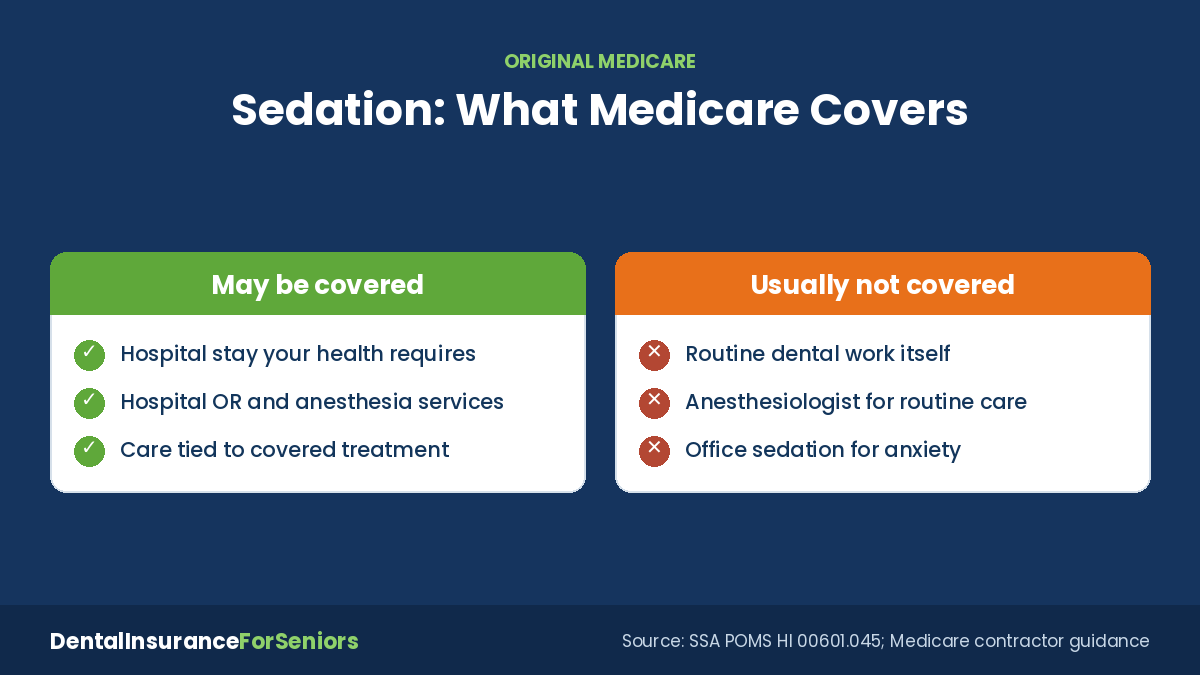
Sedation dentistry cost and Original Medicare: what may be covered versus what usually is not

Original Medicare excludes routine dental work, and that usually reaches the sedation too: Medicare contractors say anesthesia is covered only if the main procedure is, and anesthesia alone does not justify payment. Two narrow exceptions matter.

A hospital stay your health requires. Social Security’s Medicare rules let Part A cover an inpatient stay when your underlying medical condition, or the severity of the procedure, makes hospital care necessary. The hospital’s operating room and anesthesia services can then be covered even though the dental work is not.

The doctors are a different matter. The same rules exclude physician services linked to non-covered dental care, including an anesthesiologist’s fee. Part A could pay the hospital while you still owe the anesthesiologist and dentist.

Dental care tied to covered treatment. Since 2023, Part B can pay for dental care linked to certain medical treatment, such as clearing infection before a heart valve replacement or transplant. Anesthesia can then be paid along with it.

These rules are applied case by case, and the usual deductibles and coinsurance apply. The fuller picture is on Medicare coverage for oral surgery and does Medicare Part B cover dental.

Find & Compare Plans Online

Speak with a licensed insurance agent

1-855-425-2095TTY 711

Mon-Fri: 8am-9pm ET

Safety Questions Before an Older Adult Is Sedated

Older patients are sedated safely every day, but age brings more medicines and more health conditions to check. The ADA’s sedation guidelines, updated in April 2026, require a review of medical history and medications before moderate or deeper sedation, and say patients with more serious health conditions may need a consult with their physician first.

1

Bring a complete medicine list. Include prescriptions, over-the-counter drugs and supplements; some change how sedatives work.

2

Ask whether your doctor should weigh in. Heart or lung disease, a past stroke or sleep apnea can change which level is safest and where it should happen.

3

Get the fasting rules in writing. The 2026 guidelines follow the ASA fasting schedule, with changes for medicines that slow stomach emptying.

4

Plan the ride home. The guidelines call for written instructions for the patient and the escort or caregiver.

5

For a parent with dementia, ask about experience. Ask how often the office sedates patients with memory loss, and whether a hospital setting would be better.

Plain fact: Which sedation is right, and whether it is safe for a given person, is a decision for the dentist or oral surgeon together with the patient’s own doctor.

Before a Long Implant or Full-Mouth Visit: A Coverage Checklist

Sedation is most often used for the biggest jobs, such as several implants at once or removing all remaining teeth before dentures, and those visits can last hours. See full mouth dental implants cost and the cost of full dentures with extractions for the rest of the bill.

Question to askWhy it changes the price
Which sedation code, and how many minutes?Lets you check the quote against the time table above
Surgeon or separate anesthesia provider?A separate provider bills on their own; some plans exclude that fee
Is it tied to a covered surgery code?Many plans pay sedation only alongside covered oral surgery
Was a pre-treatment estimate filed?Clinical review is common for sedation codes
How much annual maximum is left?Surgery plus sedation can use a yearly cap in one visit
Does a medical condition call for a hospital?That is where Medicare Part A may cover the facility side

Bottom Line

Expect roughly $50 to $150 for laughing gas, a few hundred dollars for a sedation pill, and several hundred to a few thousand dollars for IV sedation or general anesthesia, with long visits costing most because of 15-minute billing. Dental plans usually pay only alongside covered surgery, and Original Medicare helps only in narrow hospital and medically linked cases.

See oral surgery and sedation coverage in your ZIP code

Sedation Dentistry Cost — Frequently Asked Questions

➤ Is laughing gas much cheaper than being put to sleep?

Yes. Nitrous oxide usually costs about $50 to $150 per visit, while general anesthesia often starts around $700 to $1,000 and can pass $3,000 for a long case.

➤ Why does IV sedation cost more the longer my appointment runs?

Both are billed in 15-minute blocks, and any part of a block counts as a full one. A two-hour case means one first-block code plus seven add-on codes.

➤ Will my dental insurance pay for sedation if I am just nervous?

Often not. Many plans pay for sedation only with covered oral surgery, and a 2026 Humana Medicare Advantage dental benefit lists anxiety and fear of pain as excluded reasons.

➤ Does Original Medicare pay for anesthesia during dental implant surgery?

Usually not. Implants are routine dental work, and anesthesia follows the main procedure. Part A may cover a hospital stay your medical condition requires, but not the dentist or anesthesiologist.

➤ Does a Medicare Advantage plan cover sedation dentistry?

Some do, often only with covered surgery and after clinical review. Look in the plan’s dental booklet for codes D9222, D9230 and D9239.

➤ Can a parent with dementia be sedated for dental work?

Often, sometimes in a hospital or surgery center. The dental team and the parent’s doctor decide after reviewing medicines and health history.

➤ Will I need someone to take me home after sedation?

For oral, IV or deeper sedation, expect the office to ask for a responsible adult, who will get written aftercare instructions.

➤ What happened to code D9248 on my dental estimate?

It was retired at the end of 2025. Pill sedation is now coded D9244 or D9245, and non-IV injected or nasal sedation D9246 and D9247.

Senior Dental Insurance Quotes

Call a Licensed Agent Now

Compare dental plans for seniors and people on Medicare from several insurance companies in one call.

☎ 1-855-425-2095

TTY users 711  |  Mon–Fri: 8am–9pm ET

No obligation to enroll

Find & Compare Plans Online

Speak with a licensed insurance agent

1-855-425-2095TTY 711

Mon-Fri: 8am-9pm ET

ZRN Health & Financial Services, LLC, a Texas limited liability company