


Sinus Lift Cost for Seniors: Crestal vs. Lateral Window, Coverage and Alternatives

Reviewed by Russell Noga, Licensed Insurance Broker — Last updated November 22, 2026

A sinus lift typically costs about $1,500 to $3,500 per side before insurance, with the smaller crestal (osteotome) lift often near $1,000 to $1,800 and the larger lateral window lift near $1,500 to $3,500. Dental plans that pay at all usually treat it as major oral surgery tied to implant coverage, and Original Medicare does not pay for it.

2027 by the Numbers

$2,260

national average sinus lift fee, codes D7951/D7952 (Pearl fee data)

$1,470-$3,860

typical national fee range per sinus lift (Pearl)

4-12 months

common wait from sinus lift to implant placement (Colgate)

A sinus lift adds bone to the floor of the upper jaw, just under the sinus, so an implant has something solid to grip where upper back teeth used to be. It is a common add-on for older adults who lost molars years ago.

This page is only about the sinus lift: the two surgical approaches and their prices, why it shows up so often after 65, what carrier policies actually say, and how long the wait runs. For every other graft type, see dental bone graft cost, and for the implant itself, see how much dental implants cost.
Compare Senior Dental Plans With Oral Surgery Benefits

Crestal or Lateral Window: Two Approaches, Two Price Tags

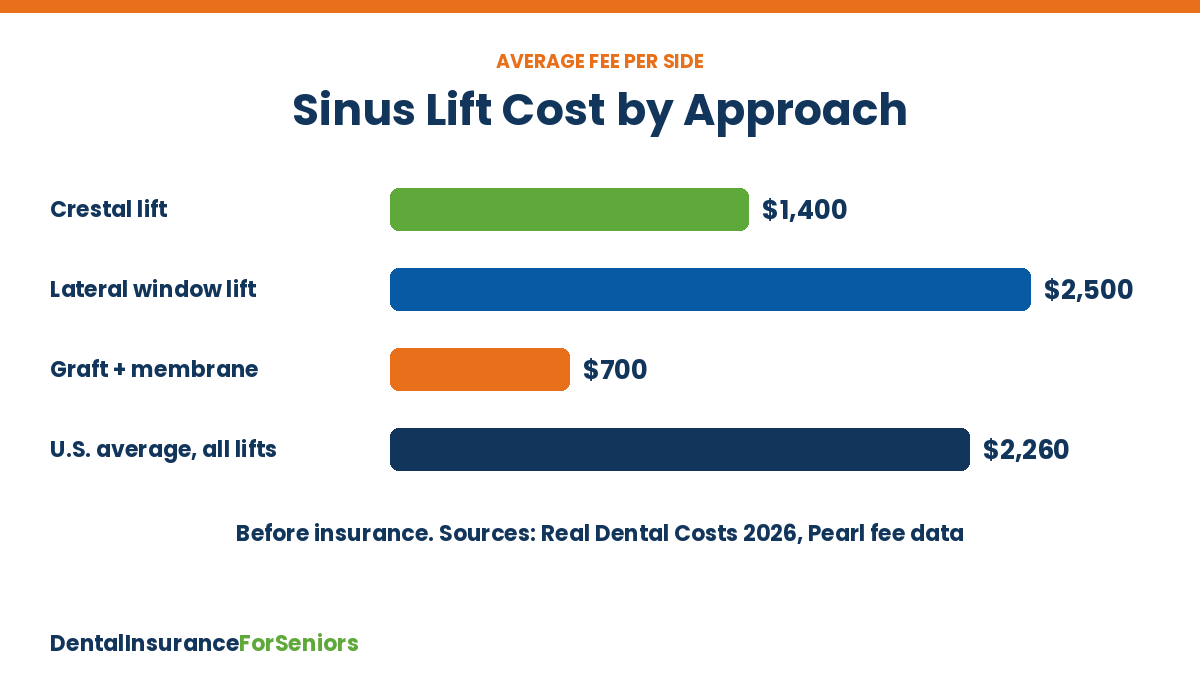
Sinus lift cost by approach: average crestal lift, lateral window lift, graft material and national average fee

Surgeons reach the sinus floor one of two ways. The crestal approach works up through the implant hole and nudges the sinus lining up a few millimeters. The lateral window approach opens a small door in the side of the jaw so more graft can be packed in. The approach drives most of the fee.

ApproachCode on the claimUsually chosen whenTypical fee per sideImplant timing
Crestal (osteotome, internal)D7952, vertical approachA moderate amount of bone remains under the sinusAbout $1,000 to $1,800Often placed the same visit
Lateral window (open)D7951, lateral open approachVery little bone remains, or a bigger lift is neededAbout $1,500 to $3,500Often staged after healing
Graft material and membraneMembrane may be billed on its own lineUsed with either approachAbout $400 to $1,200Same day as the lift

Fees: Real Dental Costs 2026 per-side ranges, before insurance. DentistryIQ notes bone is included in D7951/D7952, while membranes are billed separately. Local fees vary.

Both sides cost roughly double, since each sinus is its own surgery. A 3D (CBCT) scan, sedation, extractions and the implant, abutment and crown are usually priced on separate lines.

Senior Dental Insurance Quotes

Call a Licensed Agent Now

Compare dental plans for seniors and people on Medicare from several insurance companies in one call.

☎ 1-855-425-2095

TTY users 711  |  Mon–Fri: 8am–9pm ET

No obligation to enroll

Why Missing Upper Molars Lead to a Sinus Lift Later in Life

The upper back jaw loses height from two directions after teeth come out: the ridge shrinks from below, and the sinus floor tends to drop into the empty space from above. Someone who lost molars at 50 and is pricing implants at 70 has had decades of both.

Ridge shrinks from below. A 2023 CBCT study of 183 scans in Brazilian Oral Research credited ridge remodeling with about 70% of the height lost at toothless upper back sites.

Sinus expands from above. The same study credited sinus expansion with roughly 30%, about 0.9 mm on average.

Little bone left. About 41% of healed toothless upper back sites had under 5 mm of ridge height, a range where implants commonly need a lift first.

Scan first: Whether a lift is needed, and which kind, is decided from a 3D scan. Asking for the measured bone height in millimeters on the treatment plan makes a second opinion easier to compare.

What Carrier Policies Say About Sinus Augmentation

Dental plans that pay toward a sinus lift usually class it as major or oral surgery, often near 50% after any waiting period, counted against the yearly maximum. Carriers’ clinical policies add conditions that cost guides rarely mention.

Carrier documentWhat it says about D7951/D7952What it means for the patient
Cigna Dental Coverage Determination Guidelines, DPPO (05/2026)Allowable for implant placement only if the plan covers surgical implant placement; must be submitted with documentation of a denial from the medical planFile with medical insurance first, and confirm the dental plan covers implants
UnitedHealthcare dental clinical policy DCP027.15 (effective 08/2026)May be indicated when poor bone quality or quantity would rule out an implant; not indicated when the sinus has blocked drainage or ventilationSinus health and bone measurements matter to the review
Aetna Dental Clinical Policy Bulletin 001Calls these medical-in-nature codes reviewed for medical necessity in their own rightExpect a separate necessity review, not automatic payment

Summarized from each carrier’s publicly posted provider policy. Individual plan contracts, including senior and Medicare Advantage dental plans, govern actual benefits.

A quick example shows why the yearly maximum matters: a $2,500 lateral lift paid at 50% uses $1,250 of a $1,500 maximum, leaving $250 toward the implant that same year. More on how plans handle grafting claims is in insurance coverage for bone grafting procedures.

Claim tip: DentistryIQ notes that x-rays and gum charting alone rarely win approval; a written narrative is expected, and claims are often denied without implant coverage. A pre-treatment estimate shows the answer before surgery.

Recovery and the Wait Before the Implant

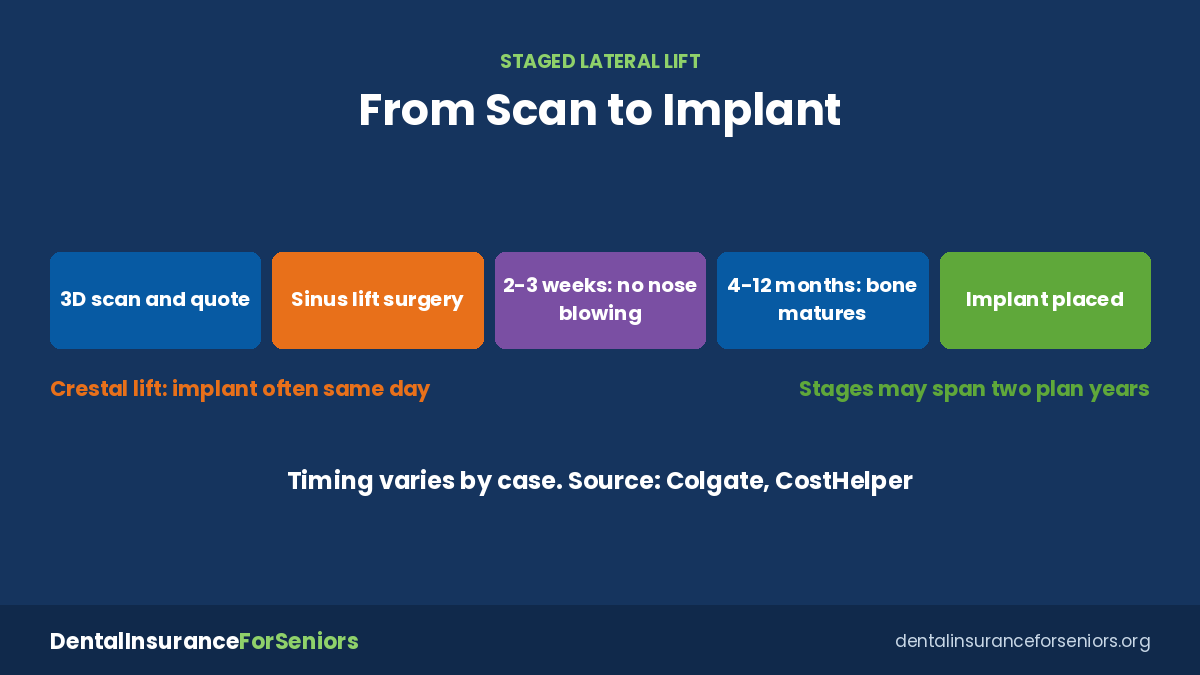
Sinus lift cost and timeline from scan to surgery, healing and implant placement

Most people describe mild soreness, some swelling and possibly a little bleeding from the nose or mouth for the first few days. The first follow-up visit is usually 7 to 10 days after surgery.

1

Protect the graft for 2 to 3 weeks. No nose blowing and no straws, and sneeze with the mouth open. Pressure in the sinus can shift the graft.

2

Plan 2 to 3 days of rest. CostHelper notes most people skip strenuous exercise for about a week.

3

Wait for the bone to mature. Implants are commonly placed about 4 to 12 months after a lift, depending on how much bone was added. A crestal lift done with the implant skips this separate wait.

4

Confirm with a new scan. Many surgeons check the graft on a scan before placing a staged implant.

Find & Compare Plans Online

Speak with a licensed insurance agent

1-855-425-2095TTY 711

Mon-Fri: 8am-9pm ET

Medicare, Medicare Advantage and Medical Insurance

Original Medicare (Parts A and B) does not pay for a sinus lift done to prepare for implants. Its dental exceptions are narrow and tied to covered medical treatment, not routine tooth replacement.

Medicare Advantage dental. Many Medicare Advantage plans include dental, but coverage of oral surgery, grafts or implants varies by plan and area, and yearly dental limits are often low. See whether Medicare Advantage covers dental implants.

Medical plan first. Because Cigna’s dental guidelines ask for a medical plan denial, a retiree or employer medical plan may need to be billed first even when payment is unlikely.

Check every fall. Medicare Advantage dental benefits can change each January, so read the Annual Notice of Change before booking surgery.

Options When a Sinus Lift Is Not the Right Fit

A lift is not the only way to replace upper back teeth. Each option below trades cost, time and surgery differently.

Short implants. Implants about 4 to 6 mm long can sometimes fit the remaining bone. A small study found extra-short upper back implants did about as well as regular ones in the short term.

Zygomatic implants. Long implants anchored in the cheekbone can skip grafting in severe bone loss, but Real Dental Costs puts a full arch at about $30,000 to $50,000.

Bridge or partial denture. No sinus surgery is needed, and plans often cover these at the major-service level. Trade-offs are in dental bridge vs. implant.

Comparing quotes: A fair comparison sets the total for a lift plus implant, abutment and crown against each alternative’s full price and healing time.

Bottom Line

A sinus lift usually runs about $1,500 to $3,500 per side, with crestal lifts at the lower end. Plans that pay often require implant coverage and a necessity review, Original Medicare does not pay, and Medicare Advantage dental varies, so get a scan, a coded quote and a pre-treatment estimate first.

Check senior dental plans and prices for your ZIP code

Sinus Lift Cost — Frequently Asked Questions

➤ Is a crestal sinus lift cheaper than a lateral window lift?

Usually. Cost guides put a crestal lift near $1,000 to $1,800 per side and a lateral window lift near $1,500 to $3,500.

➤ What do D7951 and D7952 mean on my treatment plan?

D7951 is a sinus augmentation through a lateral open approach, and D7952 is one through a vertical (crestal) approach. The code tells the plan which surgery was done.

➤ Does a sinus lift on both sides cost twice as much?

Roughly, yes. Each sinus is treated as its own procedure, so a two-sided job is often about $3,000 to $7,000 before the implants.

➤ Will my dental plan pay for a sinus lift if it does not cover implants?

Often not. Cigna’s policy, for example, allows sinus augmentation for implants only when the plan also covers surgical implant placement.

➤ Why does my plan want a denial from my medical insurance first?

Some carriers treat sinus augmentation as medical in nature. Cigna’s guidelines require proof that the medical plan denied it before the dental plan reviews it.

➤ How long after a sinus lift can I get my implant?

Often 4 to 12 months when the implant is staged. With enough existing bone, a crestal lift can be done in the same visit as the implant.

➤ Can a sinus lift be done at age 75 or 80?

Age alone is not usually the deciding factor. Surgeons weigh bone height, sinus health, smoking and conditions such as diabetes.

➤ Is there a way to get upper implants without a sinus lift?

Sometimes. Short implants may fit the remaining bone, and zygomatic implants anchor in the cheekbone for severe loss, though they cost far more.

Senior Dental Insurance Quotes

Call a Licensed Agent Now

Compare dental plans for seniors and people on Medicare from several insurance companies in one call.

☎ 1-855-425-2095

TTY users 711  |  Mon–Fri: 8am–9pm ET

No obligation to enroll

Find & Compare Plans Online

Speak with a licensed insurance agent

1-855-425-2095TTY 711

Mon-Fri: 8am-9pm ET

ZRN Health & Financial Services, LLC, a Texas limited liability company