



Apicoectomy Cost for Seniors: Code-by-Code Prices and What a Dental Plan Pays

Reviewed by Russell Noga, Licensed Insurance Broker — Last updated November 19, 2026

An apicoectomy costs about $1,119 on average before insurance (CareCredit), with most quotes falling between roughly $900 for a front tooth and $1,900 for a molar. In-network rates are often far lower, and with a senior dental plan your share is commonly a few hundred dollars, depending on whether the plan pays the surgery at a basic or a major level.

2027 by the Numbers

$1,119

national average apicoectomy, before insurance (CareCredit, ASQ360 study)

$1,414

national average apicoectomy (Humana, claims and FAIR Health data, 2026)

$701

average in-network rate for a molar, code D3425 (PayorMap, CMS price files)

An apicoectomy is small surgery on a tooth that already had a root canal. When an old root canal flares up, an endodontist opens the gum, trims off the infected tip of the root and usually seals the end with a tiny filling. Many older adults face it on a tooth that was treated years or even decades ago.

The price surprises people because it is billed in pieces: one code for the first root, another for each extra root, and sometimes a separate seal. This guide breaks the bill down code by code, shows what a typical senior plan would pay, and compares it with redoing the root canal or pulling the tooth. For the first root canal itself, see root canal cost with insurance.
Compare Senior Dental Plans That Cover Endodontic Surgery

How an Apicoectomy Is Billed, Code by Code

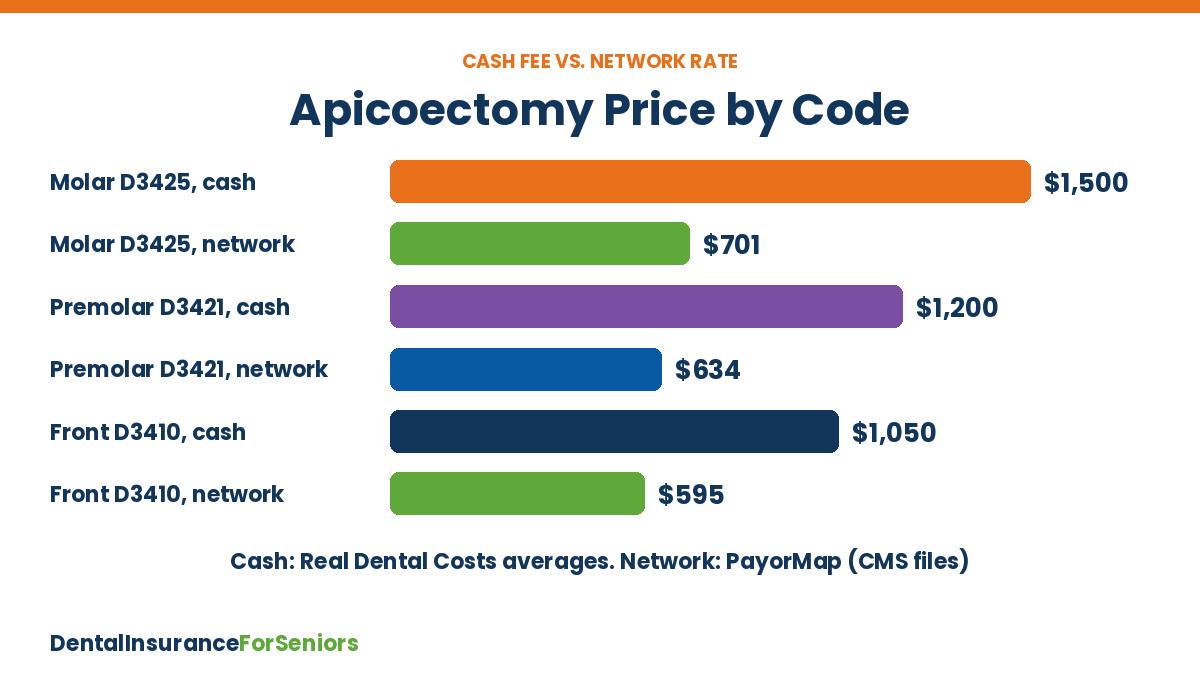
Apicoectomy cost by tooth: average cash fee versus average in-network rate for front tooth, premolar and molar codes

Dentists bill this surgery under CDT codes, and the code depends on which tooth and how many roots get treated. Cash prices below come from Real Dental Costs’ 2026 ranges. The in-network column is the average rate dental insurers have negotiated, as published in federal price-transparency files and compiled by PayorMap.

Code and toothTypical cash priceAvg. in-network rateYou pay at 80%You pay at 50%
D3410: front tooth$900 to $1,300$595About $119About $298
D3421: premolar, first root$1,000 to $1,500$634About $127About $317
D3425: molar, first root$1,300 to $1,900$701About $140About $351
D3426: each added root$350 to $600$238About $48About $119
D3430: root-end filling, per rootOften bundled into the feeVariesAsk the officeAsk the office

Our calculation: in-network average x your coinsurance share, before any deductible. Cash ranges: Real Dental Costs (2026). Network rates: PayorMap, from CMS Transparency in Coverage files, March 2026. The two sources measure different things, so treat them as a range, not a promise.

Molars cost the most. A lower molar often has two roots and an upper molar often has three, so one surgery can carry D3425 plus one or two D3426 lines.

Extra lines add up. Real Dental Costs lists microsurgery with an MTA seal at about $200 to $500, a biopsy at $100 to $350 and a 3D scan at $250 to $500 when billed separately.

Fees differ by state. CareCredit’s study found averages from $949 in Alabama to $1,606 in Hawaii.

Senior Dental Insurance Quotes

Call a Licensed Agent Now

Compare dental plans for seniors and people on Medicare from several insurance companies in one call.

☎ 1-855-425-2095

TTY users 711  |  Mon–Fri: 8am–9pm ET

No obligation to enroll

A Three-Root Molar: The Senior Bill Most Pages Skip

Most price guides quote one number per tooth. An upper molar with three treated roots is billed as D3425 once and D3426 twice. Here is that case at cash prices and at network rates on a plan with a $50 deductible.

How you payBilled amountPlan paysYou pay
No coverage, average cash fees$2,400$0$2,400
Network rate, plan pays 80% after $50$1,177About $902About $275
Network rate, plan pays 50% after $50$1,177About $564About $614
Out of network, cash fees, 50% after $50$2,400About $1,175 if the plan pays on that feeAbout $1,225 or more

Our math: $1,500 + 2 x $450 (Real Dental Costs averages) = $2,400; $701 + 2 x $238 (PayorMap network averages) = $1,177. Out-of-network plans often pay on a lower allowed amount, which raises your share. Waiting periods met, no other claims that year.

Network price gap: The same surgery can be billed at roughly half the cash fee when the endodontist is in the plan’s network. Asking whether the specialist participates can matter more than the coinsurance percentage.

Basic or Major? How Senior Dental Plans Treat Root-End Surgery

There is no single rule. Many plans file apicoectomy with endodontics or oral surgery, which may sit in the basic tier (often 70% to 80%) or the major tier (often 50%). Some list-based plans pay only for procedures printed on their schedule. Physicians Mutual, for example, states that no benefits are payable for a procedure that is not listed.

1

Find the code in the plan papers. Search the schedule or summary for D3410 through D3426. If the word apicoectomy never appears, ask the carrier in writing.

2

Check the tier and the wait. Endodontic work commonly carries a waiting period of 6 to 12 months on individual plans. Physicians Mutual lists 12 months for root canals.

3

Look for lifetime limits. One 2026 Humana dental schedule limits each first-root apicoectomy code to one per tooth per lifetime and the added-root code to two per tooth.

4

Ask for a pre-treatment estimate. Send the codes and fees to the plan before surgery so you know its share and how much of your annual maximum remains.

Claim narrative note: Plans often want proof the tooth can be saved. Delta Dental of Michigan’s criteria ask for imaging of the root tip and a patient-specific reason, and UnitedHealthcare’s policy says the surgery is not indicated for a tooth with a hopeless prognosis.

Save the Tooth or Replace It: The Price Side by Side

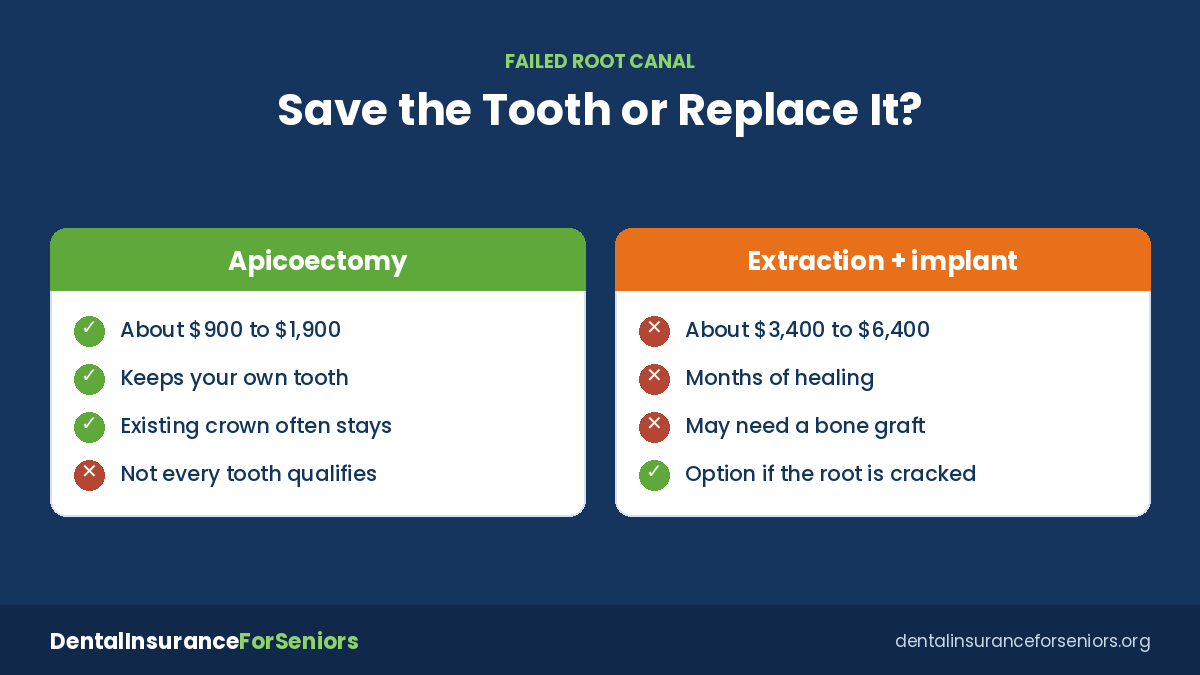
Apicoectomy cost compared with extraction plus implant for a senior deciding whether to save a tooth

When an old root canal fails, there are usually three paths: redo the root canal, do an apicoectomy, or pull the tooth and replace it. Delta Dental of Michigan’s criteria say retreatment should be considered first when the original root canal has fixable flaws. Here are cash prices for a back tooth, before insurance.

OptionTypical cash costKeeps your toothOther costs to expect
Root canal retreatment$900 to $1,500 (Real Dental Costs)YesCrown may be removed and redone; porcelain-and-metal averages $1,114 (CareCredit)
Apicoectomy, molar first root$1,300 to $1,900 (Real Dental Costs)YesAdded roots about $350 to $600 each; existing crown often stays
Surgical extraction onlyAbout $363 (CareCredit)NoA gap that can let nearby teeth shift
Extraction plus single implantAbout $3,363 to $6,363NoBone graft about $300 to $800 if needed; months of healing

Implant range: $363 extraction + $3,000 to $6,000 implant with crown (MetLife cost guide). Prices before insurance; your dentist’s fees and your mouth decide the real numbers.

Plans with a $1,000 to $1,500 yearly cap barely dent an implant, so the savings from keeping a tooth are often largest on a modest plan. Read our guide to how much dental implants cost and tooth extraction cost for those bills in full.

Strong odds of success. Humana cites a 2020 study in which about 97% of patients had excellent results up to 5 years later, and about 75% had good results after 10 to 13 years.

When saving may not pay. A cracked root, weak gum support or too little tooth left to restore can make extraction the better choice.

Find & Compare Plans Online

Speak with a licensed insurance agent

1-855-425-2095TTY 711

Mon-Fri: 8am-9pm ET

Medicare, Medicare Advantage and Endodontic Surgery

Original Medicare does not pay for routine dental work, and an apicoectomy on a failed root canal falls in that group. Medicare can pay for dental care only in narrow cases tied to covered medical treatment, such as clearing infection before certain surgeries.

Medicare Advantage dental benefits vary by plan and area. Some plans cover only exams and cleanings; others include endodontics with a dollar cap or a network rule. As one example, a 2026 Humana Gold Plus dental schedule in Florida lists the apicoectomy codes at 100% in network, with a $4,000 yearly maximum and lifetime limits per tooth. Many plans are far less generous, so check yours. See root canals under Medicare Advantage plans.

Second-surgery limit: Lifetime limits per tooth mean a repeat apicoectomy on the same root may not be paid. Ask the plan before agreeing to a second surgery on that tooth.

Paying for an Apicoectomy on a Fixed Income

An infected root rarely waits for a new plan’s waiting period, so the timing of the surgery and of any crown work matters. Your plan’s annual maximum resets each plan year, which can help when more work is coming.

Get every code in writing. Ask for the D34xx lines, any D3430 seal, the scan and the biopsy so nothing appears on the bill later.

Compare two offices. A general dentist may refer you to an endodontist; fees can differ, and in-network specialists usually cost less.

Look at a discount plan. Discount plans are not insurance, but they cut fees at member dentists and usually have no waiting period.

Use money already set aside. Funds left in a health savings account can pay qualified dental bills. Sedation, if used, is usually billed as its own line.

Bottom Line

An apicoectomy usually costs about $900 to $1,900 a tooth before insurance, and in-network rates and a plan that pays 80% can cut that to a few hundred dollars. Original Medicare will not pay, so check your plan’s codes, tier, lifetime limits and annual maximum, then weigh the price of saving the tooth against an implant.

See senior dental plans and rates for your ZIP code

Apicoectomy Cost — Frequently Asked Questions

➤ How much is an apicoectomy on a back molar?

Real Dental Costs puts a molar first root at about $1,300 to $1,900, plus about $350 to $600 for each extra root. A three-root molar can pass $2,400 at average cash prices.

➤ Which dental codes appear on an apicoectomy bill?

D3410 for a front tooth, D3421 for a premolar, D3425 for a molar’s first root and D3426 for each additional root. A root-end filling may be listed as D3430.

➤ Why is my apicoectomy quote higher than the averages online?

Specialist fees, a 3D scan, a biopsy and added roots can each add a separate line. Prices also vary by state, from about $949 to $1,606 on average in CareCredit’s study.

➤ Will a new dental plan pay for an apicoectomy right away?

Usually not. Endodontic and surgical work often has a waiting period of 6 to 12 months, and some plans exclude problems that started before coverage.

➤ Is an apicoectomy cheaper than an implant?

Yes, in most cases. An apicoectomy is often $900 to $1,900, while pulling the tooth and placing one implant with a crown can total about $3,400 to $6,400 before insurance.

➤ Does Medicare pay for an apicoectomy?

Original Medicare does not. Some Medicare Advantage plans include endodontic surgery, but the share they pay, the yearly cap and the network rules vary by plan.

➤ Can a plan deny an apicoectomy claim?

Yes. Plans may ask for X-rays and a written reason, and some deny surgery when the tooth has a poor outlook or a redo root canal is the better first step.

➤ How long does an apicoectomy last?

Humana cites research showing excellent results for about 97% of patients up to 5 years and good results for about 75% after 10 to 13 years.

Senior Dental Insurance Quotes

Call a Licensed Agent Now

Compare dental plans for seniors and people on Medicare from several insurance companies in one call.

☎ 1-855-425-2095

TTY users 711  |  Mon–Fri: 8am–9pm ET

No obligation to enroll

Find & Compare Plans Online

Speak with a licensed insurance agent

1-855-425-2095TTY 711

Mon-Fri: 8am-9pm ET

ZRN Health & Financial Services, LLC, a Texas limited liability company