



Root Canal Cost With Insurance: What Seniors Pay for the Tooth and the Crown

Reviewed by Russell Noga, Licensed Insurance Broker — Last updated November 4, 2026

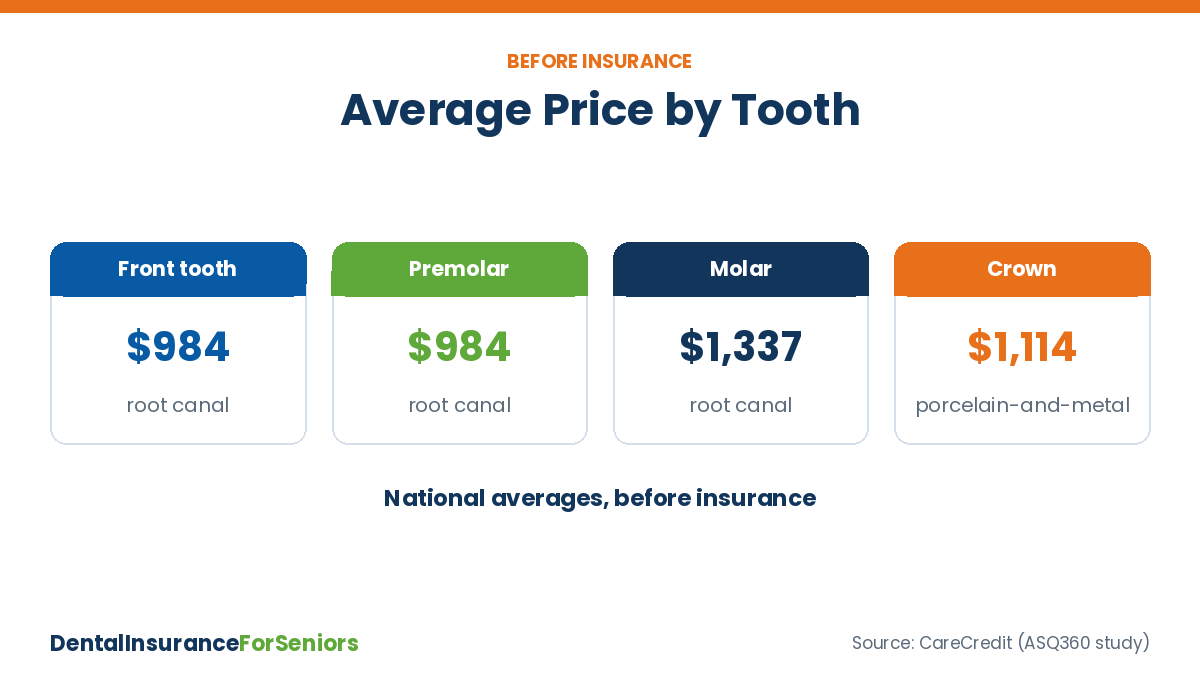
With dental insurance, a root canal usually costs a senior about $180 to $670 out of pocket, compared with roughly $984 for a front tooth and $1,337 for a molar without coverage. Your share depends on whether the plan pays endodontics as basic care (often 80%) or major care (often 50%), and a crown afterward can add $1,000 or more before insurance.

2027 by the Numbers

$1,337

average molar root canal before insurance (CareCredit)

$984

average front or premolar root canal (CareCredit)

$1,114

average porcelain-and-metal crown (CareCredit)

A root canal saves a tooth whose nerve is infected or dying. For people on Medicare, the tooth’s position sets the base fee, a crown often follows, and the plan’s tier, wait and yearly cap decide how much lands on a fixed income.

This guide is for retirees and adult children reading a treatment estimate. Still shopping for coverage? Start with dental plans that cover root canals and crowns.
Compare Senior Dental Plans That Pay for Root Canals

Root Canal Prices by Tooth, Before and After Coverage

Root canal cost with insurance starting point: average cash price for a front tooth, premolar and molar root canal plus a crown

Molars cost more because they have more canals to find, clean and seal. Here is what two national fee sources mean at the two most common coverage levels, before any deductible.

ToothAverage cash priceYou pay at 80%You pay at 50%
Front tooth (incisor or canine)$984 (CareCredit); $912 (ADA survey via ValuePenguin)About $182 to $197About $456 to $492
Premolar$984 (CareCredit); $1,044 (ADA survey via ValuePenguin)About $197 to $209About $492 to $522
Molar$1,337 (CareCredit); $1,246 (ADA survey via ValuePenguin)About $249 to $267About $623 to $669

Our calculation from the published averages. In-network fees are often lower than these averages; deductibles, waiting periods and the annual maximum can change your share.

Senior Dental Insurance Quotes

Call a Licensed Agent Now

Compare dental plans for seniors and people on Medicare from several insurance companies in one call.

☎ 1-855-425-2095

TTY users 711  |  Mon–Fri: 8am–9pm ET

No obligation to enroll

The Crown That Often Doubles the Bill

A root canal leaves a back tooth hollow and more likely to crack, so dentists usually cap molars and premolars with a crown. Front teeth sometimes need only a filling afterward. ValuePenguin puts the average root canal plus crown at $2,209 without insurance.

Crown typeAverage cash price (CareCredit)
Resin or temporary crown$697
Porcelain fused to metal$1,114
All-metal crown$1,211
All-porcelain crown$1,399

CareCredit figures from a 2023-2024 ASQ360 cost study. A core buildup, X-rays and numbing may be billed separately.

The root canal code excludes the crown. Codes D3310 (front), D3320 (premolar) and D3330 (molar) describe treatment excluding the final restoration, so the crown is a separate claim.

Crowns are usually major care. Even plans that pay root canals at 80% often pay crowns at 50%, with a longer wait and a replacement limit.

Redo work has its own codes. Retreatment of an old root canal is billed as D3346, D3347 or D3348, and plans may limit it.

What Three Senior-Friendly Plans Pay, Side by Side

Brochures rarely say where endodontics sits, so we pulled the rules from each carrier’s published summary for plans people 65 and older can buy on their own.

Plan (as published)Root canal tier and shareCrown shareWaitDeductible and yearly max
Humana Extend 5000 (Georgia)Major: 50% year one, 60% year two onSame as root canals6 months; can be waived with 12 months of prior coverage$75; $5,000
Delta Dental PPO Premium (individual)Major: 50%50%Varies by state$50; $2,000
Delta Dental PPO Basic (individual)Not coveredNot coveredNot applicable$50; $1,000
Physicians Mutual (Economy to Premier)25%, 40%, 55% or 70% by plan levelSame as root canals12 monthsVaries by plan

Sources: Humana GA Extend 5000 summary; Delta Dental individual PPO plan page; Physicians Mutual covered-procedures chart (lower levels pay set dollar amounts that average these shares). Checked November 2026; terms vary by state.

Read the fine print: Humana’s summary limits root canal therapy to one per tooth per lifetime and crowns to once per tooth every five years. A tooth treated years ago under another plan may still count against a lifetime limit.

Our Out-of-Pocket Math: One Molar Root Canal and Crown

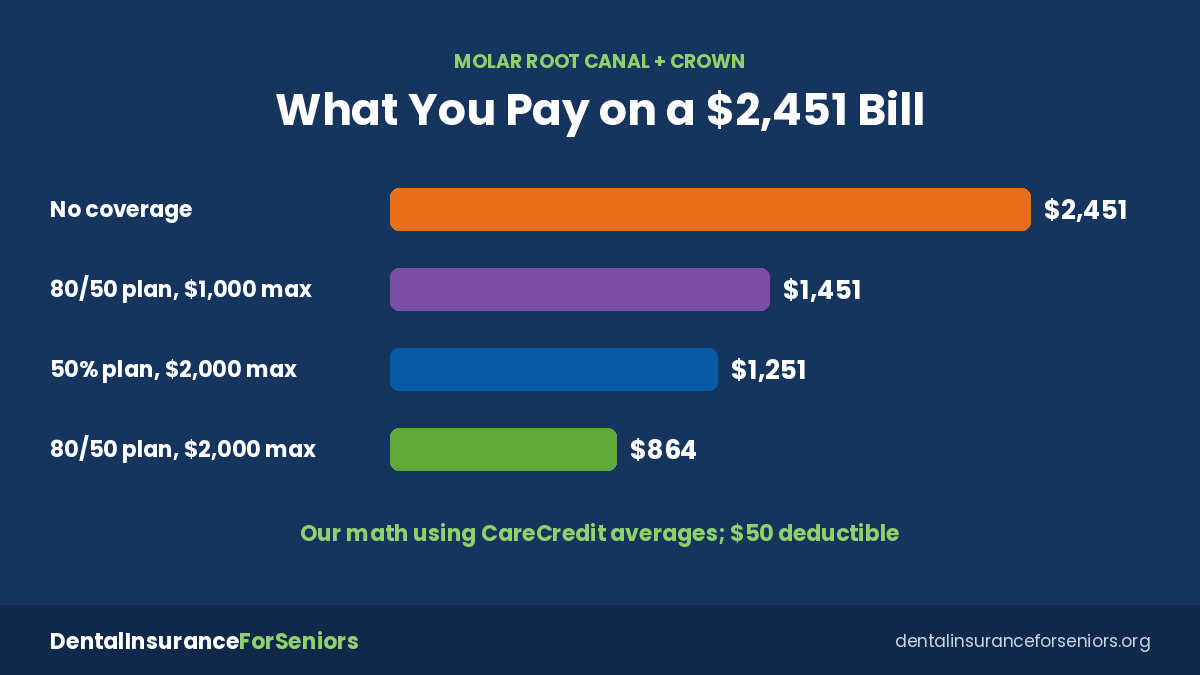
Root canal cost with insurance for a molar plus crown: what you pay with no coverage, a $1,000 maximum, a 50% plan and a $2,000 maximum

We priced a common senior case: a molar root canal ($1,337) and a porcelain-and-metal crown ($1,114), or $2,451 before insurance. On cheaper plans, the low annual maximum hurts more than the percentage.

Coverage designPlan paysYou pay
No dental coverage$0$2,451
80% root canal, 50% crown, $50 deductible, $1,000 max$1,000 (cap reached)$1,451
Same plan with a $1,500 max$1,500 (cap reached)$951
Same plan with a $2,000 max$1,586.60$864.40
Humana Extend 5000, year one (50% after $75)$1,188$1,263
Humana Extend 5000, year two (60% after $75)$1,425.60$1,025.40
Delta Dental PPO Premium (50% after $50)$1,200.50$1,250.50

Example: ($1,337 – $50) x 80% = $1,029.60, plus $1,114 x 50% = $557, total $1,586.60 before the cap. Assumes waiting periods are met and no other claims that year. Premiums not included.

Calendar idea: On the $1,000-max plan, a root canal in December and a crown in January would draw on two years of benefits: about $337 plus $582, or $919 instead of $1,451. Waiting too long to crown a treated molar can risk a fracture, so the timing is the dentist’s call.

Find & Compare Plans Online

Speak with a licensed insurance agent

1-855-425-2095TTY 711

Mon-Fri: 8am-9pm ET

Medicare, Medicare Advantage and Root Canal Bills

Original Medicare does not pay for routine dental care, and KFF notes that root canals are among the services it excludes. Medicare pays for dental care only when it is tied to certain covered medical treatment, such as clearing an infection before an organ transplant, heart valve surgery or some cancer treatment.

Many Medicare Advantage plans add dental benefits, but what they pay for root canals varies by plan and area. Some cover only cleanings and exams; others include endodontics with coinsurance, a yearly dollar cap or an in-network rule. See root canals under Medicare Advantage plans for the coverage side.

Evidence of Coverage check: Search the plan document for endodontics, then crowns, which may have a separate limit. A dental cap of $1,000 or less can be used up by one molar and its crown.

Paying for a Root Canal on a Fixed Income

An aching tooth rarely waits out a new plan’s waiting period, and ValuePenguin warns a new plan generally will not cover a problem you already have. These steps help.

1

Ask for a written estimate with codes. Get the D33xx code, the crown code and each fee, then ask the plan for a pre-treatment estimate.

2

Compare a general dentist and an endodontist. Fees differ by provider, and many plans pay more toward in-network offices.

3

Price a discount plan. A dental discount plan is not insurance, but it can cut fees at member dentists, often without a waiting period. Compare discount dental plans for seniors.

4

Ask about financing or a payment plan. Health credit cards such as CareCredit and in-office plans can spread the cost; read the terms on deferred interest.

5

Use HSA money you already have. Medicare enrollees cannot add new HSA money, but funds already saved can pay qualified dental costs.

Pulling the tooth costs less today, but replacing it later with a bridge or implant usually costs far more, and an implant may also need a bone graft. Plan ahead using dental plan waiting periods.

Bottom Line

With insurance, a single root canal often costs a few hundred dollars, but the crown that follows and a low annual maximum can push one molar past $1,000 out of pocket. Original Medicare will not help, so compare tiers, waits and yearly caps, and ask about timing and payment options before you schedule.

See endodontic coverage and rates in your ZIP code

Root Canal Cost With Insurance — Frequently Asked Questions

➤ How much is a molar root canal with insurance?

Using CareCredit’s $1,337 average, expect about $267 at 80% coverage or about $669 at 50%, before the deductible. The crown is billed separately.

➤ Is a root canal basic or major dental work?

It depends on the plan. Many plans treat endodontics as basic care, but Humana’s Extend 5000 lists root canals as major, and Delta Dental’s PPO Premium pays them at its 50% major-service level.

➤ Why does a front tooth root canal cost less than a molar?

Front teeth usually have one canal, while molars often have three or more. More canals take more time, so the fee rises.

➤ Do I need a crown after every root canal?

Not always. Molars and premolars usually get a crown because they take chewing pressure, while a front tooth sometimes needs only a filling. Ask your dentist.

➤ Will my new dental plan pay for a root canal I need right now?

Probably not right away. Many plans have a wait of 6 to 12 months for root canals, and a problem that existed before the plan began may not be covered.

➤ Does Medicare pay for a root canal?

Original Medicare does not cover routine root canals. Some Medicare Advantage plans include them, with rules that vary by plan and area.

➤ What happens if the root canal and crown go over my annual maximum?

The plan stops paying at its yearly cap, and you pay the rest. On a $1,000-max plan, a molar and crown can leave you about $1,450 to cover.

➤ Is a root canal retreatment covered too?

Often, with limits. Retreatment has its own codes, and Humana’s summary allows one root canal per tooth per lifetime, so check first.

Senior Dental Insurance Quotes

Call a Licensed Agent Now

Compare dental plans for seniors and people on Medicare from several insurance companies in one call.

☎ 1-855-425-2095

TTY users 711  |  Mon–Fri: 8am–9pm ET

No obligation to enroll

Find & Compare Plans Online

Speak with a licensed insurance agent

1-855-425-2095TTY 711

Mon-Fri: 8am-9pm ET

ZRN Health & Financial Services, LLC, a Texas limited liability company