



Dental Implant Financing for Seniors: Loans, Payment Plans and Smarter Ways to Pay

Reviewed by Russell Noga, Licensed Insurance Broker — Last updated November 13, 2026

Dental implant financing means spreading an implant bill of about $3,000 to $6,000 per tooth over time, most often through a dentist’s in-house payment plan, a medical credit card or a personal loan. Seniors usually pay less overall by using dental insurance and any leftover HSA money first, then financing only the gap with a fixed rate or a true 0% plan.

2027 by the Numbers

$3,000-$6,000

typical cost of one implant with abutment and crown (MetLife)

26.99%

APR on a typical medical credit card (CFPB, 2023 report)

$1 billion

deferred interest paid on health care card charges, 2018-2020 (CFPB)

Retirement income arrives in fixed monthly amounts, while an implant quote arrives as one large number. Financing bridges that gap, but a plan that looks free on day one can turn expensive by month thirteen.

This guide covers the payment side only: which money to use first, how each type of credit works, and what to avoid. For price ranges by tooth and add-on, see how much dental implants cost.
Compare Senior Dental Plans Before You Finance

Shrink the Balance Before You Borrow

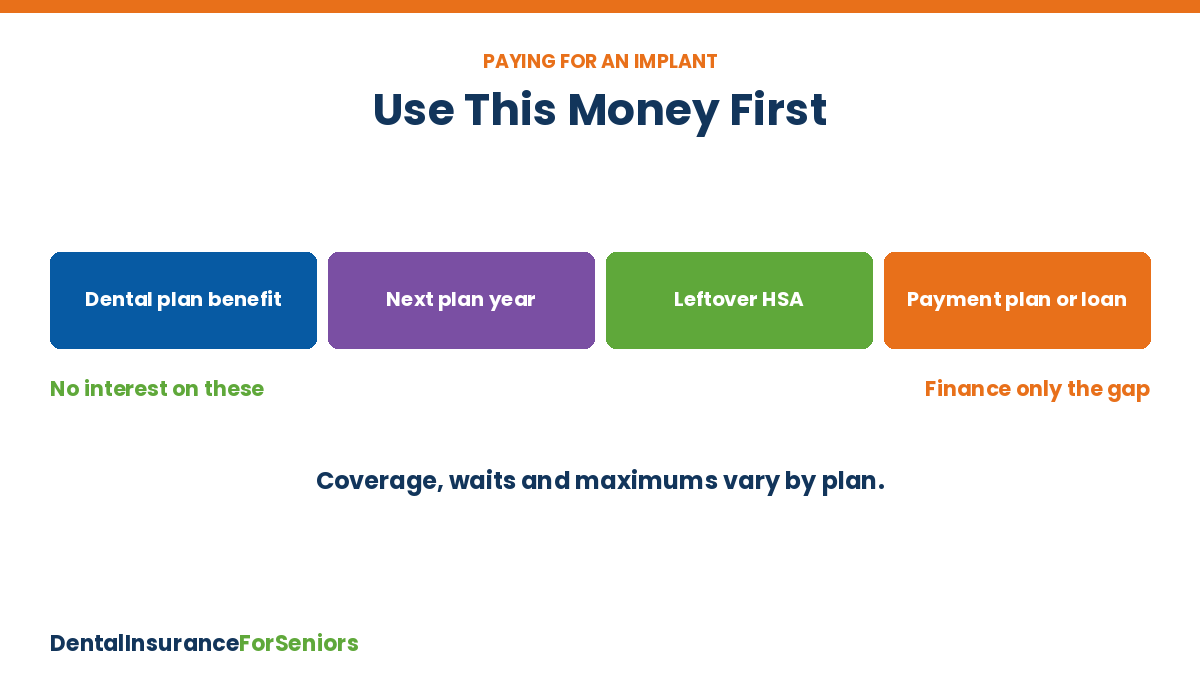
Dental implant financing order for seniors: dental plan, plan-year timing, HSA money, then payment plan or loan

Every dollar paid by a plan or savings account is a dollar that never collects interest. Original Medicare does not pay for most dental care, including routine implants, so coverage has to come from somewhere else.

Senior dental insurance. Many plans treat implants as major care, often paid around 50%, after a waiting period and up to a yearly maximum that often lands between $1,000 and $2,000. Waits can stretch to a year, so read dental implant insurance waiting periods before you book surgery.

Two benefit years, one implant. An implant is placed in phases, with months of healing between the post and the crown. If those phases fall on each side of your plan’s reset date, each phase may count against a different year’s maximum. A pre-treatment estimate confirms how your plan dates each step.

Medicare Advantage dental. Some Medicare Advantage plans include a dental allowance or implant benefit. Amounts, networks and rules vary by plan and area, and an allowance that resets each year can be timed the same way.

Senior Dental Insurance Quotes

Call a Licensed Agent Now

Compare dental plans for seniors and people on Medicare from several insurance companies in one call.

☎ 1-855-425-2095

TTY users 711  |  Mon–Fri: 8am–9pm ET

No obligation to enroll

Implant Payment Options Compared

Once coverage is used, the rest can be paid several ways, each with its own catch.

OptionHow it worksWatch-outs
Dentist’s in-house payment planThe office splits the bill into monthly payments, sometimes with no interestShort terms mean higher payments; late fees and deposit rules vary by office
Medical credit cardA card used only for health care, often with a 6- to 18-month promotionDeferred interest can charge back interest from the purchase date if any balance remains
Personal loan (bank or credit union)A lump sum repaid in fixed monthly amounts over a set termInterest starts right away; some lenders add an origination fee
Leftover HSA moneyTax-free withdrawals for qualified dental costs, even after you join MedicareNo new deposits once Medicare starts; keep receipts
Dental school clinicStudents or residents treat patients under faculty supervision, often at reduced feesScreening visits, longer appointments and limited openings
Discount planA yearly fee buys lower prices at member dentistsNot insurance; you still pay the reduced bill yourself

General descriptions only. Terms, rates and fees vary by lender, office and plan. This is not financial advice.

Discount plans and school clinics lower the price instead of spreading it out. Details on each are in dental discount plans for implant procedures and our guide to alternatives to dental insurance for implants.

Paying With HSA Money After Medicare Starts

An HSA built up during working years can still pay for implants in retirement, but the rules change once Medicare begins.

Deposits stop. Federal rules bar new HSA contributions once you are enrolled in any part of Medicare. Anyone drawing Social Security at 65 is usually enrolled in Part A automatically.

Spending continues. Money already in the account can still be withdrawn tax-free for qualified medical and dental expenses. IRS Publication 502 counts dental treatment and artificial teeth; teeth whitening does not count.

Age 65 softens the penalty. After 65, a non-medical withdrawal is taxed as income but no longer carries the extra 20% penalty. A qualified dental bill stays fully tax-free.

HSA timing rule: Medicare Part A coverage can start up to six months before the month you sign up if you enroll after 65. HSA deposits made during those back-dated months can trigger a tax penalty, so contributions usually need to stop about six months before a late Medicare enrollment.

Medical Credit Cards and the Deferred-Interest Trap

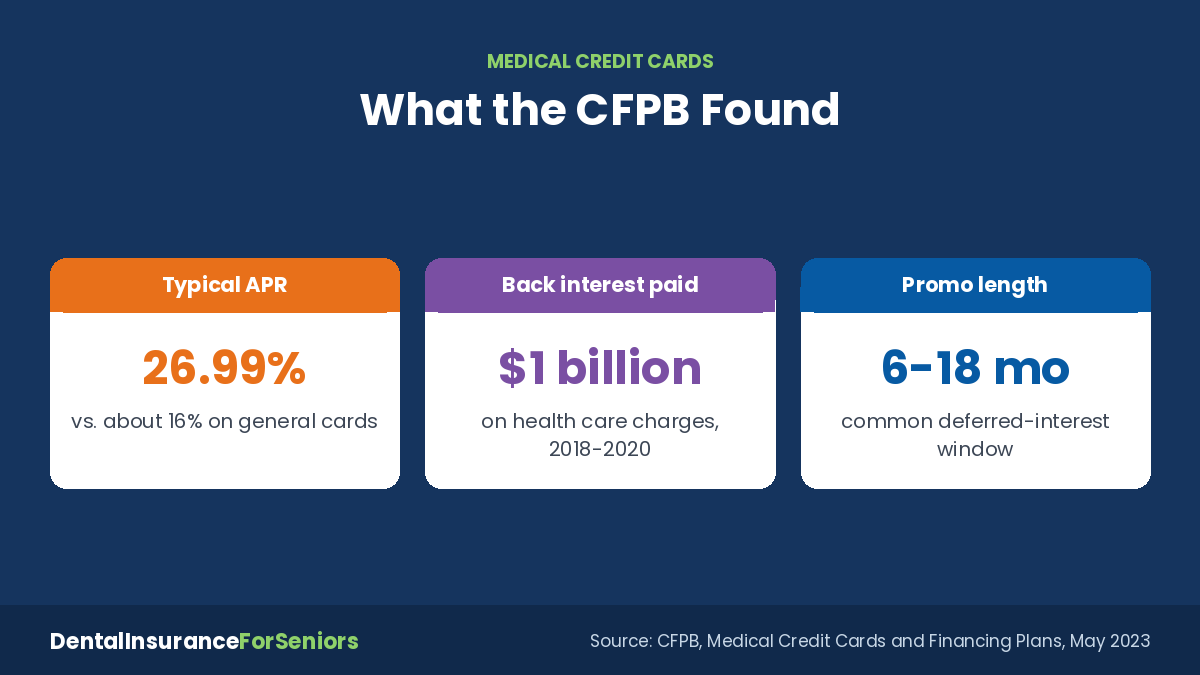
Dental implant financing with medical credit cards: CFPB findings on APR and deferred interest

Medical credit cards are often offered at the front desk as zero-interest deals, but many use deferred interest. If even a small balance is left when the promotion ends, the card can charge all the interest that built up since the day of the treatment, not just interest on what is left.

A 2023 Consumer Financial Protection Bureau report found the typical medical credit card APR was 26.99%, versus about 16% on general cards. About one in five deferred-interest health care purchases from 2018 to 2020 ended up charged that back interest. The report also cited a complaint from an older patient who said a dental office opened a card in his name without his consent.

1

Divide the balance by the promo months. That number, plus a small cushion, clears the bill in time; the card’s minimum payment may not.

2

Ask whether it is true 0% or deferred. With a true 0% offer, unpaid balances only start collecting interest after the promotion ends.

3

Never sign at the chair. Take the paperwork home and read the APR, promo end date and late-fee terms first.

Find & Compare Plans Online

Speak with a licensed insurance agent

1-855-425-2095TTY 711

Mon-Fri: 8am-9pm ET

Payment Plans, Loans and the Math on One Implant

Past a promotion, the choice is usually the dentist’s own plan or a loan from a bank or credit union. Some offices spread a balance over a few months to a year, sometimes interest-free. Dental implant loans carry one fixed rate and end date, and lenders generally count Social Security and pensions as income.

Our cost math: one $4,500 implant, five ways to pay. These are illustrations we computed, not quotes.

Way to paySetupWhat you payExtra cost
True 0% plan$4,500 over 12 months$375 a month, $4,500 total$0
Deferred-interest card, last payment missed$375 a month at a 26.99% APRAbout $5,158 totalAbout $658 in back interest
Dental plan, all in one plan year50% coinsurance, $1,500 maximum$3,000 (plan pays $1,500)$0
Dental plan, phases split over two plan yearsPost and abutment $2,500 in year one, crown $2,000 in year two$2,250 (plan pays $2,250)$0
Two-year split, your share from existing HSA$2,250 withdrawn for a qualified expense$0 from monthly income$0 interest, $0 tax

Our math. $4,500 sits inside MetLife’s $3,000 to $6,000 range; the phase split is an example. Back interest = 26.99% / 12 x the 12 month-start balances ($4,500 down to $375), simple interest. Plan rows assume the waiting period is met, no deductible, no other claims that year, and that your plan covers each phase. Real plans, cards and fees vary.

Red Flags and a Checklist for Families

Co-signing a loan or card makes the co-signer equally responsible, and late payments can show up on both credit reports. Paying the dental office directly avoids that shared debt.

Same-day pressure. A discount that expires if you leave the consultation is a sales tactic, not a dental need.

Unclear APR. Skip any offer that will not put the post-promotion rate in writing.

Too-good free offers. Implant grant ads often lead to financing. See free dental implants for seniors for routes that are real.

Family money note: A written treatment plan listing every phase and fee lets family members compare offers and see what insurance, HSA money and the patient will each cover.

Bottom Line

The cheapest dental implant financing is the borrowing you avoid: use insurance, plan-year timing and leftover HSA money first. For the rest, a fixed-rate loan or true 0% plan is easier to manage than a deferred-interest card, and nothing should be signed at the first visit.

Related: are dental expenses tax deductible How the 7.5% floor, Medicare premiums and the senior standard deduction affect deducting dentures and implants.

See dental plans that help with implants in your ZIP code

Dental Implant Financing — Frequently Asked Questions

➤ Can I get a dental implant loan if my only income is Social Security?

Often, yes. Lenders generally count Social Security, pensions and retirement withdrawals as income, but approval and rates still depend on credit history and existing debt.

➤ Is a medical credit card the same as 0% financing?

Not always. Many medical credit cards use deferred interest, which can charge back interest from the purchase date if the promotion is not paid in full. True 0% offers do not add that back interest.

➤ Can I still use my HSA for implants once I am on Medicare?

Yes. You cannot add new money after Medicare enrollment, but existing HSA funds can pay qualified dental costs tax-free. Confirm with your HSA administrator that the implant qualifies.

➤ Does Medicare have a payment plan for dental implants?

No. Original Medicare does not pay for most dental care, including routine implants. Some Medicare Advantage plans include dental allowances, and those vary by plan and area.

➤ Will applying for implant financing hurt my credit score?

A prequalification check is often a soft inquiry that does not affect your score. A full application usually triggers a hard inquiry, which can lower a score slightly for a time.

➤ What happens if the promotional period ends with a balance left?

On a deferred-interest card, all the interest that built up since the purchase can be added at once. On a true 0% offer, interest usually starts only on the remaining balance.

➤ Should my adult child co-sign my implant financing?

Co-signing makes your child legally responsible for the debt, and missed payments can affect both credit reports. Some families prefer to pay the dental office directly instead.

➤ Is it better to save up or finance an implant?

Saving avoids interest, but delay is not always safe. Ask the dentist whether treatment can wait or be spaced to match your budget and plan year.

Senior Dental Insurance Quotes

Call a Licensed Agent Now

Compare dental plans for seniors and people on Medicare from several insurance companies in one call.

☎ 1-855-425-2095

TTY users 711  |  Mon–Fri: 8am–9pm ET

No obligation to enroll

Find & Compare Plans Online

Speak with a licensed insurance agent

1-855-425-2095TTY 711

Mon-Fri: 8am-9pm ET

ZRN Health & Financial Services, LLC, a Texas limited liability company