


Gum Graft Cost for Seniors: Per-Tooth Prices, Codes and Coverage

Reviewed by Russell Noga, Licensed Insurance Broker — Last updated November 6, 2026

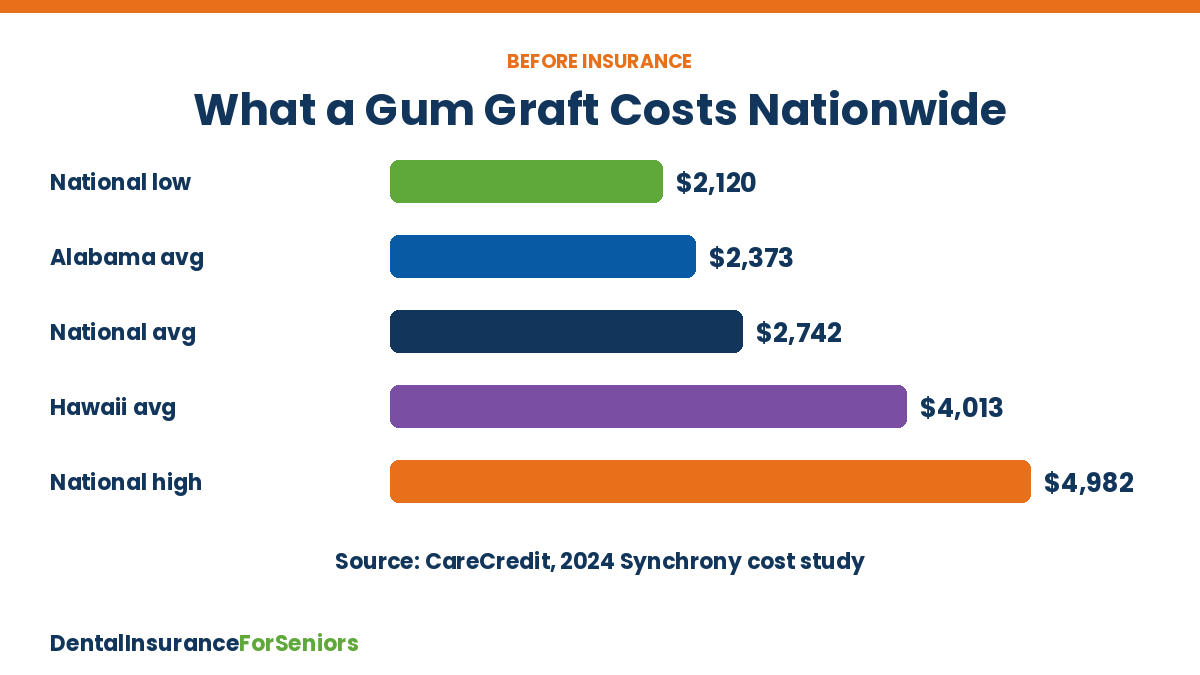
A gum graft usually costs about $600 to $1,500 per tooth when your own tissue is used and roughly $1,500 to $3,000 per tooth with donor tissue, before insurance; a treated area of several teeth averages about $2,742 nationally. Dental plans that cover grafts often pay around half after any waiting period, but only up to the yearly maximum, and Original Medicare generally pays nothing.

2027 by the Numbers

$2,742

national average for gum graft surgery, range $2,120 to $4,982 (CareCredit, 2024 Synchrony cost study)

$600-$1,200

typical connective tissue graft, per tooth (Real Dental Costs, 2026)

88%

of people 65 and older have gum recession at one or more sites (Journal of the American Dental Association)

Gum recession means the gumline pulls back and exposes a tooth root. A gum graft, or soft tissue graft, covers that root with new tissue. Quotes are easy to misread: some offices price each tooth, others an area of several teeth, and the billing code changes after the first tooth.

This guide is for people on Medicare and adult children reading a periodontist’s estimate. If recession has not started, see how seniors can prevent gum disease.
Compare Senior Dental Plans That Include Gum Surgery

What Each Type of Gum Graft Costs, With Its Billing Code

Gum graft cost chart showing the national low, average and high price and state averages for Alabama and Hawaii

Two published fee guides give different ranges, so we lined them up beside the codes dentists put on claims. Most types have one code for the first tooth and another for each added tooth in the same area.

Graft typeCode: first tooth / each added toothReal Dental Costs (per tooth)My Specialty Dentist (per site)
Connective tissue graft (tissue from under the palate)D4273 / D4283$600 to $1,200$700 to $2,000
Free gingival graft (tissue from the palate surface)D4277 / D4278$800 to $1,500$600 to $1,500
Pedicle graft (gum moved over from a nearby tooth)D4270$800 to $1,500$700 to $2,000
Donor tissue graft (processed human tissue)D4275 / D4285$1,500 to $3,000Adds about $200 to $800
Pinhole technique (tissue shifted through a small opening)Ask the office$1,500 to $3,500 per quadrant$1,000 to $3,000 per area

Prices are before insurance and come from each publisher’s 2026 guide. Codes are from the ADA’s CDT code set as listed in Aetna’s dental clinical policy on soft tissue grafts. Pinhole billing varies by office and plan.

Location matters too. CareCredit’s state averages for a connective tissue graft run from about $2,373 in Alabama to about $4,013 in Hawaii.

Senior Dental Insurance Quotes

Call a Licensed Agent Now

Compare dental plans for seniors and people on Medicare from several insurance companies in one call.

☎ 1-855-425-2095

TTY users 711  |  Mon–Fri: 8am–9pm ET

No obligation to enroll

Why the Gumline Pulls Back With Age

A review in the Journal of the American Dental Association found recession at one or more sites in 88% of people 65 and older, versus about half of adults 18 to 64. It appears with good and poor brushing habits alike.

Decades of wear. The review links recession to hard brushing and other trauma, teeth out of line, gum inflammation and tobacco. Each has had more years to act by retirement.

Past gum disease. Gum lost to periodontitis does not grow back. A deep cleaning stops infection but does not cover roots; see deep cleaning teeth cost with insurance.

Exposed roots are softer. Roots lack enamel, so they are more prone to sensitivity and decay. That is a common reason a graft is suggested.

Our Math: Your Share With a Typical Senior Dental Plan

We ran common graft jobs through a plan design many seniors see: 50% coverage after the waiting period and a $1,500 annual maximum. Fees use the Real Dental Costs averages of $900 per tooth for a connective tissue graft and $2,200 per tooth for donor tissue.

Job (average fee)Total billPlan paysYou pay
1 tooth, own tissue ($900)$900$450$450
2 teeth, own tissue$1,800$900$900
4 teeth, own tissue, all this year$3,600$1,500 (cap reached)$2,100
4 teeth, own tissue, 2 this year and 2 next year$3,600$1,800 over two years$1,800
2 teeth, donor tissue ($2,200 each)$4,400$1,500 (cap reached)$2,900
Any job with no dental coverageSame$0Full bill

Illustration only, computed by us. Assumes no deductible, no other dental claims that year and a plan that approves the graft. Real plans differ in percentage, maximum and fee schedule.

Where the cap bites: Past about $3,000 in fees, a 50% plan with a $1,500 maximum stops paying and every extra dollar is yours. When recession can be treated in stages, splitting them across plan years lets two maximums help. See annual maximums in dental insurance.

Own Palate Tissue or Donor Tissue: The Price Trade-Off

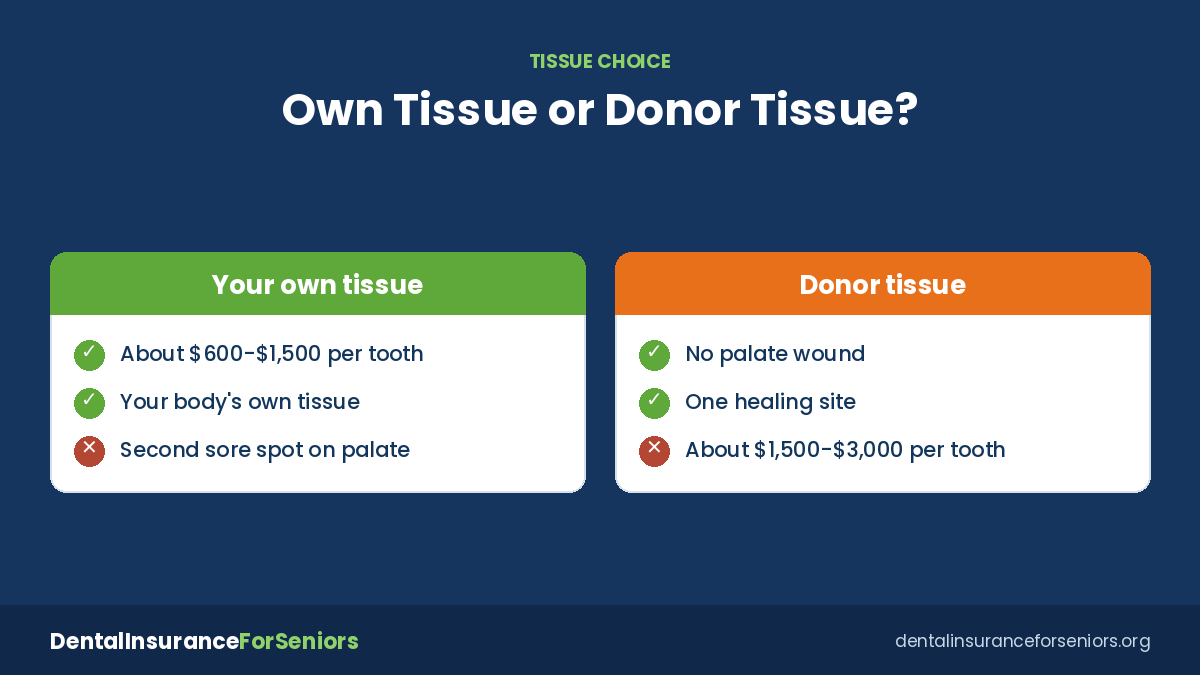
Gum graft cost compared for grafts using your own palate tissue versus donor tissue

The biggest choice on the quote is where the tissue comes from. Your own palate tissue adds a second sore spot; donor tissue skips that but costs more.

Your own tissue. Usually the lower fee per tooth. The palate heals as a second site, which can be harder for people whose denture or partial rests there.

Donor tissue. No palate wound, but fee guides put it hundreds to a few thousand dollars higher per tooth.

Pinhole approach. Offered by some periodontists for several neighboring teeth, often priced per area. Coverage depends on how the office codes it.

Gum grafts rebuild soft tissue only. Lost jawbone, often found before an implant, needs a different procedure priced in dental bone graft cost.

Find & Compare Plans Online

Speak with a licensed insurance agent

1-855-425-2095TTY 711

Mon-Fri: 8am-9pm ET

Will Medicare or a Medicare Advantage Plan Pay?

Medicare.gov says that in most cases Original Medicare does not cover dental services. Exceptions are narrow, such as some inpatient dental care and dental work tied to covered treatment like a heart valve replacement, transplant or cancer care. A graft for ordinary recession does not qualify.

Medicare Advantage dental. Some plans offer comprehensive dental that may include periodontal surgery. Coverage, dollar limits and networks vary by plan and area. Compare Medicare Advantage plans with dental benefits.

Where to look. The Evidence of Coverage lists periodontics, prior authorization and the yearly dental limit. The Annual Notice of Change each fall shows January changes.

Medigap. Medicare Supplement policies do not add dental, so Medigap members usually need a separate dental or discount plan.

Getting a Gum Graft Approved Before Surgery

Plans commonly exclude grafts done only for looks, and CareCredit notes some pay only when a set amount of recession is present.

1

Get codes and fees in writing. List the first-tooth code, any added-tooth codes and each fee.

2

Send a pre-treatment estimate. Aetna’s soft tissue graft policy asks for millimeters of recession and attached gum per tooth, plus x-rays, and recommends photos before surgery.

3

Check the waiting period. New senior plans often delay periodontal surgery 6 to 12 months; see dental plan waiting periods.

4

Confirm the tier. Some plans list periodontal surgery as basic care, others as major.

5

Price the gap. Ask about dental school clinics, office payment plans or a discount plan, which is not insurance but has no yearly cap.

Bottom Line

Expect roughly $600 to $1,500 per tooth for a graft using your own tissue and more for donor tissue, with multi-tooth areas often running $2,000 to $5,000. A 50% plan with a $1,500 maximum covers small jobs well but runs out on larger ones, so get a pre-treatment estimate and consider staging the work across plan years.

Find dental plans with periodontal benefits in your ZIP code

Gum Graft Cost — Frequently Asked Questions

➤ Is a gum graft priced per tooth or for the whole mouth?

Most periodontists price per tooth or site, with added-tooth codes for neighbors in the same area. Three or four adjacent teeth in one visit often total about $2,000 to $5,000.

➤ Which gum graft type is usually the least expensive?

In published fee guides, a connective tissue graft using your own tissue tends to sit at the lower end, about $600 to $1,200 per tooth. Donor tissue grafts usually cost the most.

➤ Why is a donor tissue graft more expensive?

The processed tissue is part of the fee. In exchange, there is no second wound on the roof of the mouth.

➤ Do dental plans cover gum grafts for appearance?

Usually not. Plans tend to pay only when the graft protects a tooth or treats recession, and they may ask for measurements and x-rays first.

➤ I just bought a dental plan. Can I get a graft next month?

Possibly not with coverage. Many senior plans make periodontal surgery wait several months to a year.

➤ Does Medicare Part B pay for gum surgery?

Not for ordinary recession. Original Medicare covers dental work only in narrow cases tied to covered medical care, such as before certain heart or transplant surgeries.

➤ Can my Medicare Advantage plan cover a gum graft?

Some plans with comprehensive dental may, often with a yearly dollar limit and prior approval. Coverage varies by plan and area, so check the Evidence of Coverage.

➤ How do I keep a graft from going over my annual maximum?

Ask whether the teeth can be treated in stages, then time the stages so they fall in different plan years. Get a pre-treatment estimate for each stage.

Senior Dental Insurance Quotes

Call a Licensed Agent Now

Compare dental plans for seniors and people on Medicare from several insurance companies in one call.

☎ 1-855-425-2095

TTY users 711  |  Mon–Fri: 8am–9pm ET

No obligation to enroll

Find & Compare Plans Online

Speak with a licensed insurance agent

1-855-425-2095TTY 711

Mon-Fri: 8am-9pm ET

ZRN Health & Financial Services, LLC, a Texas limited liability company