



Crown Lengthening Cost for Seniors: Per-Tooth Fees, Insurer Rules and the Crown That Follows

Reviewed by Russell Noga, Licensed Insurance Broker — Last updated November 24, 2026

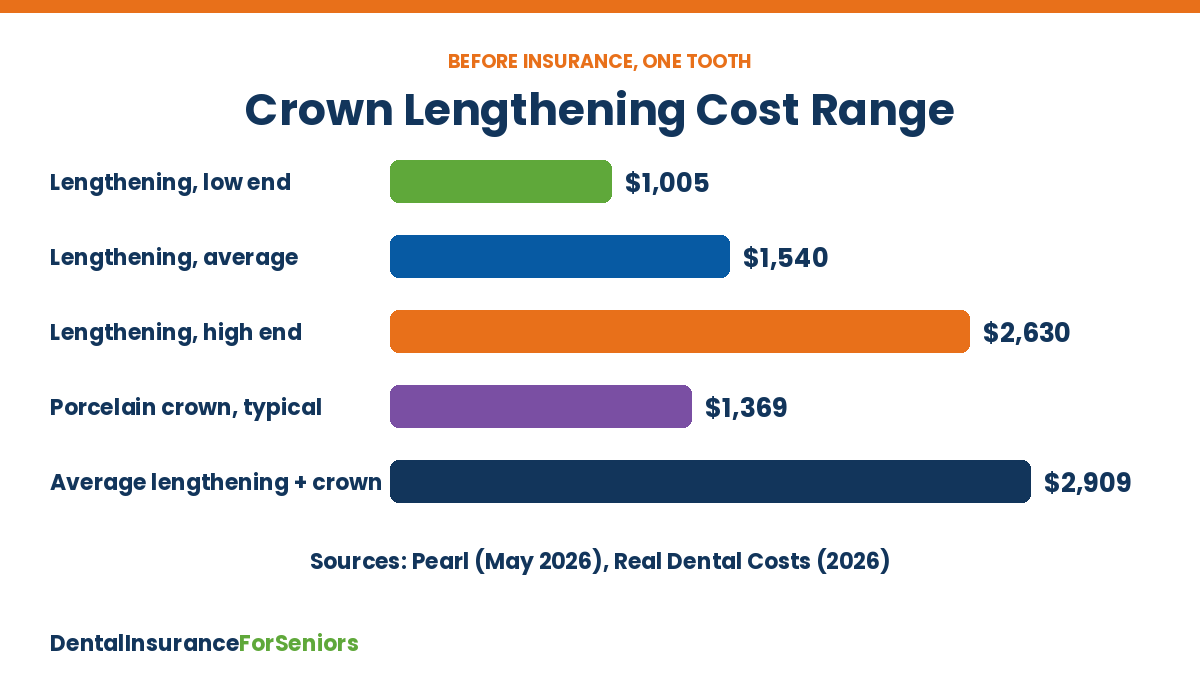
Crown lengthening costs about $1,540 per tooth on average before insurance, with a typical range of about $1,005 to $2,630, according to Pearl’s 2026 analysis of ADA fee survey data. The crown that follows is billed separately, so one tooth often totals close to $3,000, and Original Medicare pays for neither in routine cases.

2027 by the Numbers

$1,540

national average fee for crown lengthening (D4249), typical range $1,005 to $2,630 (Pearl, ADA fee survey data, May 2026)

4-6 weeks

minimum healing before final crown impressions in Aetna’s dental claim documentation guidelines

36 months

Cigna’s no-repeat window for D4249 on the same tooth by the same office (guideline PERIO-05)

Crown lengthening is a small gum and bone surgery that uncovers more of a tooth so a crown has something solid to grip. The gum is opened, a little bone is trimmed from around the root, and the gum is stitched back lower. It is usually the first half of a two-part bill.

This page covers the surgery’s price and how insurers judge the claim. For the crown itself, see dental crown cost.
Compare Senior Dental Plans That Include Gum Surgery

Price of Crown Lengthening, Tooth by Tooth

Crown lengthening cost per tooth compared with a porcelain crown and the combined total

Crown lengthening is priced per tooth. Published figures vary because some quotes cover gum trimming only while others include bone removal.

SourceFee before insuranceWhat the figure covers
Pearl national cost data (updated May 2026)$1,005 to $2,630, average $1,540Hard-tissue lengthening, code D4249
My Specialty Dentist (updated June 2026)$1,000 to $3,000 per toothRises with more teeth and more bone removed
CostHelper$50 to $350 per toothGum-only reshaping, with no bone removed

Fees vary by region and office. Exams, x-rays, sedation and the crown itself are separate charges.

D4249 is clinical crown lengthening with bone removal, billed per tooth. D4210 and D4211 are gum-only trimming (gingivectomy) for four or more, or one to three, teeth in a quadrant, and D4212 is gum trimming on one tooth to reach decay. Gum-only work usually costs less, but Aetna’s claim guidelines say it will not be paid as D4249.

Who does the surgery: Pearl notes that a periodontist or oral surgeon usually does this surgery, though a general dentist may handle simple cases. Each office sets its own fee, so ask both for a written D4249 quote.

Senior Dental Insurance Quotes

Call a Licensed Agent Now

Compare dental plans for seniors and people on Medicare from several insurance companies in one call.

☎ 1-855-425-2095

TTY users 711  |  Mon–Fri: 8am–9pm ET

No obligation to enroll

Why Older Teeth Often Need More Height

The surgery solves one problem: too little healthy tooth above the bone to hold a crown edge without irritating the gum. Several situations common after 65 cause it.

A break at the gumline. A tooth with a large old filling can snap off near or below the gum.

Decay under an old crown. Decay under the edge of a decades-old crown can reach below the gum.

Teeth worn short. Grinding and acid wear shorten teeth, but Delta Dental’s 2025 processing policies exclude tooth loss from wear, attrition, abrasion or abfraction.

A gummy smile. Lengthening front teeth for looks alone is treated as cosmetic and rarely paid.

How Five Insurers' Policies Judge a D4249 Claim

We compared the provider policies five dental insurers publish for crown lengthening. Their rules explain most denials, and no fee guide lists them together.

Insurer documentWhen it paysWhat the office must sendLimits and exclusions
Aetna Dental CPB 004 (July 2026) and claim guidelinesDecay or a fracture at or near the bone on x-raysDated pre-op x-rays; 4 to 6 weeks of healing before crown impressionsGum-only work not paid as D4249; folded into gum disease surgery if done together
Cigna DPPO guideline PERIO-05 (June 2026)Healthy gums; flap plus bone removalGum charting and x-raysNot same day as a restoration, with gum disease, or for looks; no same-office repeat within 36 months
UnitedHealthcare DCP013.15 (May 2026)Healthy area, little or no crown showingNot statedMay not be indicated with unmanaged conditions or medicines that slow healing
Delta Dental 2025 processing policies (deltadentalins.com)Under 3 mm of tooth between bone and planned crown edgeBitewing x-rays within 12 months plus a narrativeNot for teeth shortened by wear; generally not with gum disease
Select Health D010 (revised October 2022)Flap, bone removal and stitches in chart notesPeriapical x-ray; notes showing a healing periodNot same day as a restoration; 3 months of follow-up included

Compiled by us from each insurer’s provider policy. Your plan booklet controls, and other Delta Dental companies set their own rules.

If the surrounding gums are diseased, gum treatment comes first; see osseous surgery cost.

Two Bills, One Yearly Maximum

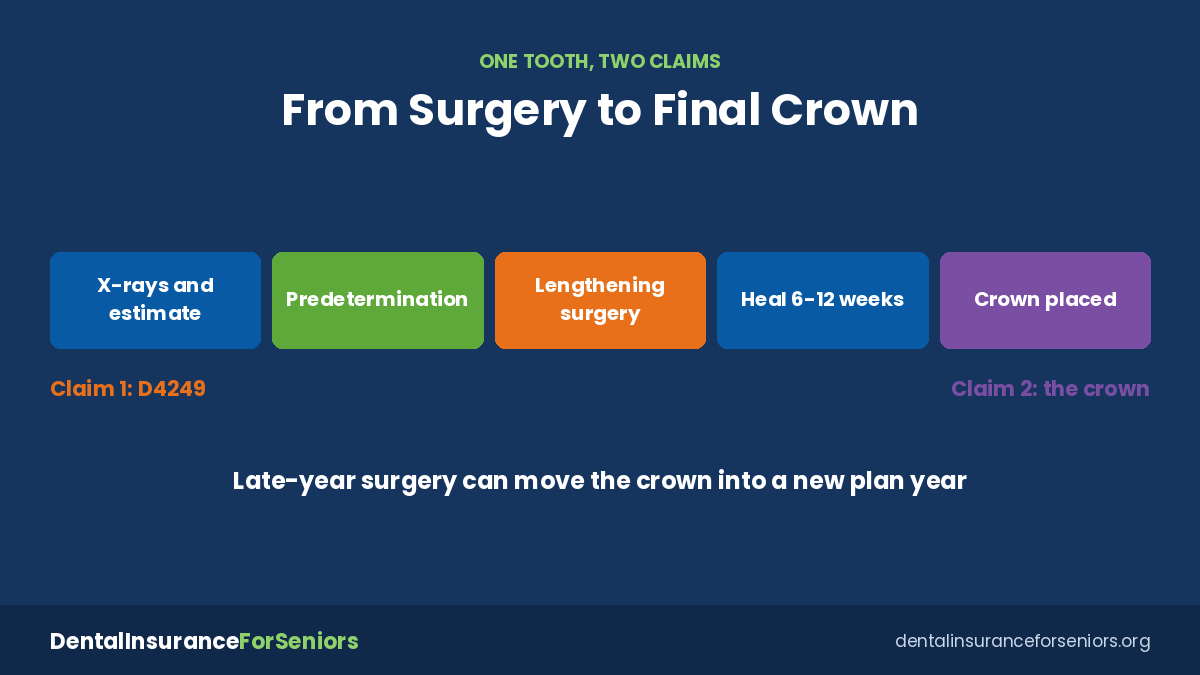
Crown lengthening cost timeline from x-rays and predetermination to surgery, healing and the final crown

Lengthening and the crown are separate claims that draw on one annual maximum. Many senior plans pay both as major care at about 50%, though a few list periodontal surgery as basic care.

Plan situationTotal feesPlan paysYou pay
$1,500 yearly maximum, both in one plan year$2,909$1,455$1,454
$1,000 yearly maximum, both in one plan year$2,909$1,000 (maximum reached)$1,909
$1,000 maximum, $400 already used on fillings that year$2,909$600$2,309
$1,000 maximum, surgery in November, crown in new plan year$2,909$770 + $685$1,454
Major-care waiting period not yet finished$2,909$0$2,909

Our illustration: Pearl’s $1,540 lengthening average and Real Dental Costs’ $1,369 typical 2026 porcelain crown, both at 50%, no deductible. Real plans differ.

Row four shows why timing matters: the crown waits for healing, so late-year surgery can push it into a fresh maximum. Plans differ on whether a crown counts on the prep date or the cementing date, so ask. See annual maximums in dental insurance and dental plan waiting periods.

Find & Compare Plans Online

Speak with a licensed insurance agent

1-855-425-2095TTY 711

Mon-Fri: 8am-9pm ET

Medicare, Medicare Advantage and Gum-Line Surgery

Original Medicare does not cover most dental care, and lengthening a broken or decayed tooth falls outside its narrow exceptions tied to covered medical treatment, such as an organ transplant. Medigap plans add no dental benefits.

Medicare Advantage dental. Some plans cover periodontal surgery and crowns, but services, copays, yearly limits and networks vary by plan and area.

Commercial rules can apply. Select Health states its Medicare Advantage dental follows its commercial crown lengthening policy.

Stand-alone senior dental plans. These often cover major care after a waiting period, up to a yearly maximum.

Compare Medicare Advantage plans with dental benefits in your area.

Alternatives and Steps Before You Agree to Surgery

Pull the tooth and replace it. This avoids lengthening, but an implant or bridge usually costs more; see dental bridge vs implant.

Orthodontic extrusion. Braces-type hardware slowly pulls the root upward. Pearl calls it slower and usually more expensive.

Filling or partial denture. For some back teeth, a lower-cost option may exist; ask about each tooth’s long-term outlook.

1

Ask for codes and fees. Get D4249 listed separately from the crown, buildup and sedation.

2

Request a predetermination. The insurer states in writing what it will pay, flagging missing x-rays first.

3

Check the calendar. Confirm waiting periods have ended and whether the crown can fall in the next plan year.

4

Bring a medication list. Insurer policies flag blood thinners and steroids; never stop a prescribed drug without the prescriber’s approval.

Bottom Line

Plan on roughly $1,000 to $2,600 for crown lengthening on one tooth, plus the crown. Original Medicare will not help and one tooth can use up a senior plan’s yearly maximum, so get a predetermination and ask whether the crown can land in a new plan year.

Check dental plans and prices in your ZIP code

Crown Lengthening Cost — Frequently Asked Questions

➤ Is crown lengthening charged per tooth?

Yes. Code D4249 is billed for each tooth treated, so two neighboring teeth usually mean two fees.

➤ Does the crown lengthening fee include the crown?

No. The crown is placed after the gum heals, often 6 to 12 weeks later, and billed on its own claim.

➤ Why is gum-only lengthening cheaper?

Trimming gum alone takes less time than removing bone. It is billed under gingivectomy codes, and Aetna will not pay it as D4249.

➤ Will insurance pay for lengthening on a tooth worn down by grinding?

Possibly not. Delta Dental’s 2025 processing policies exclude teeth whose structure was lost to wear or abrasion, so get a predetermination first.

➤ Can the crown be started the same day as the surgery?

Usually not for insurance. Cigna and Select Health do not pay lengthening on the same day as a restoration on that tooth, and Aetna expects 4 to 6 weeks of healing.

➤ Is crown lengthening major or basic dental care?

Most plans group it with major or periodontal surgery near 50%, but some call periodontal surgery basic care. Your plan booklet decides.

➤ Does Medicare Advantage pay for crown lengthening?

Only if its dental benefit covers periodontal surgery. Benefits, yearly caps and networks vary, so check the Evidence of Coverage.

➤ Is a gummy smile correction covered?

Rarely. Lengthening only to change the smile’s look is treated as cosmetic, and Cigna excludes work done solely for appearance.

Senior Dental Insurance Quotes

Call a Licensed Agent Now

Compare dental plans for seniors and people on Medicare from several insurance companies in one call.

☎ 1-855-425-2095

TTY users 711  |  Mon–Fri: 8am–9pm ET

No obligation to enroll

Find & Compare Plans Online

Speak with a licensed insurance agent

1-855-425-2095TTY 711

Mon-Fri: 8am-9pm ET

ZRN Health & Financial Services, LLC, a Texas limited liability company