


Flexible Partial Dentures Cost for Seniors: Prices and Insurance

Reviewed by Russell Noga, Licensed Insurance Broker — Last updated November 15, 2026

Flexible partial dentures cost about $700 to $2,000 per arch before insurance, and a small one-tooth flexible partial often runs about $500 to $1,500. Dental plans usually treat them as major care, but many pay only the allowance for a cheaper acrylic or metal partial, so you cover the difference.

2027 by the Numbers

$923

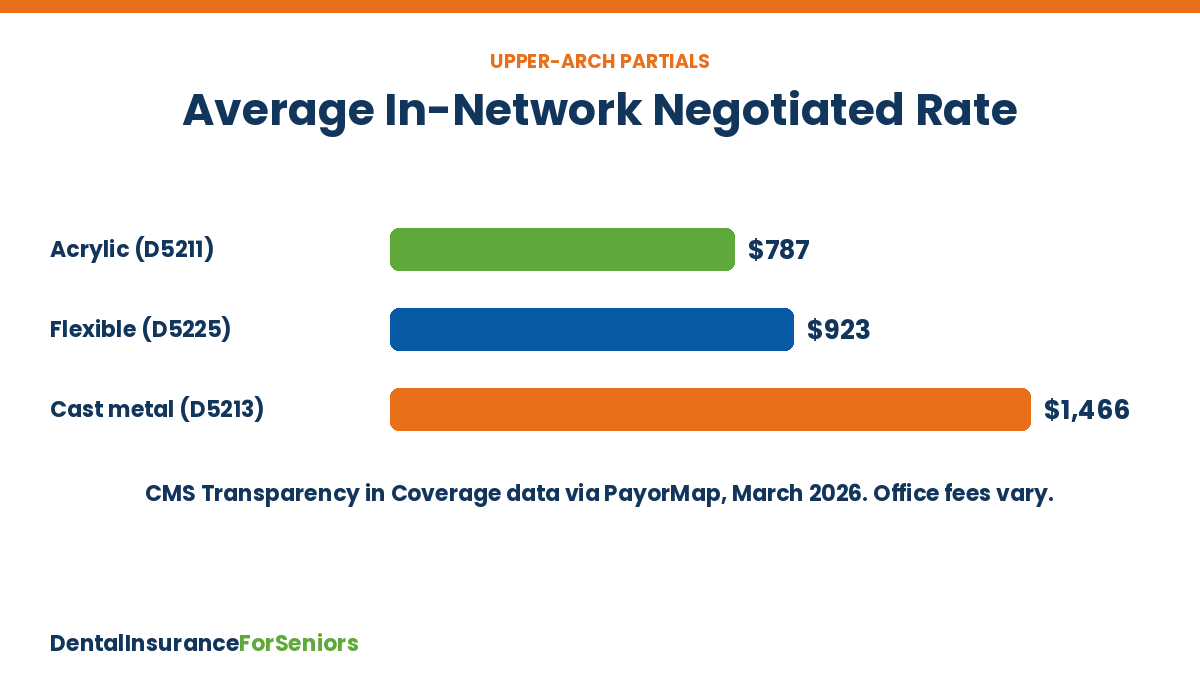
average in-network negotiated rate, upper flexible partial D5225 (CMS Transparency in Coverage data via PayorMap, 2026)

$787

same average for an upper acrylic-base partial, D5211

5 years

a common replacement limit per arch in dental plan policies

A flexible partial is a removable denture made from a thin, bendable nylon-type resin. Instead of metal clasps, it uses gum-colored arms that hug your natural teeth. Seniors often like it because it feels lighter and shows no metal when they smile.

The catch is not only the sticker price. Insurance often treats the flexible version differently, and the material is harder to fix later. For pricing across all partial types, see our guide to partial dentures cost with insurance.
Compare Senior Dental Plans for Partials

What a Flexible Partial Costs Per Arch and Per Tooth

Flexible partial dentures cost compared with acrylic and cast metal partials by average negotiated rate

Fees vary by dentist, region and dental lab. The lab work for the nylon base drives most of the cost, whether it carries one tooth or five.

One full arch. Consumer cost guides often put a flexible partial at about $700 to $2,000 for an upper or lower arch, before any extractions or exam fees.

One or two teeth. A small flexible partial that fills a single gap, similar in size to a flipper, often costs about $500 to $1,500. That is usually more than a basic acrylic flipper.

Add-on charges. Exams, X-rays and extractions are billed separately. Simple extractions alone can add roughly $75 to $450 per tooth in many areas.

Senior Dental Insurance Quotes

Call a Licensed Agent Now

Compare dental plans for seniors and people on Medicare from several insurance companies in one call.

☎ 1-855-425-2095

TTY users 711  |  Mon–Fri: 8am–9pm ET

No obligation to enroll

Flexible vs Acrylic vs Cast-Metal Partials Side by Side

Each partial type has its own CDT code, the billing code your dentist sends to the plan. The code shapes how the claim is paid, so it belongs on any price comparison.

TypeCDT code (upper / lower)Typical cash price per archAverage negotiated rate, upper archHow plans often treat itLifespan and fixes
Flexible (nylon resin base)D5225 / D5226Often $700 to $2,000$923Major service; may be paid at a cheaper alternate allowanceOften estimated at 3 to 5+ years; hard to reline or repair
Acrylic (resin base)D5211 / D5212Often from about $300; usually the lowest$787Major service; often the allowance plans fall back onBulkier; easier to reline and add teeth to
Cast metal frameworkD5213 / D5214Often $1,000 to $2,500 or more$1,466Major service; often seen as the standard long-term partialCan last 10+ years; clasps can often be adjusted

Negotiated rates: national averages from CMS Transparency in Coverage files as compiled by PayorMap (March 2026 refresh), which reflect in-network rates insurers agreed to, not what every office charges. Cash price ranges: consumer cost guides. Lifespan estimates vary, and clinical data on flexible partials is limited.

In-network dentists usually agree to fees near these rates, and the gap between the flexible and acrylic figures hints at what you may owe if your plan downgrades the claim.

How Dental Plans Pay for Codes D5225 and D5226

D5225 is the code for an upper partial with a flexible base, and D5226 is the lower one. Plans that cover removable partials usually list these codes, but listing a code is not the same as paying it in full.

Alternate benefit clause. Many policies pay for the least costly treatment that is still professionally acceptable. A flexible partial may be paid at the allowance for an acrylic or cast-metal partial, and you owe the difference.

Major-service coinsurance. Partials are usually major care, which many senior plans cover at around 50% after the deductible.

Waiting periods. Many plans make new members wait, often up to 12 months, before major work is covered. See how dental plan waiting periods work.

Replacement limits. One partial per arch every five years is a common rule in plan policies, though some plans use longer or shorter limits.

Claim check: Before the lab starts, have the office send a pre-treatment estimate listing D5225 or D5226. The response shows whether the plan will apply an alternate benefit and what share is left for you.

Pros and Cons of a Flexible Partial After 65

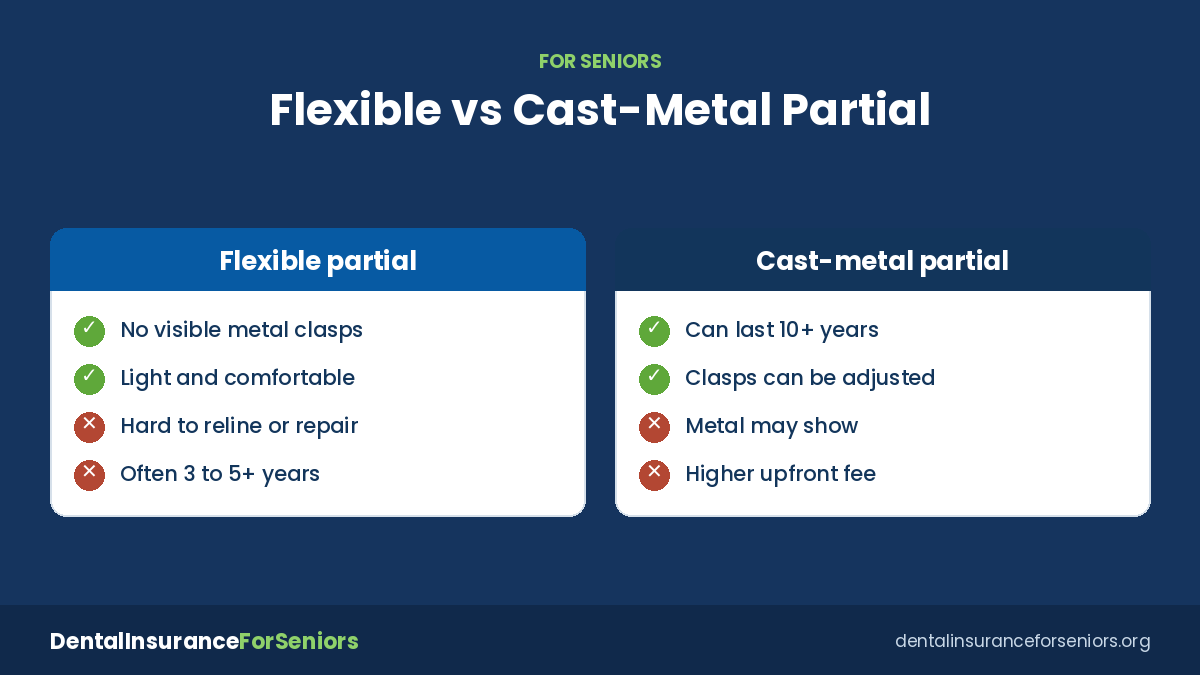
Flexible partial dentures pros and cons for seniors compared with cast metal partials

Comfort is the main draw, but older mouths change. Gums shrink over time, and more teeth may be lost, so the ability to adjust a partial matters more for seniors than for younger adults.

Comfort and looks. The thin base flexes with the gums and the clasps blend in, which many wearers find easier to get used to.

No metal or acrylic monomer. The nylon-type material can suit people sensitive to metal or to the chemicals in standard acrylic.

Harder to reline. As the gums change, acrylic and metal partials can often be relined. Flexible bases are harder to reline, so a loose one may need to be remade. Learn what a denture reline costs.

Limited repairs. Adding a tooth or fixing a crack is difficult with nylon resin, and a replacement often costs close to the original price.

A flexible base is also less rigid, so it may not suit a mouth where the remaining teeth give weak support.

Find & Compare Plans Online

Speak with a licensed insurance agent

1-855-425-2095TTY 711

Mon-Fri: 8am-9pm ET

Worked Example: A Downgraded Flexible Partial Claim

This illustration shows how an alternate benefit changes the bill. The numbers are made up for the example and are not a quote.

1

The fee. The dentist charges $1,500 for an upper flexible partial, code D5225.

2

The plan’s allowance. The plan applies its alternate benefit and allows $800, its fee for an acrylic partial.

3

The coinsurance. With the deductible already met, the plan pays 50% of $800, which is $400.

4

Your share. You pay the remaining $1,100. Had the plan paid half of the full fee, your share would have been $750.

Worth asking: Your annual maximum still caps the plan’s payment. If other work this year has used most of it, the plan may pay even less than the example shows. See dental insurance for major dental work for seniors.

Medicare Rules and Lower-Cost Routes

Original Medicare (Parts A and B) does not cover dentures, including partials. A Medicare Supplement plan does not add dental benefits either.

Medicare Advantage. Some Medicare Advantage plans include dental benefits that may help with partials. Coverage, yearly dental limits and networks vary by plan and area, and a plan may still pay at a cheaper material’s rate. Read more on whether Medicare Advantage covers dentures.

Stand-alone senior dental plan. A separate plan may cover partials as major care. Compare its alternate benefit wording, waiting period and annual maximum.

If cost is the barrier. Choosing an acrylic or cast-metal partial, or asking about payment plans, can lower what you pay out of pocket.

Bottom Line

Flexible partial dentures often cost about $700 to $2,000 per arch, and a one-tooth version often runs $500 to $1,500. Dental plans usually count them as major care, but many pay only the rate for a cheaper acrylic or metal partial, and the material is harder to reline or repair later. Get a pre-treatment estimate before you choose.

Check dental plans that cover major work in your ZIP code

Flexible Partial Dentures Cost — Frequently Asked Questions

➤ What is the price of a flexible denture per tooth?

Flexible partials are priced by the appliance, not by the tooth. A small one replacing one or two teeth often costs about $500 to $1,500, while a full-arch flexible partial often runs $700 to $2,000.

➤ Why did my plan pay less for my flexible partial than expected?

Many dental plans have an alternate benefit clause. They may pay the allowance for a lower-cost acrylic or cast-metal partial instead of the flexible one, and you owe the difference.

➤ What CDT codes are used for flexible partials?

D5225 is used for an upper partial with a flexible base, and D5226 for a lower one. Acrylic partials use D5211 and D5212, and cast-metal partials use D5213 and D5214.

➤ Are flexible partials more expensive than acrylic ones?

Usually, yes. National in-network negotiated rates average about $923 for an upper flexible partial and about $787 for an upper acrylic partial, and cash prices show a similar gap.

➤ How long does a flexible partial denture last?

Many dentists estimate about 3 to 5 years or more with good care, but published data is limited. Cast-metal partials can often last 10 years or longer.

➤ Can a flexible partial be relined or repaired?

It is harder than with acrylic or metal partials. Relining the nylon-type base is difficult and repairs are limited, so a loose or cracked flexible partial may need to be remade.

➤ Does Medicare Advantage cover flexible partial dentures?

Some Medicare Advantage plans include dental benefits that may help pay for partials, but coverage varies by plan and area. Check whether the plan limits the material it pays for and its yearly dental maximum.

➤ How soon can insurance replace my flexible partial?

Many dental plans pay for a new partial on the same arch only once every five years or so. If a flexible partial wears out sooner, you may pay the full cost of a replacement.

Senior Dental Insurance Quotes

Call a Licensed Agent Now

Compare dental plans for seniors and people on Medicare from several insurance companies in one call.

☎ 1-855-425-2095

TTY users 711  |  Mon–Fri: 8am–9pm ET

No obligation to enroll

Find & Compare Plans Online

Speak with a licensed insurance agent

1-855-425-2095TTY 711

Mon-Fri: 8am-9pm ET

ZRN Health & Financial Services, LLC, a Texas limited liability company