



Are Dental Expenses Tax Deductible? A Guide for Seniors on Medicare

Reviewed by Russell Noga, Licensed Insurance Broker — Last updated November 14, 2026

Yes, dental expenses are tax deductible when they treat or prevent dental disease, including dentures, fillings, extractions and cleanings, and so are dental insurance premiums you pay with after-tax money. The catch is that you must itemize on Schedule A, and only the part of your total medical and dental costs above 7.5% of your adjusted gross income counts.

2027 by the Numbers

7.5%

of adjusted gross income your medical costs must pass first (IRS Pub. 502)

$2,050

extra 2026 standard deduction for a single filer 65+ (IRS)

$6,000

new senior deduction per person 65+, tax years 2025-2028 (IRS)

$202.90

2026 standard Medicare Part B monthly premium (CMS)

A new set of dentures or a mouth full of fillings can cost more than a month of Social Security. Retirees, and the adult children who help with their paperwork, often wonder whether the IRS gives any of that money back.

It can, but the rules favor people with large bills in one year. Typical price ranges are in how much dentures cost.
Compare Senior Dental Plans and Premiums

Which Dental Bills the IRS Counts and Which It Rejects

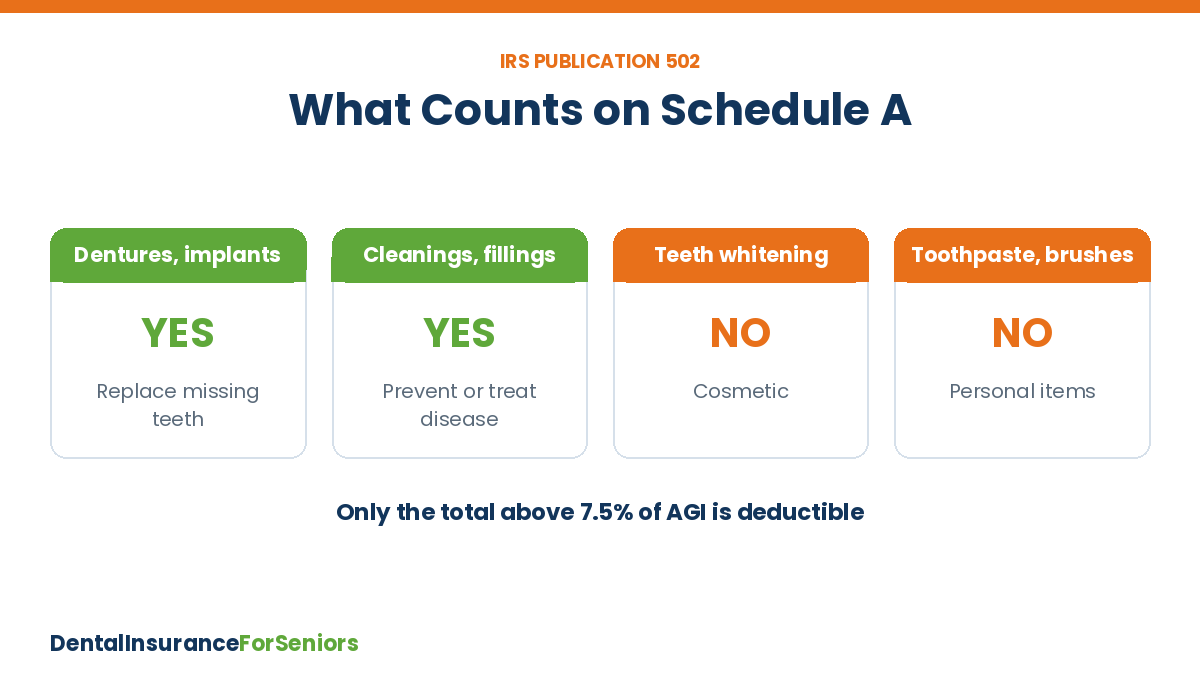
Are dental expenses tax deductible: dentures and fillings count, teeth whitening and toothpaste do not

IRS Publication 502 lets you include amounts paid to prevent and relieve dental disease. The test is medical purpose: the work has to treat a problem or keep one from starting, not just improve your smile.

ExpenseCounts as a medical expense?Why
Cleanings, sealants, fluorideYesListed as preventive treatment in Pub. 502
X-rays, fillings, extractionsYesListed as treatment of dental disease
Dentures and other artificial teethYesPub. 502 names artificial teeth directly
Implants that replace missing teethGenerally yesTreat tooth loss rather than appearance; keep the treatment plan
Teeth whiteningNoPub. 502 excludes it as cosmetic
Toothbrush and toothpasteNoTreated as personal items

Source: IRS Publication 502 (2025 edition). Bills a dental plan, HSA or other source reimbursed do not count.

Gray-area test: A procedure aimed only at appearance that does not improve function or treat disease is cosmetic under IRS rules.

Senior Dental Insurance Quotes

Call a Licensed Agent Now

Compare dental plans for seniors and people on Medicare from several insurance companies in one call.

☎ 1-855-425-2095

TTY users 711  |  Mon–Fri: 8am–9pm ET

No obligation to enroll

How the 7.5% Floor Works, With a Retiree Example

The IRS does not let you deduct every dollar. You add up all qualifying medical and dental costs for the year, subtract 7.5% of your adjusted gross income, and only the remainder goes on Schedule A. The example below uses round numbers for illustration only.

1

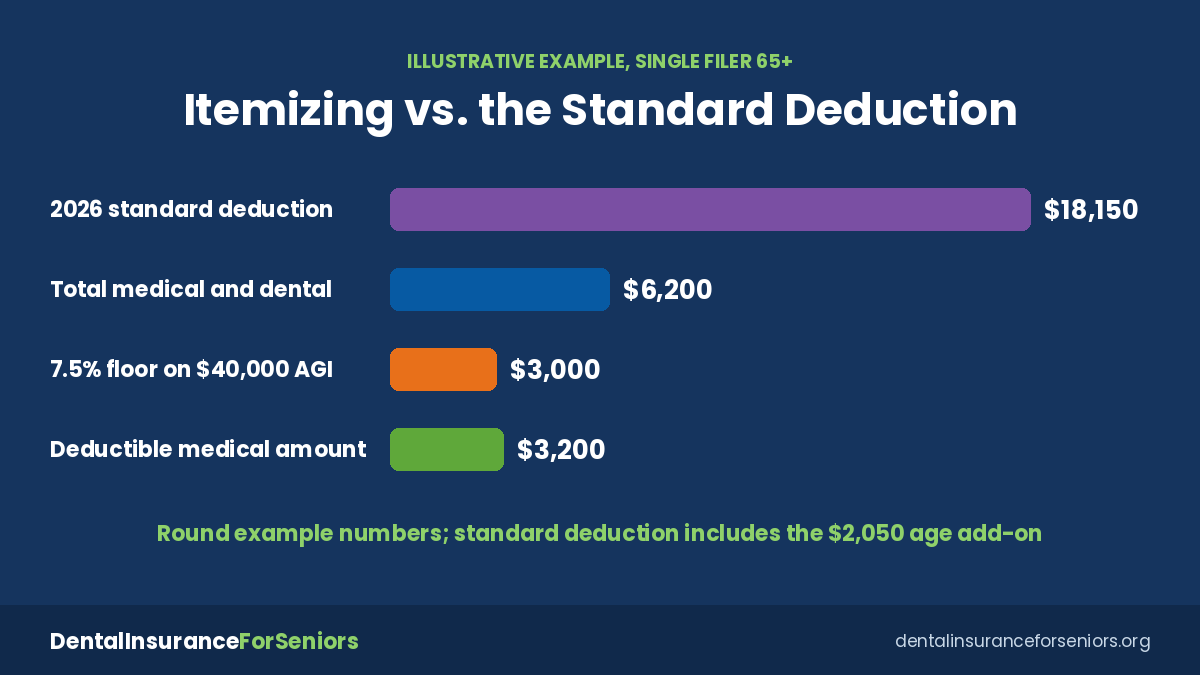
Start with income. A single retiree has an adjusted gross income of $40,000. Seven and a half percent of that is $3,000, the floor.

2

Total the year’s bills. Part B premiums at $202.90 a month come to about $2,435. Add a $45-a-month dental plan ($540), $2,800 for dentures and $425 for cleanings and a filling. Total: $6,200.

3

Subtract the floor. $6,200 minus $3,000 leaves $3,200 of medical and dental expense that could go on Schedule A.

4

Compare to the standard deduction. Itemizing only helps if all itemized deductions together beat the standard deduction, covered in the section after next.

Notice that the dental bills alone ($3,765) would barely clear the floor. Premiums are what push this retiree well past it.

Premiums Count Too: Dental Plans and Medicare Stack Up

For people on Medicare, premiums are often the larger number, and they go into the same pile as the dentist’s bill.

Premium you paySchedule A (if itemizing)Tax-free from an existing HSA at 65+
Stand-alone senior dental planYes, if paid with after-tax moneyUnclear; confirm with the HSA administrator
Medicare Part BYes (Pub. 502)Yes
Medicare Part DYes (Pub. 502)Yes
Medicare Advantage plan premiumGenerally treated as health insurance; confirm with a preparerYes
Medigap (Medicare Supplement)Generally treated as health insurance; confirm with a preparerNo, Medigap is excluded
Part A payroll tax withheld while workingNoNot applicable

Sources: IRS Publications 502 and 969. Premiums paid through an employer’s pre-tax payroll deduction cannot also be deducted.

Why this matters: A year of Part B premiums at the 2026 standard rate is roughly $2,435 per person. For a couple, that alone can cover much of the 7.5% floor before a single dental visit.

Why Many Seniors Still Take the Standard Deduction

Are dental expenses tax deductible example: medical deduction compared with the 2026 standard deduction for a single filer 65 or older

People 65 and older get a larger standard deduction, so the bar for itemizing is higher. In the example above, the $3,200 medical deduction would need about $14,950 of other itemized deductions, such as state taxes, mortgage interest or gifts to charity, just to match the standard amount.

Filing status2025 standard deduction with age add-on2026 standard deduction with age add-on
Single, 65 or older$15,750 + $2,000 = $17,750$16,100 + $2,050 = $18,150
Married filing jointly, both 65+$31,500 + $3,200 = $34,700$32,200 + $3,300 = $35,500

IRS figures. The married add-on is $1,600 (2025) or $1,650 (2026) for each spouse 65 or older.

The new senior deduction. For tax years 2025 through 2028, the IRS lists an added $6,000 deduction for each person 65 or older, or $12,000 for a couple if both qualify.

It applies either way. This deduction is claimed whether you itemize or not, so it does not change which choice is better. It phases out above $75,000 of modified adjusted gross income, or $150,000 for joint filers.

When itemizing wins. A year with a full denture or implant job plus high premiums can tip the math.

Find & Compare Plans Online

Speak with a licensed insurance agent

1-855-425-2095TTY 711

Mon-Fri: 8am-9pm ET

Other Routes to a Tax Break on Dental Costs

Some of these work even for retirees who never itemize.

Health savings account money. Deposits stop once you enroll in Medicare, but a balance saved earlier can still pay qualified dental work tax-free. It can also pay Part B, Part D and Medicare Advantage premiums after 65, though not Medigap. Expenses paid this way cannot also go on Schedule A.

Self-employed seniors. Part-time consultants and business owners may deduct medical, dental and vision insurance premiums, plus Medicare premiums paid voluntarily, on Form 7206 without itemizing, limited by business earnings. Months when you were eligible for an employer-subsidized plan do not count.

Retiree plan through a former employer. If dental premiums already come out before tax, they are not deductible a second time.

For paying a large balance over time, see dental implant financing.

Timing a Big Dental Job and Keeping the Paperwork

The IRS counts expenses in the year you pay them. Because the 7.5% floor resets every January, bunching large bills into one calendar year can turn a worthless deduction into a real one.

1

Ask for the full treatment plan. Extractions, bone grafts, implants and the final teeth can run over many months. Phase prices are in how much dental implants cost.

2

Look at where the payments land. If most of the work is paid in one year, the deduction may be worth more than splitting it across two.

3

Do not prepay future care. Paying ahead for treatment not yet provided generally does not count for this year.

4

Keep a folder. Save itemized dental receipts, plan statements showing what was reimbursed, and the Social Security or Medicare notice showing premiums. The IRS says to keep records, not to send them with the return.

Not tax advice: Tax rules change and personal situations differ. Check with a tax professional or IRS Publication 502 before deciding to itemize or reschedule care.

Bottom Line

Dental work that treats or prevents disease, along with dental and Medicare premiums, can be tax deductible, but only for those who itemize and only above 7.5% of income. Most seniors take the larger standard deduction, so the break usually matters in a year with major work. A dental plan lowers the bill directly, and its premium still counts if you itemize; compare dental plans for seniors on Medicare.

See dental plan rates for seniors in your ZIP code

Dental Expense Tax Deductions — Frequently Asked Questions

➤ Can I deduct my dentures on my taxes?

Yes, Publication 502 names artificial teeth as a medical expense. The cost joins your other medical bills and counts only if you itemize and the total exceeds 7.5% of AGI.

➤ Are senior dental insurance premiums deductible?

Premiums you pay yourself with after-tax money count as medical expenses on Schedule A. Premiums taken out of a paycheck or pension before tax do not.

➤ Does the Medicare Part B premium count toward the 7.5% threshold?

Yes, Part B premiums are a medical expense under IRS rules, and so are Part D premiums. They are added to dental bills in the same total.

➤ What if my dental plan paid part of the bill?

Only your share counts. Anything the plan or another source reimbursed is left out.

➤ Is the $6,000 senior deduction only for people who itemize?

No, it is available whether you itemize or take the standard deduction, for tax years 2025 through 2028. Higher incomes see it reduced or eliminated.

➤ Can I deduct a parent’s dental bills?

Possibly, if the parent qualifies as your dependent for medical expense purposes and you paid the bills. A tax preparer can confirm.

➤ Are cosmetic veneers or whitening deductible?

Whitening is excluded, and work done only for appearance is generally treated as cosmetic. Restorative work that fixes damage or disease is a different matter.

➤ Should I delay dental work to get a bigger deduction?

Do not put off needed care for taxes. When timing is flexible, paying for a multi-stage job within one calendar year can help clear the floor.

Senior Dental Insurance Quotes

Call a Licensed Agent Now

Compare dental plans for seniors and people on Medicare from several insurance companies in one call.

☎ 1-855-425-2095

TTY users 711  |  Mon–Fri: 8am–9pm ET

No obligation to enroll

Find & Compare Plans Online

Speak with a licensed insurance agent

1-855-425-2095TTY 711

Mon-Fri: 8am-9pm ET

ZRN Health & Financial Services, LLC, a Texas limited liability company