


Mini Dental Implants Cost for Seniors: Per Post, Per Lower Denture and What Plans Pay

Reviewed by Russell Noga, Licensed Insurance Broker — Last updated November 11, 2026

Mini dental implants cost about $500 to $1,500 per post, and a set of four minis to steady a loose lower denture usually runs about $3,000 to $5,000 per arch before insurance. That is often less than half the price of a standard implant overdenture, but minis tend to have a shorter service life, and many senior dental plans pay little toward them.

2027 by the Numbers

$500-$1,500

per mini implant post (The Senior List, RealDentalCosts)

$3K-$5K

four minis to hold one lower denture (RealDentalCosts)

$425-$1,389

lowest and highest state average negotiated rate for code D6013 (PayorMap, CMS data)

Mini dental implants are thin, one-piece titanium posts, generally under 3 millimeters wide, roughly half the width of a standard implant. For an older adult whose lower denture rocks and slides, a dentist may suggest placing a few of them so the denture snaps on and stays put.

This guide sticks to the mini version: the price of each post, the cost of a lower-denture set with and without a new denture, how long minis tend to last next to standard implants, and the insurance code that decides whether a plan pays. For the price of regular-width implants, see our guide to how much dental implants cost.
Compare Senior Dental Plans That Help With Implants

What Mini Dental Implants Cost Before Insurance

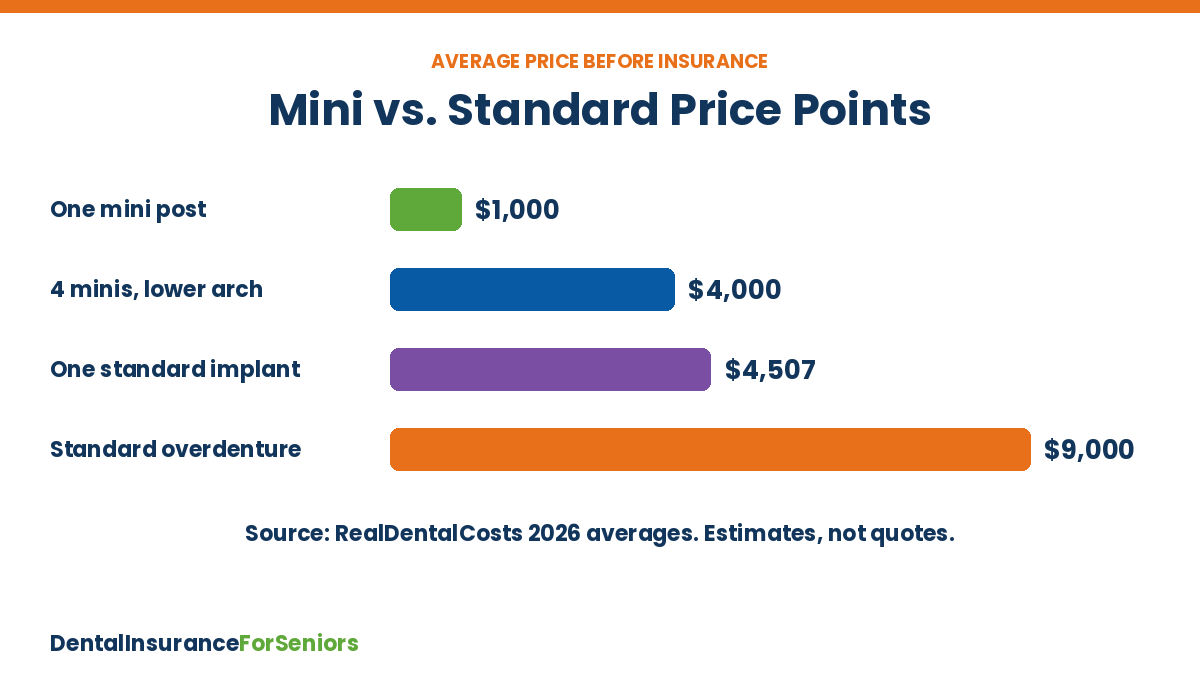
Mini dental implants cost chart comparing one mini post, four minis for a lower denture, one standard implant and a standard overdenture

Mini implants are priced by the post, but most seniors buy them as a set. The figures below are national estimates from independent price guides, not quotes. Your dentist’s fee depends on your area, scans, and whether the denture is new or reused.

What you are buyingTypical rangeSource
One mini implant post$500 to $1,500 (about $1,000 average)RealDentalCosts; The Senior List
One mini post placed by a dental office$500 to $1,200CDA Dentist 2026 price guide
Four minis to stabilize a lower denture$3,000 to $5,000 per arch (about $4,000 average)RealDentalCosts
Full denture stabilization, 4 or more minis$2,500 to $5,000+CDA Dentist 2026 price guide
Mini system for one arch$2,000 to $5,000NewMouth

RealDentalCosts labels its per-implant figures an editorial estimate (2026 edition). Prices are before insurance and vary by office and state.

Ask whether a quote includes the denture. A set price for the minis alone can look low if a new denture, a reline or the metal housings inside the denture are billed separately.

Senior Dental Insurance Quotes

Call a Licensed Agent Now

Compare dental plans for seniors and people on Medicare from several insurance companies in one call.

☎ 1-855-425-2095

TTY users 711  |  Mon–Fri: 8am–9pm ET

No obligation to enroll

Why Seniors With a Loose Lower Denture Are Offered Minis

Lower dentures have less gum to grip than upper ones, so they are the most common reason an older patient asks about implants. Minis fill a specific gap between living with adhesive and paying for full-size implants.

Thin or shrunken jawbone. The Senior List notes minis may suit people with limited bone who want to avoid bone grafting. A graft is a separate charge, often several hundred to a few thousand dollars.

A smaller procedure. Minis are often placed through a small punch in the gum instead of a larger surgical opening, which can mean a shorter visit for someone with health concerns.

Teeth that snap in the same day. A Dentistry Today clinical article describes four minis in the front of the lower jaw being loaded right away, so the denture is held in place the day they go in.

Where minis fall short: The Senior List lists heavy tooth grinding and molar replacement as poor fits for minis. A 2017 systematic review of 24 studies also found failures far more common in the upper jaw than the lower jaw, so upper-denture cases deserve a second opinion.

Keep Your Current Denture or Buy a New One?

None of the top price guides prices this choice, yet it can swing the bill more than the minis themselves. A Dentistry Today clinical article describes the dentist first checking whether the existing lower denture can be adapted, and making a new one only if the old one is too worn or thin.

1

Denture check. The dentist looks at the fit, wear and thickness of the current denture to see if it can hold the metal housings.

2

Posts placed. The minis go into the front of the lower jaw, often four of them.

3

Retrofit in the chair. The denture is hollowed slightly over each post and the housings are set in with acrylic during the same visit.

4

Fit and follow-up. Bite and comfort are checked, and the small retentive inserts in the housings are adjusted over time.

If a new denture is needed, it is a second line on the bill. Our snap in dentures cost guide covers the full price of a new implant-held denture.

Mini vs. Standard Implants: Upfront Price and Service Life

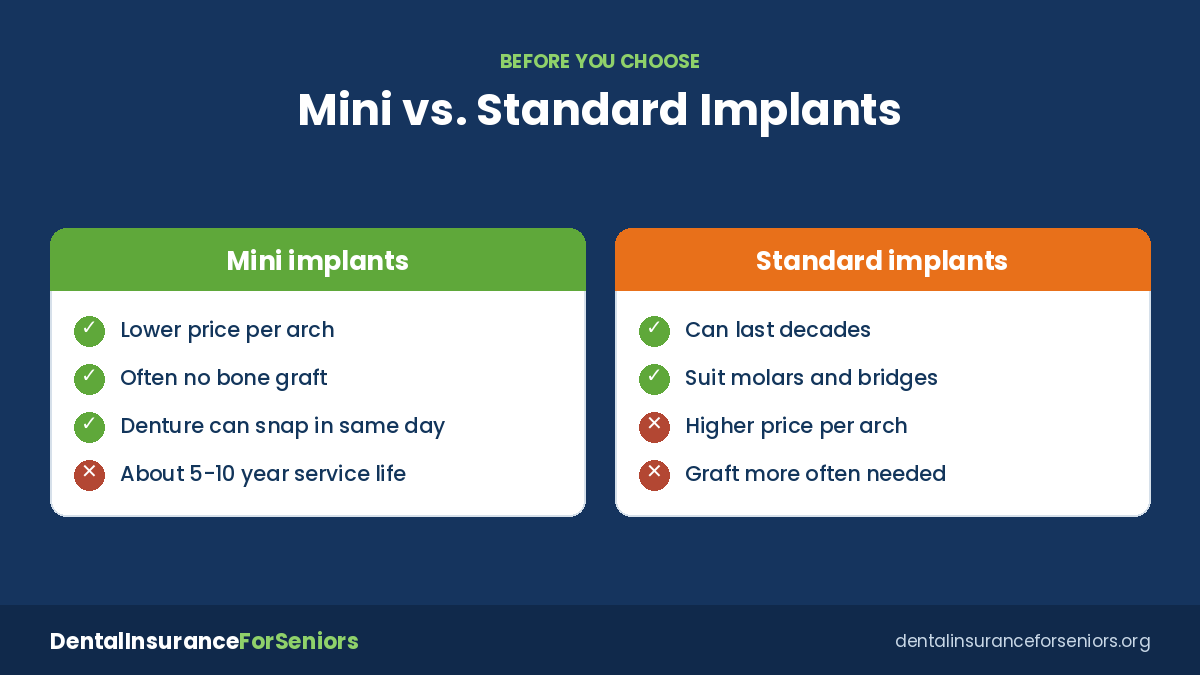
Mini dental implants cost and trade-offs compared with standard implants for seniors

Minis cost less on day one. The longer question is how many years each option buys, especially for someone in their late 60s or 70s weighing cost against the years ahead.

Point of comparisonMini implantsStandard implants
Post widthUnder 3 mm, one pieceAbout 3.5 to 6 mm, two piece
Lower overdenture, per archAbout $3,000 to $5,000About $6,000 to $13,000
Typical service life citedAbout 5 to 10 yearsOften decades, with care
Best suited forHolding a lower denture; small front teethSingle teeth, molars, fixed bridges

Sources: RealDentalCosts mini vs standard comparison (reviewed May 2026); The Senior List mini implant guide. Service life figures are estimates, not guarantees.

The research is shorter-term than the price guides suggest. A 2017 systematic review of 24 studies, covering 1,273 patients with an average age near 66, found a 92% survival rate for minis holding complete overdentures, but the average follow-up was only about two and a half years. If a mini fails, it is usually replaced on its own, which is another fee. For a broader look at the trade-offs, see dentures vs implants cost.

Find & Compare Plans Online

Speak with a licensed insurance agent

1-855-425-2095TTY 711

Mon-Fri: 8am-9pm ET

Code D6013: How Senior Dental Plans Treat Mini Implants

Dentists bill a mini implant under its own code, D6013 (surgical placement of a mini implant), added to the dental code set around 2015. Standard implants use D6010. That difference matters, because a plan’s implant benefit may list one code and not the other. We checked three carriers’ own plan documents for buyers who can purchase coverage on their own.

Plan documentImplant benefitWait and limitsIs D6013 named?
Physicians Mutual covered-procedures list (four options)D6010 at fixed dollar amounts, or 70% on the Premier option$1,000 lifetime cap on implants and implant servicesNot on the list
Delta Dental of Iowa Individual Preferred Prime (2027)60% in network12-month wait; once every 5 years; $1,000 yearly plan maximumNot named; implants described as surgically placed in the jawbone
Mutual of Omaha Dental Preferred outlineMajor services 20% at first, 50% after year oneNo major-service wait; $3,000 implant lifetime maximumNot named; some implants excluded as non-eligible

Sources: Physicians Mutual covered-procedures document (DNTL_PDF_CP04_0126); Delta Dental of Iowa policy form INDPREFPR012027; Mutual of Omaha Dental Preferred outline of coverage. Checked November 2026. Terms vary by state.

Before you sign: Ask the office for a pre-treatment estimate that lists D6013 by code, and send it to the plan. A written answer shows whether the minis count toward the implant benefit, fall under a lifetime cap, or are denied outright.

Federal price-transparency data gives a feel for what insurers agree to pay dentists for D6013. PayorMap’s state averages, drawn from CMS Transparency in Coverage files in March 2026, ran from $425 in Tennessee to $1,389 in Nevada per mini implant.

Medicare, Medicare Advantage and Other Ways to Pay Less

Original Medicare (Parts A and B) does not cover routine dental care, so it will not pay for mini implants placed to hold a denture. A Medicare Supplement plan follows the same rule.

Medicare Advantage dental. Some plans include dental benefits that may cover implants, but coverage, allowances and networks vary by plan and area. Read the Evidence of Coverage for implants, then see whether Medicare Advantage covers dental implants.

Discount plans. A dental savings plan does not pay claims, but it can lower the fee at participating offices with no waiting period. Compare dental discount plans for implant procedures.

Reuse the denture. If your current lower denture is in good shape, a chairside retrofit can save the cost of a new one.

Time the waiting period. If a plan has a 12-month implant wait, buying coverage a year ahead of treatment may be worth more than the premium.

Bottom Line

Mini dental implants cost most seniors about $500 to $1,500 per post, or roughly $3,000 to $5,000 to steady one lower denture, well below a standard implant overdenture. The trade-off is a shorter expected service life and thinner long-term research. Ask for a quote that shows the D6013 code and the denture line, and get a pre-treatment estimate from your plan before treatment begins.

Check implant benefits on dental plans in your ZIP code

Mini Dental Implants Cost — Frequently Asked Questions

➤ How many mini implants does a lower denture usually need?

Four is common for a complete lower denture, placed in the front of the jaw. Your dentist decides the number based on your bone and bite.

➤ Is it cheaper to put minis under the denture I already have?

Often, yes. When the existing denture is in good shape, the dentist can set the metal housings into it at the same visit, so you avoid paying for a new denture.

➤ Are mini implants worth it for someone in their late 70s?

They can be, because the procedure is smaller and costs less upfront. Price guides cite a service life of about 5 to 10 years, which some families weigh against age and health.

➤ Why might a dental plan pay for regular implants but not minis?

Minis are billed under code D6013, while standard implants use D6010. Some plan lists name D6010 without D6013, so a pre-treatment estimate is the safest check.

➤ Do mini implants work for an upper denture?

Sometimes, but the evidence is weaker. A 2017 systematic review found failures far more common in the upper jaw than the lower jaw.

➤ What happens if one mini implant fails?

It is usually removed and replaced on its own, which adds a new fee. Ask how the office prices a replacement post before you start.

➤ Will Original Medicare pay for mini dental implants?

No. Original Medicare does not cover routine dental care, implants or dentures. Some Medicare Advantage plans include dental benefits that vary by plan.

➤ Do I need a bone graft before mini implants?

Often not, which is a main reason minis are offered to seniors with thin bone. If your dentist still recommends a graft, ask for that fee as its own line.

Senior Dental Insurance Quotes

Call a Licensed Agent Now

Compare dental plans for seniors and people on Medicare from several insurance companies in one call.

☎ 1-855-425-2095

TTY users 711  |  Mon–Fri: 8am–9pm ET

No obligation to enroll

Find & Compare Plans Online

Speak with a licensed insurance agent

1-855-425-2095TTY 711

Mon-Fri: 8am-9pm ET

ZRN Health & Financial Services, LLC, a Texas limited liability company