



Dental Crown Cost for Seniors: Prices by Material and What Plans Really Pay

Reviewed by Russell Noga, Licensed Insurance Broker — Last updated November 9, 2026

A dental crown costs about $697 to $1,399 on average without insurance, depending on the material, with full ranges from $488 to $3,254 per tooth, according to CareCredit’s 2024 cost study. With a senior dental plan that pays crowns as major care at 50% after the waiting period, a typical porcelain crown leaves roughly $700 to $750 for you to pay, while Original Medicare pays nothing toward a routine crown.

2027 by the Numbers

$697-$1,399

average crown price, resin to porcelain, before insurance (CareCredit 2024 study)

$1,100-$2,000

typical out-of-network permanent crown (Delta Dental 2023 data)

59%

of capped Medicare Advantage enrollees with extensive dental had a $1,000-or-less yearly limit (KFF, 2021 plans)

A crown is a tooth-shaped cap cemented over a tooth that is cracked, worn, heavily filled or weakened by a root canal. After 65, the bill often arrives just as work-based dental coverage ends.

Below, crowns are priced by material and run through four senior plans’ published rules. Comparing coverage instead? See dental insurance that covers crowns.
Compare Senior Dental Plans That Help Pay for Crowns

Crown Prices by Material, From Resin to Porcelain

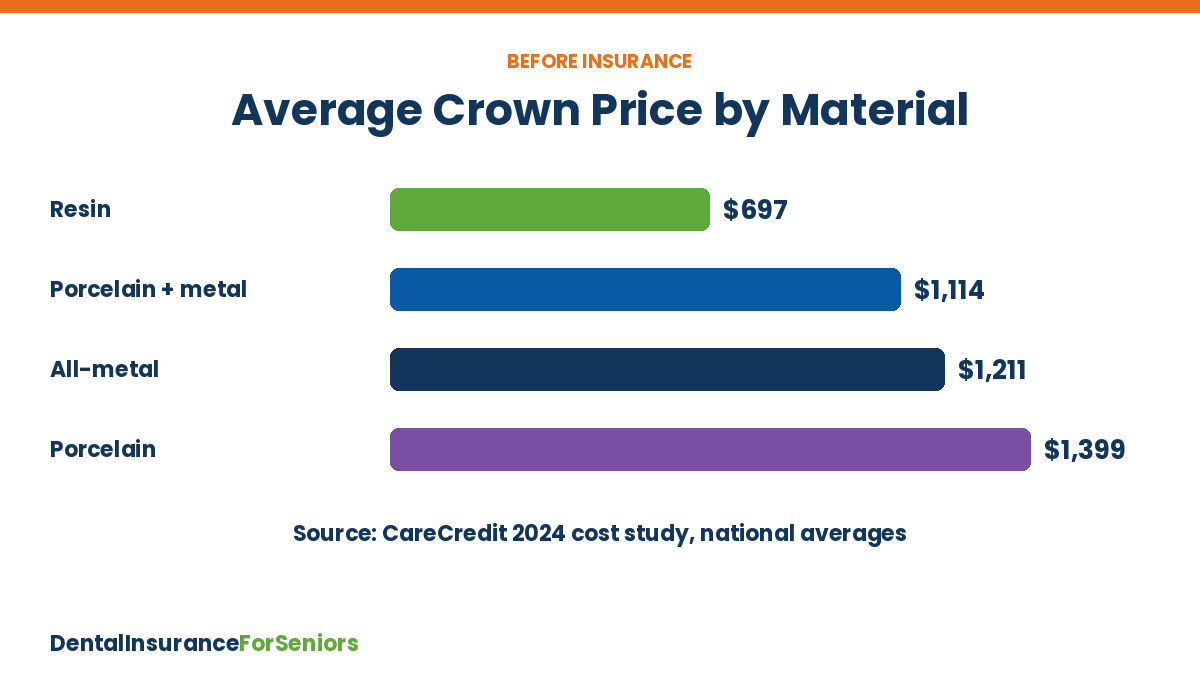
Dental crown cost by material: average price of resin, porcelain-fused-to-metal, all-metal and porcelain crowns before insurance

Material drives the fee. Resin is cheapest and least durable, metal holds up on back teeth, and porcelain looks most natural. Figures come from the 2024 Synchrony Average Procedural Cost Study published by CareCredit.

Crown materialNational averageTypical range
Resin (often a temporary crown)$697$488 to $1,593
Porcelain fused to non-gold metal$1,114$770 to $2,454
All-metal$1,211$821 to $2,861
Porcelain$1,399$915 to $3,254

Source: CareCredit, 2024 Synchrony Average Procedural Cost Study (ASQ360 Market Research). Prices are per tooth before insurance and exclude the first exam, extractions and follow-up visits.

Zirconia and all-ceramic. GoodRx, citing Authority Dental, lists these at $1,000 to $2,500, averaging near $1,300.

Out-of-network fees run high. Delta Dental’s 2023 data puts a permanent crown from an out-of-network dentist at $1,100 to $2,000.

Senior Dental Insurance Quotes

Call a Licensed Agent Now

Compare dental plans for seniors and people on Medicare from several insurance companies in one call.

☎ 1-855-425-2095

TTY users 711  |  Mon–Fri: 8am–9pm ET

No obligation to enroll

How Four Senior Dental Plans Treat a Crown

Brochures say crowns are covered but rarely show the three rules that set the bill: the wait, the plan’s share and the yearly cap. This table pulls them from each carrier’s own summary for plans a person on Medicare can buy alone.

Plan (as published)Wait for crownsPlan pays for crownsYearly maximum
Cigna Dental 100012 months; may be waived with 12+ months of prior major coverage50% after a $50 deductible$1,000
Humana Extend 50006 months50% in year one, 60% from year two, after a $75 deductible$5,000
Ameritas PrimeStar CompleteNone20% in network in year one, 50% after year one$2,500 in year one, $3,000 after
Spirit Dental (PPO plans)NoneCoinsurance rises each year up to year three; $100 lifetime deductible$1,200 to $5,000, by plan and year

Sources: Cigna Dental 1000 broker flyer and summary of benefits; Humana Extend 5000 summary; Ameritas PrimeStar brochure; Spirit Dental crown coverage page. Checked November 2026. Terms vary by state, so confirm your state’s version.

Plan-document check: A no-wait plan can still pay little in the first year. Ameritas PrimeStar Complete covers crowns from day one, but at 20% in network until the policy’s second year. A plan with a waiting period may pay more per crown once the wait ends.

One $1,399 Porcelain Crown, Six Ways to Pay

The table runs one porcelain crown at CareCredit’s $1,399 average through each plan, assuming no other claims that year. In-network fees are often lower than the national average.

SituationPlan paysYou pay
No dental coverage$0$1,399
Cigna Dental 1000, inside the 12-month wait$0$1,399
Ameritas PrimeStar Complete, year one (20%)$269.80$1,129.20
Humana Extend 5000, after 6 months, year one (50%)$662$737
Cigna Dental 1000, after the wait (50%)$674.50$724.50
Humana Extend 5000, year two (60%)$794.40$604.60

Our calculation: (fee minus deductible) x plan share. Example: ($1,399 – $50) x 50% = $674.50. Premiums are not included.

Cap math: On Cigna Dental 1000, one crown uses $674.50 of the $1,000 yearly maximum. A second crown the same year would be capped at the remaining $325.50, so two crowns would cost about $1,798 out of pocket instead of $1,449. See how annual maximums in dental insurance reset each plan year.

Medicare, Medicare Advantage and the Crown Bill

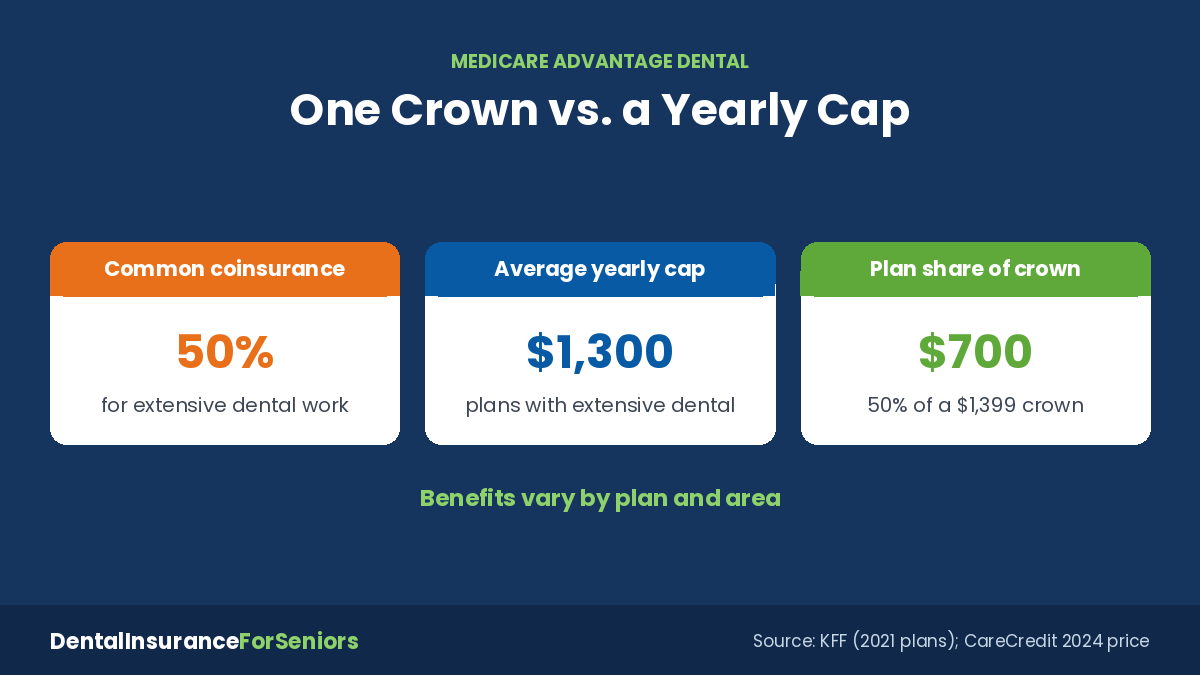
Dental crown cost and Medicare Advantage: KFF figures on dental coinsurance and yearly limits compared with one porcelain crown

Medicare.gov says that in most cases Medicare does not cover dental services such as cleanings, fillings and extractions, and a crown for a decayed or cracked tooth is routine care. Original Medicare helps only when dental work is tied to certain covered medical care, such as clearing a mouth infection before heart valve surgery, a transplant or cancer treatment.

Many Medicare Advantage plans include dental benefits, but crown coverage varies by plan and area. KFF’s review of 2021 plans found 50% was the most common coinsurance for extensive dental work, and the average yearly limit was about $1,300. Compare Medicare Advantage dental plans.

Look for the word crowns. Some plans cover only exams and cleanings; others list crowns under comprehensive dental.

Find the dental cap. KFF found 59% of capped enrollees with extensive benefits had a limit of $1,000 or less. One porcelain crown at 50% uses about 70% of that.

Find & Compare Plans Online

Speak with a licensed insurance agent

1-855-425-2095TTY 711

Mon-Fri: 8am-9pm ET

Replacement Limits and Crowns After a Root Canal

Many seniors are replacing a crown placed decades ago. CareCredit says a crown lasts about 10 years on average with good care. Plans limit how often they pay for a new one, and the clock may run from the old crown’s placement date.

Humana Extend 5000. Ceramic crowns: once per tooth every five years.

Cigna Dental 1000. One crown per tooth per 84 months, and only when decay or fracture rules out a filling.

Spirit Dental. Generally no replacement within five years of the last placement, unless an accidental injury while covered caused it.

Least costly alternative. Spirit’s terms pay for the cheaper treatment when more than one would fix a tooth; other plans may do the same.

After a root canal, back teeth usually need a crown because the treated tooth breaks more easily, and the two are billed as separate claims. For the combined bill, see root canal cost with insurance.

Ways to Lower Crown Costs on a Fixed Income

When the dentist says the tooth can safely wait a few weeks, these steps can trim the bill.

1

Request a pre-treatment estimate. The insurer’s reply shows what it expects to pay and flags waits, frequency limits or a cheaper-material rule.

2

Ask about the material. A metal or porcelain-fused-to-metal crown on a back molar usually costs less than all-porcelain.

3

Try a dental school clinic. NIDCR says these clinics often charge reduced fees, with students closely supervised by licensed dentists.

4

Price a discount plan. It is not insurance, but it lowers fees at member dentists, often with no wait or yearly cap. Compare discount dental plans for seniors.

5

Phase the work across plan years. If several teeth need crowns, ask whether one can wait until January, when the yearly maximum resets.

Before you sign: Ask whether the quote includes the core buildup, temporary crown and X-rays, which some offices bill separately. Adult children reviewing a parent’s estimate can request each fee in writing.

Bottom Line

A crown usually costs $697 to $1,399 before insurance, and a senior dental plan that pays major care at 50% can cut a porcelain crown to about $700 once its wait is over. Original Medicare will not help, and a low yearly cap or a replacement limit can matter more than the percentage, so get a pre-treatment estimate before booking.

Check crown coverage and plan prices for your ZIP code

Dental Crown Cost — Frequently Asked Questions

➤ What is the cheapest type of dental crown?

Resin, averaging $697 in CareCredit’s 2024 study, but it wears faster and is often used as a temporary crown.

➤ How much is a porcelain crown without insurance?

CareCredit’s 2024 study puts the national average at $1,399, with a range of $915 to $3,254.

➤ Can I buy dental insurance and get a crown right away?

Ameritas PrimeStar and Spirit Dental list no waiting period, but may pay a lower share in year one. Cigna Dental 1000 makes you wait 12 months.

➤ Does Medicare Part B pay for a crown?

No. Original Medicare does not cover routine dental work such as crowns. Some Medicare Advantage plans do, with rules that vary by plan and area.

➤ Why did my plan pay less than half for my crown?

A deductible, a lower first-year share or a cheaper-material rule can each cut the payment. Plans may also pay from their own fee schedule.

➤ How often will insurance replace a crown?

Often only after five to seven years. Humana Extend 5000 uses five years; Cigna Dental 1000 uses 84 months.

➤ Is a crown worth it compared with pulling the tooth?

Pulling costs less at first, but replacing the missing tooth later usually costs much more. Ask your dentist about each option.

➤ Will a dental school charge less for a crown?

Often. NIDCR says dental school clinics offer reduced-cost care under licensed dentist supervision, though it can take more visits.

Senior Dental Insurance Quotes

Call a Licensed Agent Now

Compare dental plans for seniors and people on Medicare from several insurance companies in one call.

☎ 1-855-425-2095

TTY users 711  |  Mon–Fri: 8am–9pm ET

No obligation to enroll

Find & Compare Plans Online

Speak with a licensed insurance agent

1-855-425-2095TTY 711

Mon-Fri: 8am-9pm ET

ZRN Health & Financial Services, LLC, a Texas limited liability company