



Dental Filling Cost for Seniors: Silver, White and Glass Ionomer Prices

Reviewed by Russell Noga, Licensed Insurance Broker — Last updated November 5, 2026

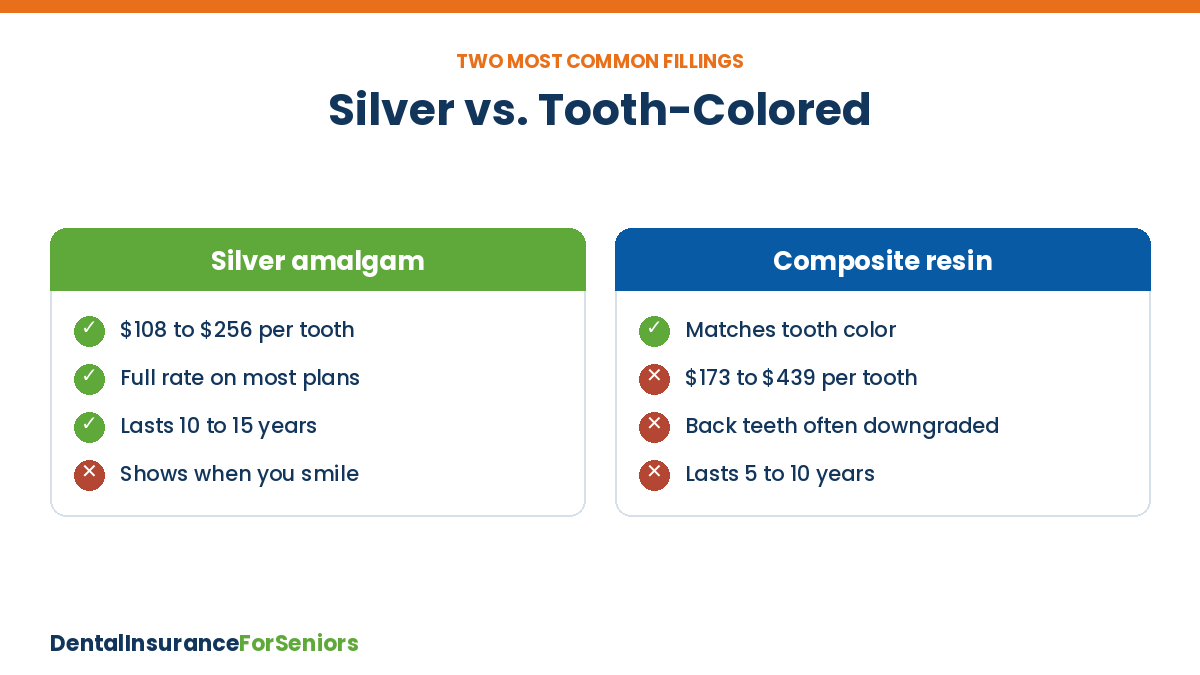
A dental filling costs about $108 to $256 for silver amalgam and $173 to $439 for a tooth-colored composite without insurance, with a national composite average of $226, according to CareCredit. With a dental plan that pays fillings at 80% after the deductible, a senior often pays roughly $45 to $140 per tooth, depending on the deductible and whether the plan pays a back-tooth white filling only at the silver rate.

2027 by the Numbers

$226

national average composite filling before insurance (CareCredit)

96%

of adults 65 and older have had tooth decay (NIDCR, 2011-2016)

12.5%

of seniors had untreated decay in 2017-March 2020 (NIDCR)

Cavities do not stop at retirement. Gums pull back with age, roots get exposed and many daily medicines dry the mouth, so a person on Medicare can face a filling bill after work-based dental coverage has ended.

Below, filling prices are broken out by material, size and tooth, then run through real plan rules. If a cavity is deep enough to need a cap, see dental insurance that covers crowns.
Compare Senior Dental Plans That Pay for Fillings

Filling Prices by Material: Three Price Sources Compared

Dental filling cost for seniors compared: silver amalgam versus tooth-colored composite price, look and insurance treatment

No single source lists every filling type the same way, so we placed three national price sources in one table: CareCredit (a 2024 ASQ360 cost study), Delta Dental (its 2024 claims data from out-of-network dentists) and GoodRx (an average for each material).

Filling materialCareCredit (range)Delta Dental (range)GoodRx (average)
Silver amalgam$108 to $256$110 to $455, by surfaces$160
Tooth-colored composite$173 to $439 (average $226)$145 to $480 front; $165 to $530 back$191
Glass ionomer$116 to $285Not listedNot listed
Gold$361 to $817Not listed$400
Porcelain$755 to $1,774Not listed$1,150

Compiled November 2026 from CareCredit (2024 Synchrony Average Procedural Cost Study), Delta Dental (2024 internal data) and GoodRx. Prices are per tooth before insurance; in-network fees are often lower.

Senior Dental Insurance Quotes

Call a Licensed Agent Now

Compare dental plans for seniors and people on Medicare from several insurance companies in one call.

☎ 1-855-425-2095

TTY users 711  |  Mon–Fri: 8am–9pm ET

No obligation to enroll

Surfaces, Front Teeth and Back Teeth: What Moves the Price

A tooth has five surfaces a dentist can fill, and each extra surface means more drilling, material and chair time. The procedure code on your estimate shows the surface count and tells the insurer which tooth was treated. X-rays and the exam may appear as separate lines.

Silver codes D2140 to D2161. These cover amalgam on one, two, three, or four or more surfaces. The four-surface code costs the most.

Front white codes D2330 to D2335. These cover composite resin on incisors and canines, where looks matter most and many plans pay the full composite rate.

Back white codes D2391 to D2394. These cover composite on premolars and molars. Plans often treat these codes differently, as the next section explains.

Delta Dental’s back-tooth premium. Its published composite range runs $165 to $530 for back teeth, versus $145 to $480 for front teeth.

What Individual Dental Plans Pay Toward a Filling

Fillings usually sit in the basic tier, which many plans pay at 70% to 80% after the deductible. Waits and white-filling rules are buried in each plan summary. Here are three plans a retiree can buy on their own.

Plan (as published)Plan pays for fillingsWait for fillingsFine print
Humana Extend 5000 PPO80% after a $75 deductible90 daysComposite covered on front teeth only; one filling per tooth per two years; $5,000 yearly max
Cigna Dental 100080% after a $50 deductibleSummary says waits may applyOne filling per 12 months on the same surfaces; $1,000 yearly max
Physicians Mutual (Economy to Premier)25%, 40%, 55% or 70%, by plan levelNone listedLower levels pay set dollar amounts; percentages are averages

Sources: Humana Extend 5000, Cigna Dental 1000 and Physicians Mutual plan summaries, checked November 2026. Terms vary by state.

Downgrade clause: Many plans have an alternate benefit rule that pays a back-tooth composite as if it were a silver filling, and the patient generally owes the difference. Dental billing firm eAssist calls this one of the most common downgrades.

Back-tooth white filling, $226 feePlan paysYou pay
No dental coverage, or still inside the waiting period$0$226
80% plan, deductible already met, full composite rate$180.80$45.20
80% plan, deductible met, paid at a $160 silver rate$128$98
Same downgrade, $50 deductible not yet met$88$138

Our math using the CareCredit composite average ($226) and GoodRx amalgam average ($160): ($160 – $50) x 80% = $88.

When a Cavity Outgrows a Filling

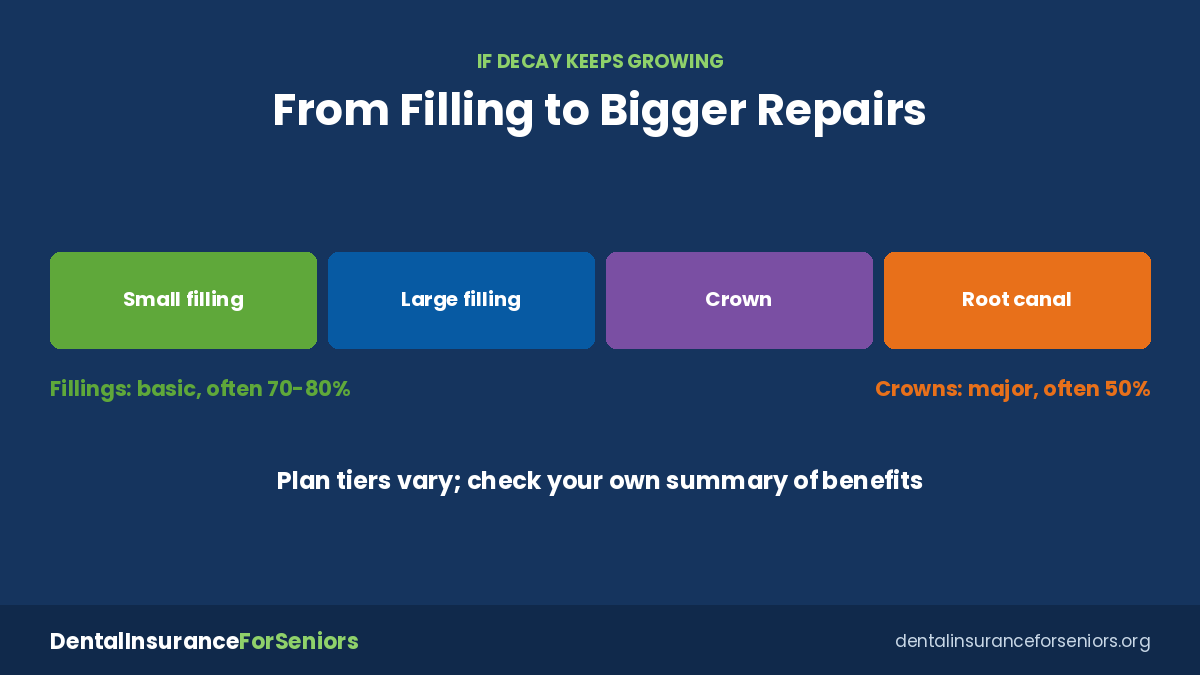
Dental filling cost rises as decay grows: small filling, large filling, crown, then root canal

A filling is the cheapest repair for decay. If a cavity keeps growing, each next step costs more and is often paid at a lower plan tier.

1

Small to medium cavity. A one- or two-surface filling usually fixes it in one visit.

2

Large decay or a cracked cusp. When too little tooth is left to hold a filling, a dentist may suggest a crown, which many plans pay as major care, often at 50%.

3

Decay that reaches the nerve. Pain, swelling or lasting sensitivity can mean the pulp is infected. Coverage for that step is covered in dental insurance that covers root canals.

Old fillings wear out too. Aspen Dental puts typical filling life at 10 to 15 years for amalgam and 5 to 10 years for composite, so many seniors pay to replace work done decades ago.

Find & Compare Plans Online

Speak with a licensed insurance agent

1-855-425-2095TTY 711

Mon-Fri: 8am-9pm ET

Why Older Adults Often Need More Fillings

NIDCR reports that 96% of adults 65 and older have had decay in their permanent teeth. Two age-related changes keep new cavities coming, even for people who brush well.

Exposed roots. Gum recession and past gum disease uncover root surfaces. Root dentin has less mineral than enamel and starts to dissolve at a milder acid level, so decay can start near the gumline.

Dry mouth from medicines. The National Institute on Aging notes that drugs for high blood pressure, depression and bladder control often cause dry mouth, and less saliva raises cavity risk. Taking several medicines at once makes it more likely.

Ask about the material: Glass ionomer releases fluoride and is often used for root-surface cavities near the gumline. CareCredit lists it at $116 to $285, but it can wear faster on chewing surfaces. See dental care tips for dry mouth.

Medicare, Medicare Advantage and Other Ways to Pay

Medicare.gov states that Original Medicare does not cover dental services such as cleanings, fillings and extractions. It pays only for dental care tied to certain covered medical treatment, such as clearing a mouth infection before heart valve surgery or chemotherapy.

1

Check a Medicare Advantage plan’s dental terms. Many plans include dental benefits, but what they pay for fillings varies by plan and area. Some cover only exams and cleanings; others add fillings with a copay or yearly cap.

2

Buy a stand-alone plan before you need it. A plan with a short or no wait for basic care helps most when bought early. Compare dental plan waiting periods before you enroll.

3

Price a discount plan. A discount plan is not insurance, but it can lower fees at member dentists, usually without a wait or a yearly cap. See discount dental plans for seniors.

4

Ask for silver or glass ionomer on a back tooth. If your plan downgrades back-tooth composites, a covered material may cost less. Ask which option suits the tooth.

5

Spread several fillings across plan years. If several cavities are not urgent, splitting visits between December and January can draw on two yearly maximums.

Bottom Line

A filling usually costs about $108 to $439 before insurance, and a plan paying basic care at 80% can bring that under $150. Watch the waiting period, the back-tooth downgrade rule and Original Medicare’s gap, and treat small cavities before they need crowns or root canals.

Related: dental bonding cost Per-tooth bonding prices, the repair vs cosmetic codes plans use and bonding vs veneer math for seniors.

Related: inlay and onlay cost Prices by material, the CDT codes and why a plan may pay only the filling rate for a large repair.

See filling coverage and plan prices in your ZIP code

Dental Filling Cost — Frequently Asked Questions

➤ How much does a cavity filling cost without insurance?

CareCredit’s 2024 study puts silver amalgam at $108 to $256 and tooth-colored composite at $173 to $439 per tooth. The national composite average is $226.

➤ Why did my plan pay less for a white filling on a molar?

Many plans pay back-tooth composites at the lower silver-filling rate under an alternate benefit clause. You usually owe the difference.

➤ Is a filling basic or major dental care?

Most plans list fillings as basic care, often paid at 70% to 80% after the deductible. Humana Extend 5000 and Cigna Dental 1000 both pay 80% after the deductible.

➤ Does Medicare pay for fillings?

No. Medicare.gov lists fillings among the dental services Original Medicare does not cover. Some Medicare Advantage plans include fillings, with terms that vary by plan and area.

➤ Is there a waiting period for fillings?

It depends on the plan. Humana Extend 5000 lists 90 days for fillings; Physicians Mutual lists none.

➤ Why do I get more cavities now than when I was younger?

Receding gums expose softer root surfaces, and many common medicines cause dry mouth, which raises the risk of decay.

➤ Will my plan pay to redo a filling that fell out?

Often, but with limits. Cigna Dental 1000 allows one filling per 12 months on the same surfaces, and Humana Extend 5000 allows one per tooth every two years.

➤ Is glass ionomer cheaper than a white filling?

Usually a bit. CareCredit lists glass ionomer at $116 to $285, versus $173 to $439 for composite.

Senior Dental Insurance Quotes

Call a Licensed Agent Now

Compare dental plans for seniors and people on Medicare from several insurance companies in one call.

☎ 1-855-425-2095

TTY users 711  |  Mon–Fri: 8am–9pm ET

No obligation to enroll

Find & Compare Plans Online

Speak with a licensed insurance agent

1-855-425-2095TTY 711

Mon-Fri: 8am-9pm ET

ZRN Health & Financial Services, LLC, a Texas limited liability company