



Fluoride Treatment Cost for Seniors: Varnish, SDF, Prescription Paste and Plan Rules

Reviewed by Russell Noga, Licensed Insurance Broker — Last updated November 21, 2026

An in-office fluoride treatment typically costs about $20 to $60 a visit without insurance, while silver diamine fluoride often runs $25 to $90 per tooth and a tube of prescription 5,000 ppm toothpaste about $15 to $35. Many dental plans pay for fluoride only for children, so adults over 65 often pay cash unless the plan covers high-risk adults.

2027 by the Numbers

$30 to $60

fluoride varnish per visit, before insurance (Real Dental Costs, 2026)

$25 to $90

silver diamine fluoride per tooth (Real Dental Costs, 2026)

96%

of seniors 65+ with teeth have had decay in permanent teeth (NIDCR, 2011-2016)

Fluoride is often thought of as a children’s treatment, yet the mouth after 65 can need it more. Gums pull back and expose soft root surfaces, and many daily medications reduce the saliva that normally washes acid away.

This guide prices each option, from painted-on varnish to a drop of silver diamine fluoride on one spot, and explains why a plan that paid for fluoride at age 12 may skip it at 70. Cleaning prices are in teeth cleaning cost, and what a cavity costs once it needs drilling is in dental filling cost.
Compare Senior Dental Plans That Cover Adult Fluoride

Fluoride Treatment Prices by Type and Dental Code

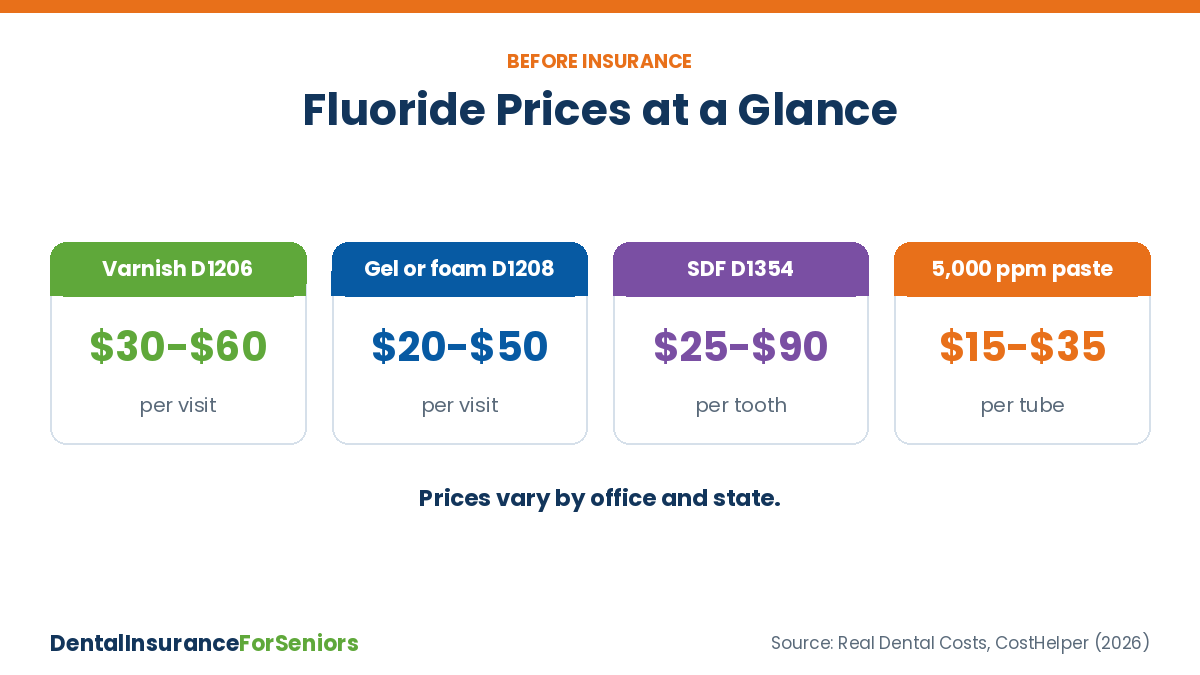
Fluoride treatment cost ranges for seniors: varnish, gel or foam, silver diamine fluoride and prescription toothpaste

Dentists bill fluoride under CDT codes, and the code on the claim decides how a plan pays it. Varnish has its own code, gels and foams share another, and silver diamine fluoride is usually billed per tooth. Cash ranges come from consumer cost guides; local fees vary.

TreatmentCDT codeTypical cash priceHow it is billed
Fluoride varnish (5% sodium fluoride)D1206About $30 to $60 (Real Dental Costs)Per visit, usually right after a cleaning
Fluoride gel or foam in traysD1208About $20 to $50 (CostHelper)Per visit
Silver diamine fluoride (SDF)D1354About $25 to $90 per tooth (Real Dental Costs)Per tooth treated
Prescription 5,000 ppm toothpasteNone (pharmacy item)About $15 to $35 a tube (Real Dental Costs); GoodRx lists coupon prices near $11 to $20 for PreviDent 5000 PlusFilled at a pharmacy with a dentist’s prescription

Codes per DentistryIQ’s adult fluoride coding guide. D1354 is described as conservative treatment of an active, nonsymptomatic cavity, so it applies to SDF and similar agents. Prices checked November 2026 and vary by office and state.

Price check: One Pennsylvania practice cited by CostHelper charges $35 for an adult treatment. Some offices fold fluoride into the cleaning fee, so ask before the visit.

Senior Dental Insurance Quotes

Call a Licensed Agent Now

Compare dental plans for seniors and people on Medicare from several insurance companies in one call.

☎ 1-855-425-2095

TTY users 711  |  Mon–Fri: 8am–9pm ET

No obligation to enroll

Why Root Surfaces Decay After 65

When gums recede, the root is exposed, and its covering is softer than enamel. Real Dental Costs notes that root surfaces decay several times faster than enamel, and these cavities often sit at the gumline, where they are hard to clean and fill.

Gum recession. Years of brushing, past gum disease and bone loss expose roots. Habits that slow it are covered in how seniors can prevent gum disease.

Medication dry mouth. Many common medications reduce saliva, and saliva is the mouth’s natural defense against acid. UnitedHealthcare’s 2026 dental policy lists dry mouth (xerostomia) as a situation where fluoride varnish is preferred.

Edges of old fillings and crowns. Decades-old restorations can leak at the margins, giving decay a start next to the gumline.

By the numbers: The National Institute of Dental and Craniofacial Research reports that 96% of seniors with teeth have had decay in their permanent teeth, and about 12.5% had untreated decay in the 2017 to March 2020 survey.

Varnish, Gel, Prescription Paste or SDF: Which Fits Which Need

The four options do different jobs. Varnish and gel strengthen surfaces before a cavity forms, prescription paste adds a daily dose at home, and SDF is used to stop a cavity that has already started.

OptionWhat it doesTypical priceHow plans usually treat it for adults
Varnish (D1206)Sticky coating painted on teeth; sets on contact with salivaAbout $30 to $60 a visitOften limited by age; some plans cover adults, often once a year, or adults at elevated risk
Gel or foam (D1208)Held in trays for a few minutesAbout $20 to $50 a visitSame age and frequency limits as varnish on many plans
5,000 ppm toothpasteDaily high-strength paste used at home in place of regular toothpasteAbout $15 to $35 a tubeNot a dental plan benefit; a pharmacy item that some Part D plans may list
Silver diamine fluoride (D1354)Liquid that can stop an active cavity without drilling; turns the decayed spot blackAbout $25 to $90 per toothVaries widely; some plans cover it, others do not; check the code

Prices: Real Dental Costs and CostHelper. Plan treatment summarized from DentistryIQ, Delta Dental and UnitedHealthcare provider materials; your plan’s own schedule governs.

SDF trade-off. The ADA says SDF permanently stains the treated decay black, which matters on front teeth but often less on a back root.

SDF evidence for older adults. The ADA notes SDF has shown results against root decay in the elderly. The FDA cleared it for tooth sensitivity, so using it on decay is off-label.

How Dental Plans Handle Fluoride Once You Are an Adult

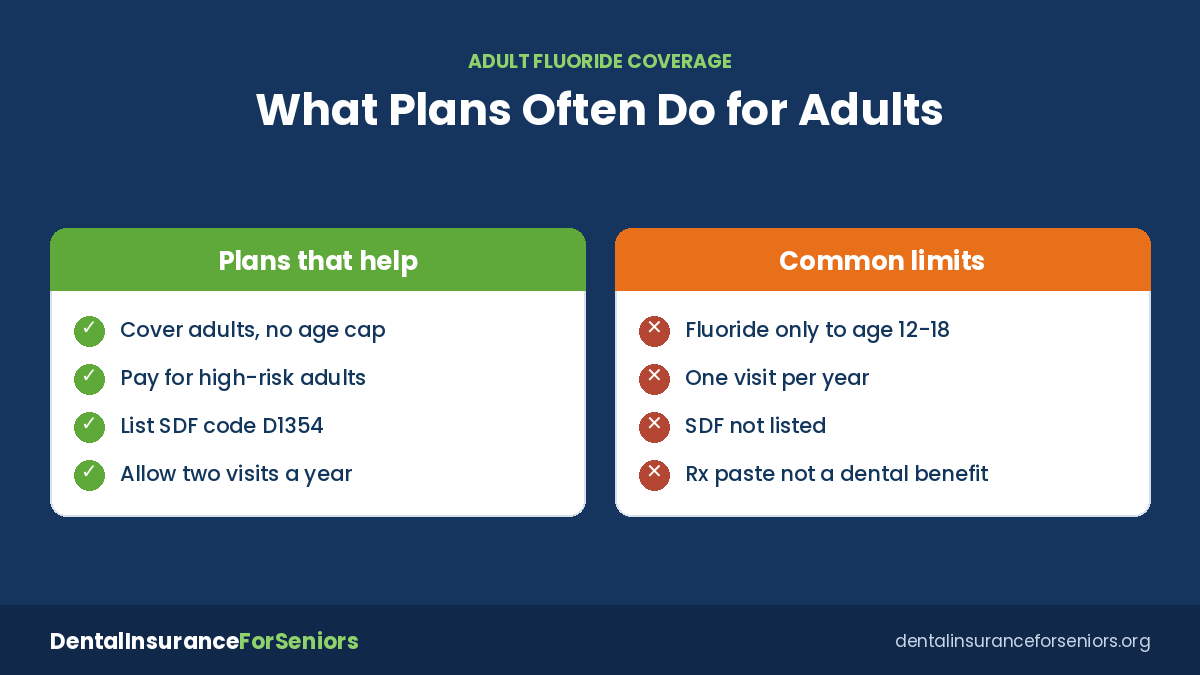
Fluoride treatment cost coverage: what dental plans often pay for adults versus common limits

Fluoride sits in the preventive tier, so people expect it to be paid like a cleaning. For adults it often is not. DentistryIQ notes that many carriers long denied fluoride benefits to anyone over 18, and that many major carriers now cover adults, almost always once per benefit year. Delta Dental tells dentists that most of its PPO and DeltaCare USA plans cover fluoride for children up to age 12, and many to 18 and older.

The age cutoff, frequency and any high-risk exception are written into each plan’s schedule. A plan sold to seniors may carry the same child-age limit as a family plan.

1

Search the schedule for D1206 and D1208. Look for an age limit next to each code, such as through age 14 or under 19.

2

Check the frequency. Once or twice per benefit year is common where adults are covered.

3

Look for a high-risk rule. Some plans pay adult fluoride only with a documented risk finding, such as a dry mouth diagnosis or a caries risk assessment (code D0603 for high risk).

4

Ask about D1354 separately. SDF is billed per tooth and may sit in a different tier.

Find & Compare Plans Online

Speak with a licensed insurance agent

1-855-425-2095TTY 711

Mon-Fri: 8am-9pm ET

Medicare, Medicare Advantage and Prescription Fluoride

Original Medicare does not pay for routine dental care, including fluoride. Some Medicare Advantage plans include preventive dental benefits, and whether they cover adult fluoride varies by plan and area, so read the dental schedule or Evidence of Coverage. See preventive dental care in Medicare Advantage plans.

Prescription 5,000 ppm toothpaste is a pharmacy product, so it is a drug question, not a dental one. GoodRx’s Medicare page for PreviDent 5000 Plus shows an average deductible-phase copay of about $24 for a 30-day supply on plans that cover it, which suggests some Part D formularies list it. A coupon price may be lower than the plan copay.

Part D check: Look up the exact product in the Medicare Plan Finder drug list, or ask the pharmacist to compare the Part D copay with the coupon price.

Questions to Ask Before Buying a Plan for Fluoride

Someone with dry mouth or exposed roots may want fluoride two or more times a year. That is modest next to a filling, but worth checking before buying. Other age-related problems that raise decay risk are in oral health conditions affecting seniors.

Does adult fluoride appear at all? Ask for the age limit on D1206 and D1208 in writing.

How many per year? If a dentist recommends varnish every three to six months, a once-a-year limit leaves later visits to cash.

Is SDF covered, and at what tier? Ask whether D1354 is paid per tooth and whether it counts against the annual maximum.

Cash math: Two varnish visits a year at $30 to $60 each total about $60 to $120, while one composite filling runs about $150 to $450 per tooth (Real Dental Costs). Practical tips for living with medication dry mouth are in dental care tips for dry mouth.

Bottom Line

Fluoride treatment usually costs about $20 to $60 a visit, SDF about $25 to $90 per tooth, and prescription 5,000 ppm paste about $15 to $35 a tube. Many plans still cap fluoride at a child’s age, so seniors with dry mouth or exposed roots should check the age limit, frequency and SDF rules before buying.

See dental plans and rates in your ZIP code

Fluoride Treatment Cost — Frequently Asked Questions

➤ How much does a fluoride varnish cost for an adult without insurance?

Consumer cost guides put varnish at about $30 to $60 a visit. Some offices charge less or include it with the cleaning fee.

➤ Why won’t my dental plan pay for fluoride at my age?

Many plans limit codes D1206 and D1208 to children, often through age 12, 14 or 18. Some cover adults, usually once a year or with a documented high decay risk.

➤ Is silver diamine fluoride cheaper than a filling?

Usually. SDF often runs about $25 to $90 per tooth, while a composite filling can cost about $150 to $450. It stains the decay black and does not suit every cavity.

➤ Does Medicare pay for fluoride treatments?

Original Medicare does not cover routine dental care, including fluoride. Some Medicare Advantage plans include preventive dental benefits, and adult fluoride coverage varies by plan.

➤ Can Part D pay for prescription fluoride toothpaste?

Some Part D plans may list a 5,000 ppm product such as PreviDent 5000 Plus. Check the plan’s drug list and compare the copay with a coupon price.

➤ Who needs fluoride after 65?

Dentists often suggest it for exposed roots, medication dry mouth, frequent new cavities or past head and neck radiation.

➤ How often should seniors get fluoride varnish?

It depends on risk. High-risk adults may be advised to get it two or more times a year, but plans that cover adults often pay once per benefit year.

➤ What dental codes should I look for in a plan?

D1206 for varnish, D1208 for gel or foam, and D1354 for silver diamine fluoride. A high-risk assessment may be billed as D0603.

Senior Dental Insurance Quotes

Call a Licensed Agent Now

Compare dental plans for seniors and people on Medicare from several insurance companies in one call.

☎ 1-855-425-2095

TTY users 711  |  Mon–Fri: 8am–9pm ET

No obligation to enroll

Find & Compare Plans Online

Speak with a licensed insurance agent

1-855-425-2095TTY 711

Mon-Fri: 8am-9pm ET

ZRN Health & Financial Services, LLC, a Texas limited liability company