



Does Medicaid Cover Dentures? State Rules for Seniors and Dual Eligibles

Reviewed by Russell Noga, Licensed Insurance Broker — Last updated November 2, 2026

Yes, Medicaid covers dentures for adults in most states, but not all, because adult dental care is an optional Medicaid benefit that each state designs on its own. Where dentures are covered, states usually require prior approval and limit how often a set can be replaced, from once every five years in California to one set per lifetime in Pennsylvania unless an exception is approved.

2027 by the Numbers

13

states with no complete-denture coverage for most adults on Medicaid (CareQuest Institute, 2023 data)

8 years

New York Medicaid’s usual wait before replacing a denture (NY eMedNY dental manual)

1 set

Pennsylvania’s lifetime denture limit without a benefit limit exception (PA Medicaid)

Federal law requires Medicaid to cover dental care for children, but for adults the choice is left to each state. That is why a retiree in Massachusetts can get new complete dentures through Medicaid while a neighbor of the same age in Texas usually cannot.

This page is for people 65 and older, especially those with both Medicare and Medicaid, and for family members sorting out a parent’s coverage. For broader help when money is tight, see dental insurance for low-income seniors.
Compare Denture Coverage Options in Your Area

Why Your State Decides Whether Medicaid Pays for Dentures

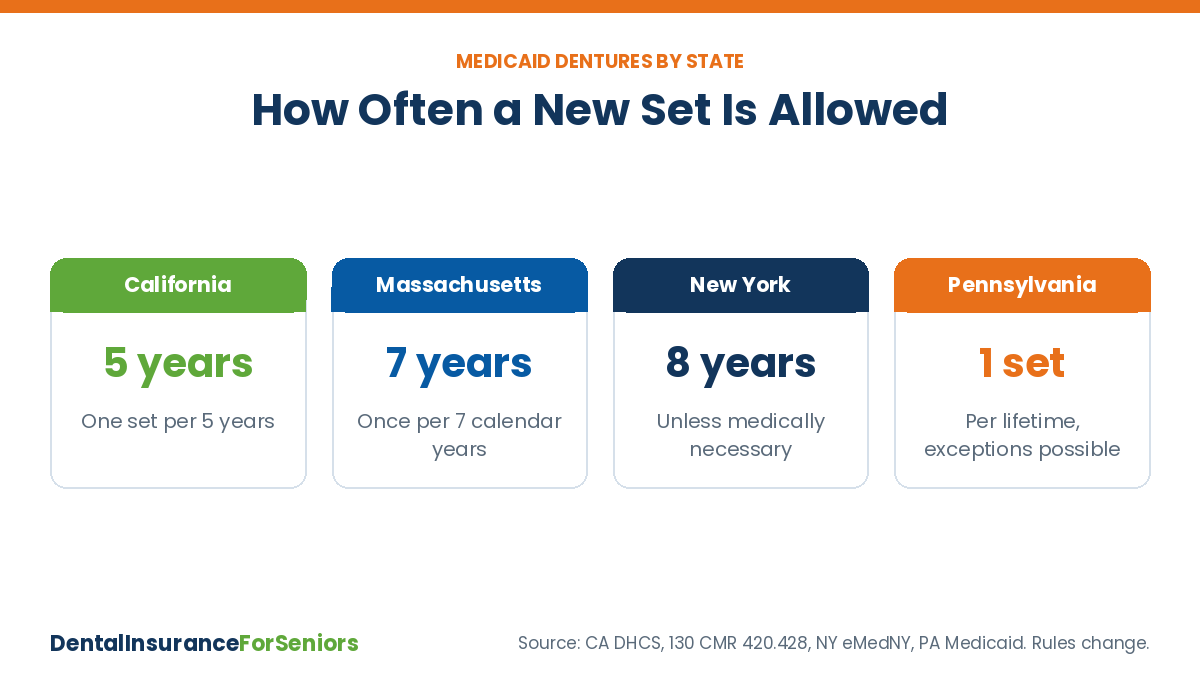
Does Medicaid cover dentures: denture replacement limits in California, Massachusetts, New York and Pennsylvania

Dental care for adults 21 and older is not on the federal list of required Medicaid benefits, so every state picks its own level of coverage. Some offer exams, fillings, extractions and dentures. Others limit adults to emergency care for pain or infection, and a few offer almost nothing.

A 2024 CareQuest Institute review of state rules in effect at the end of 2023 found 13 states with no complete-denture coverage for their largest group of adult enrollees. Eight of those still cover complete dentures for certain groups, such as nursing facility residents or long-term care waiver members. Coverage for partials and relines was thinner still.

Key point: A state with adult dental Medicaid does not always include dentures. Complete dentures, partials and relines are listed separately in state benefit rules, so check each one.

Senior Dental Insurance Quotes

Call a Licensed Agent Now

Compare dental plans for seniors and people on Medicare from several insurance companies in one call.

☎ 1-855-425-2095

TTY users 711  |  Mon–Fri: 8am–9pm ET

No obligation to enroll

How Seven States Handle Medicaid Dentures for Adults

The table pulls each state’s published rules into one view. The waiting period before a replacement, often called a replacement clock, matters most once a first set is approved.

StateAdult denture coverageReplacement rule
California (Medi-Cal Dental)Complete and partial denturesOne set every 5 years, no lifetime limit; earlier for documented loss, trauma or medical change
Massachusetts (MassHealth)Complete dentures for all members; partials when tooth-loss criteria are metOnce per 7 calendar years
New York (Medicaid)Full and partial dentures when medically necessary, with prior approvalUsually 8 years unless medically necessary, with a justification form
Pennsylvania (Medical Assistance)Complete and partial denturesOne set per lifetime unless a benefit limit exception is approved
Tennessee (TennCare)Complete, partial and immediate dentures and relines for adults 21+ since 2023Set in TennCare’s procedure code list
Florida (Medicaid)Full and partial dentures for recipients 21+Set in state coverage policy and fee schedule
Texas (Medicaid)No general adult denture benefitSTAR+PLUS home and community waiver members may get dentures within a $5,000 yearly dental limit

Sources: CA DHCS SPA 23-0029; 130 CMR 420.428 (MassHealth); NY eMedNY dental manual and NY DOH 2024 update; PA Medicaid benefit summary; TennCare; Florida AHCA; Texas HHS STAR+PLUS handbook. Rules change; check your state before treatment.

Prior Approval, Replacement Clocks and Other Fine Print

Even in states with a strong benefit, a denture claim is rarely automatic. These rules most often slow down or stop a request.

Prior approval. Many states, including New York, require the dentist to send records for approval before the denture is made. Work started before approval can leave the patient with the bill.

Replacement clocks. Lost or broken dentures are usually not replaced until a set number of years pass, unless there is proof of medical need, trauma or a loss outside the patient’s control.

Repair before replace. New York, for example, may deny a repair costing more than half the price of a new denture and ask for a replacement request instead.

Group limits. Some states cover dentures only for certain adults, such as nursing facility residents or waiver members.

Before the first appointment: Ask the dental office three questions: whether it accepts your state’s Medicaid or Medicaid dental plan, whether the denture needs prior approval, and when your current denture becomes eligible for replacement under state rules.

If You Have Both Medicare and Medicaid

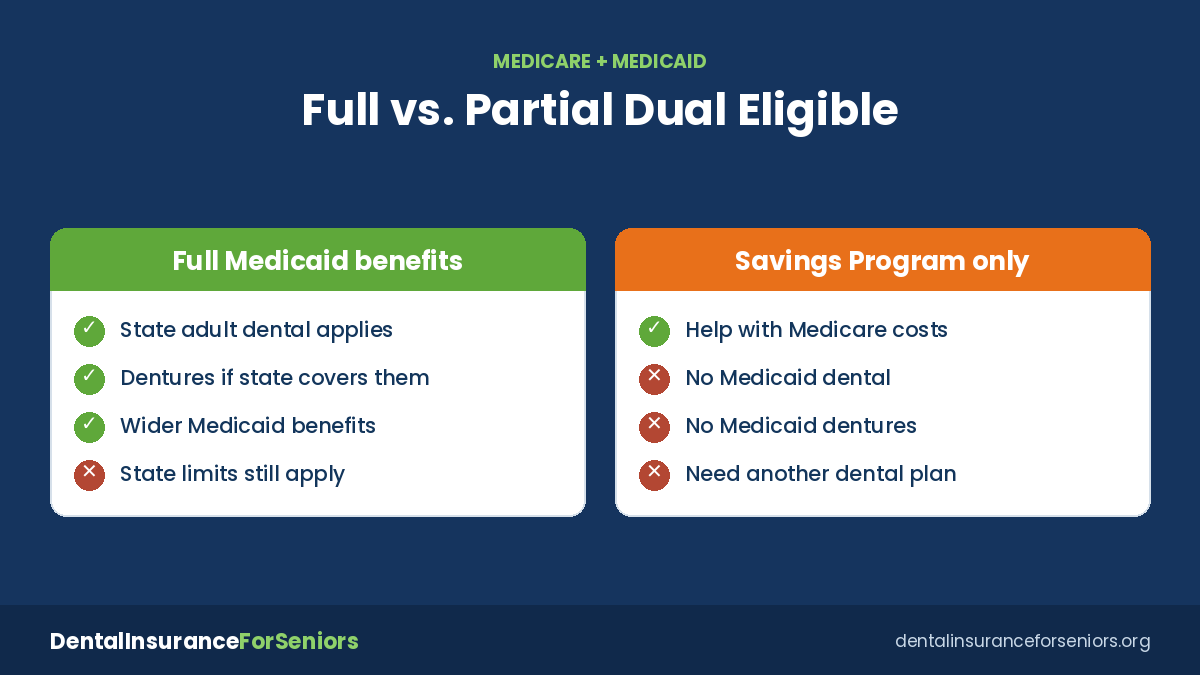
Does Medicaid cover dentures for dual eligibles: full-benefit dual vs Medicare Savings Program only

Original Medicare does not pay for dentures, so for people with both programs, Medicaid is often the only public source of denture coverage. For a closer look at what Medicare itself pays, read Medicare dental coverage for dentures.

Full versus partial dual eligibility. CMS lists people who qualify only for a Medicare Savings Program (QMB-only, SLMB-only or QI) as partial-benefit groups. These programs help with Medicare premiums and, for QMB, cost-sharing, but do not include full Medicaid benefits like state dental coverage. People with full Medicaid benefits, including QMB-Plus and SLMB-Plus, get whatever adult dental benefit their state offers.

Dual-Eligible Special Needs Plans (D-SNPs). These Medicare Advantage plans are built for people with both Medicare and Medicaid. Many add dental benefits on top of what the state covers, but the amount and whether dentures are included vary by plan and area. Other Medicare Advantage plans may also help; see does Medicare Advantage cover dentures.

Order of payment: When a person has both a Medicare Advantage dental benefit and Medicaid dental coverage, the Medicare plan generally pays first and Medicaid may cover remaining costs it allows. Exact rules depend on the state and the plan.

Find & Compare Plans Online

Speak with a licensed insurance agent

1-855-425-2095TTY 711

Mon-Fri: 8am-9pm ET

How to Find Out Your State's Denture Rule

1

Confirm your Medicaid category. Your Medicaid approval notice or caseworker can tell you whether you have full Medicaid benefits or only a Medicare Savings Program.

2

Find the adult dental benefit. Search your state Medicaid agency’s site for its adult dental summary or member handbook, and look for dentures, prosthodontics and relines.

3

Identify who runs dental. Many states use a dental plan or benefits manager to handle claims; the handbook or plan card names it.

4

Ask about frequency and approval. Ask how often dentures can be replaced and whether prior approval is required.

5

Find the date of your last set. That date starts the replacement clock.

6

Appeal a denial in writing. The denial notice explains how to request a fair hearing or an exception, such as Pennsylvania’s benefit limit exception.

When Medicaid Won't Pay: Other Ways to Cover Dentures

If your state does not cover dentures, you have only a Medicare Savings Program, or your replacement clock has not run out, these options can still lower the bill. To size up the bill first, read how much dentures cost.

Stand-alone senior dental plans. Many cover dentures as a major service, often around 50% after a waiting period, up to a yearly maximum.

Medicare Advantage dental. Some plans include dentures, with limits and networks that vary by plan and area.

Dental discount plans. A yearly membership gives reduced fees at participating dentists with no waiting periods, though it is not insurance.

Dental school clinics. Supervised students often make dentures at lower fees, over more visits.

Compare plans that list dentures as a covered service in our guide to dental plans covering dentures for seniors. Dentures generally cost less up front than implants, though the right choice depends on your mouth and budget.

Bottom Line

Medicaid pays for dentures in many states, but the benefit, the paperwork and the replacement schedule are set state by state, and partial dual eligibles usually have no Medicaid dental at all. Check your state’s adult dental rules first, then compare D-SNP, Medicare Advantage and stand-alone dental coverage to fill any gap.

Related: does Medicaid cover dental State adult dental levels, dual-eligible rules and D-SNP dental for seniors.

Check dental plans that help with dentures in your ZIP code

Medicaid and Dentures — Frequently Asked Questions

➤ Does Medicaid pay for dentures for people over 65?

In many states, yes. Adults 65 and older with full Medicaid benefits get the same adult dental benefit the state offers other adult enrollees.

➤ Which states do not cover dentures under Medicaid?

It changes as states update their programs. CareQuest Institute counted 13 states without complete-denture coverage for most adult enrollees at the end of 2023, though some cover certain groups. Your state Medicaid agency has the current rule.

➤ Will Medicaid replace dentures that were lost or broken?

Usually only after the state’s replacement period, such as five years in California or seven in Massachusetts. Earlier replacement is sometimes approved for loss outside your control, trauma or a medical change.

➤ Do I need prior approval for Medicaid dentures?

In many states, yes. The dentist sends records to the state or its dental plan before making the denture, so confirm approval before work begins.

➤ Does a Medicare Savings Program cover dentures?

No. QMB-only, SLMB-only and QI help with Medicare costs but do not include full Medicaid benefits such as dental. You would need full Medicaid, a Medicare Advantage plan with dental or a separate dental plan.

➤ Do D-SNPs cover dentures?

Some do. D-SNPs often add dental benefits beyond what the state covers, but whether dentures are included and how much the plan pays varies by plan and area.

➤ Does Medicaid cover partial dentures?

Fewer states cover partial dentures than complete dentures. Where they are covered, states may require certain teeth to be missing and the remaining teeth to be healthy.

➤ What can I do if my state’s Medicaid will not pay for dentures?

Look at stand-alone senior dental plans, Medicare Advantage plans with denture benefits, discount plans and dental school clinics. Comparing plans in your ZIP code shows which list dentures as covered.

Senior Dental Insurance Quotes

Call a Licensed Agent Now

Compare dental plans for seniors and people on Medicare from several insurance companies in one call.

☎ 1-855-425-2095

TTY users 711  |  Mon–Fri: 8am–9pm ET

No obligation to enroll

Find & Compare Plans Online

Speak with a licensed insurance agent

1-855-425-2095TTY 711

Mon-Fri: 8am-9pm ET

ZRN Health & Financial Services, LLC, a Texas limited liability company