



Dental Bonding Cost for Seniors: Repair Pricing, Plan Codes and Cheaper-Than-Crown Options

Reviewed by Russell Noga, Licensed Insurance Broker — Last updated November 16, 2026

Dental bonding costs about $288 to $915 per tooth before insurance, with a national average of $431, according to CareCredit’s 2024 cost study. When bonding repairs a chip, break or worn spot, many dental plans pay it like a tooth-colored filling under basic care, but bonding done only to change how a tooth looks is usually excluded as cosmetic.

2027 by the Numbers

$431

national average bonding price per tooth (CareCredit 2024 study)

$1,817

average single porcelain laminate veneer, for comparison (CareCredit)

46.7%

average share of adults with worn notches at the gumline (2020 review of studies)

Bonding is a thin layer of tooth-colored resin that a dentist shapes onto a tooth and hardens with a curing light. For people past 65, it is one of the least costly ways to fix a chipped edge, fill a worn notch near the gums or cover a stained spot.

The price on the bill matters less than how the claim is coded. The same resin can be billed as a covered repair or as an excluded cosmetic service, and that choice decides who pays. If the tooth is too damaged for resin, compare dental crown cost before you decide.
Compare Senior Dental Plans That Cover Tooth Repairs

What Bonding Costs Per Tooth Before Insurance

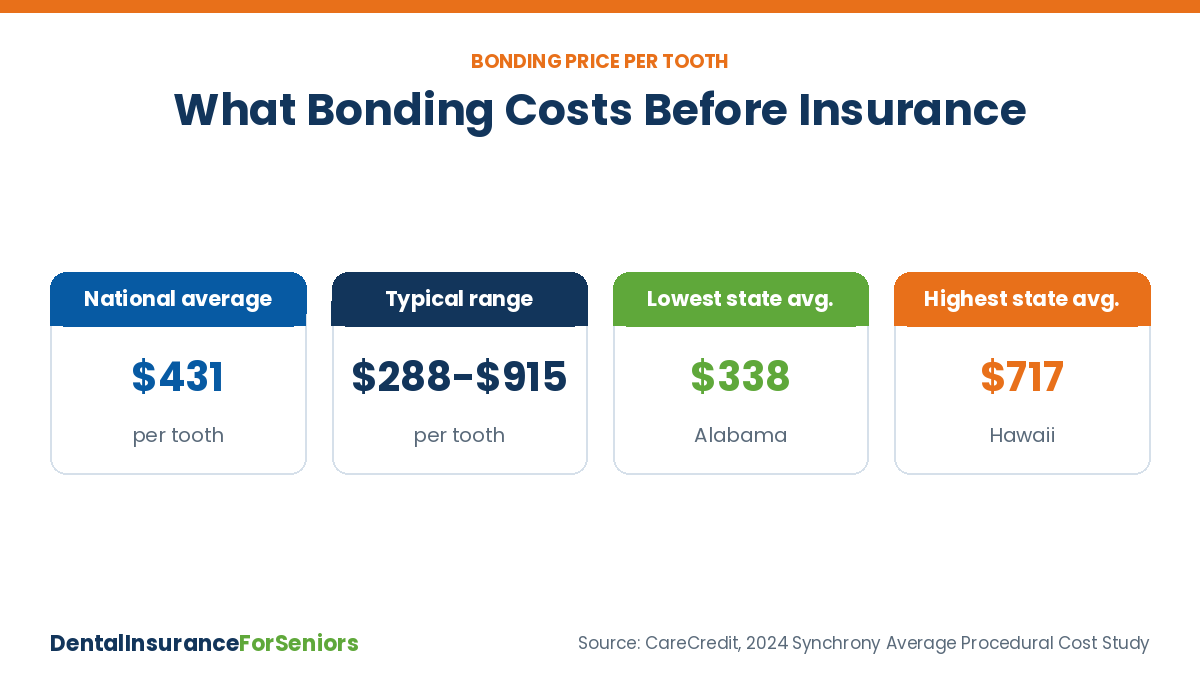
Dental bonding cost per tooth: national average, price range and lowest and highest state averages

CareCredit’s 2024 Synchrony Average Procedural Cost Study lists bonding at $288 to $915 per tooth, averaging $431. State averages ran from $338 in Alabama to $717 in Hawaii. Humana’s consumer guide gives a wider $100 to $500 per tooth range for out-of-pocket bonding.

Size of the repair. Touching up a tiny chip takes far less resin and chair time than rebuilding a broken corner or covering the whole front of a tooth.

Number of teeth. Prices are quoted per tooth, so bonding four front teeth costs roughly four times as much as one.

Where you live. The CareCredit study found more than a $375 spread between the lowest and highest state averages.

Visit add-ons. An exam, x-rays or a cleaning before bonding may be billed as separate lines on the same day.

Senior Dental Insurance Quotes

Call a Licensed Agent Now

Compare dental plans for seniors and people on Medicare from several insurance companies in one call.

☎ 1-855-425-2095

TTY users 711  |  Mon–Fri: 8am–9pm ET

No obligation to enroll

Repair or Cosmetic? How the Claim Code Decides Coverage

Insurers see a CDT procedure code, not the word bonding. Repairs billed with resin-based composite codes are normally treated like fillings, while a resin veneer placed for looks falls under a code many plans exclude or limit.

Bonding jobCode a dentist may useHow plans often treat it
Small chip on a front toothD2330 (composite, one surface, anterior)Basic care, often 70% to 80% after the deductible
Broken front corner or edgeD2335 (four or more surfaces or involving incisal angle, anterior)Basic care; a claim narrative explaining the break helps
Worn notch at the gumlineD2330 or D2391 (one surface), a Class V repairBasic care when there is damage or decay; plan rules vary
Sensitive exposed root, no notchD9911 (desensitizing resin, cervical or root surface, per tooth)Some plans pay; others exclude it
Resin veneer for color or shapeD2960 (labial veneer, resin laminate, direct)Often excluded as cosmetic; covered only by plans that include veneers

Code wording from the ADA CDT descriptors as published by UnitedHealthcare and DentistryIQ, checked November 2026. Your plan’s benefit document decides coverage.

Coding fact: UnitedHealthcare’s 2026 clinical policy lists veneer coverage only for enamel fractures that cannot be repaired with a direct restoration and for teeth with enamel defects, and only for plans that include veneers. Purely cosmetic use is not a listed reason.

What a Senior Pays for Bonding With a Dental Plan

Here is the same $431 front-tooth repair run through four common situations. In-network dentists often charge a lower contracted fee, so real bills may come in under these figures.

Situation ($431 bonding)Plan paysYou pay
No dental plan$0$431
Plan bought last month, basic waiting period not over$0$431
Repair coded as composite, 80% after a $50 deductible$304.80$126.20
Repair coded as composite, 50% after a $50 deductible$190.50$240.50
Cosmetic bonding on a plan that excludes it$0$431

Our math using the CareCredit average: ($431 – $50) x 80% = $304.80. Percentages are illustrations of common plan levels, not a specific plan.

Timing matters: Many individual plans place repairs under a waiting period for basic care, often a few months. A chip that can wait may cost far less after the wait ends. See dental plan waiting periods to compare plans.

Bonding vs Veneer vs Crown on a Fixed Income

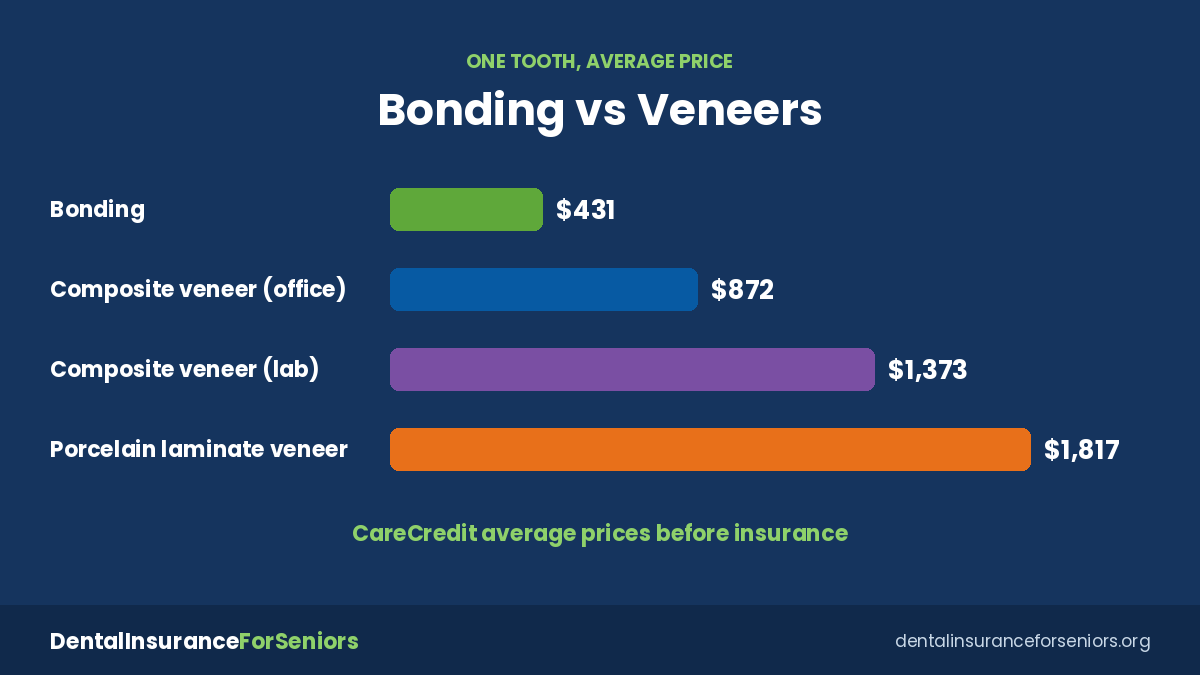
Dental bonding cost compared with composite and porcelain veneer prices per tooth

Bonding costs the least up front but does not last as long. CareCredit puts bonding at about 5 to 10 years and porcelain veneers at 10 to 20 years. Humana’s guide gives bonding 3 to 10 years before a touch-up or redo.

Option (one tooth)Average price (CareCredit)Typical lifeCost per year of use
Bonding$4315 to 10 yearsAbout $43 to $86
Composite veneer made in the office$872VariesNot calculated
Porcelain laminate veneer$1,81710 to 20 yearsAbout $91 to $182
Crown (resin to porcelain)$697 to $1,399Varies by materialNot calculated

Our per-year math divides each average price by its lifespan range. Crown prices from CareCredit’s 2024 study; lifespans from CareCredit.

On a per-year basis, bonding often stays the cheaper choice even if it is redone once. A crown makes more sense when a large part of the tooth is gone, and a plan may pay it as major care. For cover-up work on several front teeth, read dental insurance for veneers.

Find & Compare Plans Online

Speak with a licensed insurance agent

1-855-425-2095TTY 711

Mon-Fri: 8am-9pm ET

Gumline Notches and Exposed Roots After 65

A common reason older adults get bonding has nothing to do with looks. Years of brushing, grinding and gum recession can wear wedge-shaped notches into the tooth near the gums, called noncarious cervical lesions or abfraction. A 2020 review in the Journal of Dentistry found these notches in 46.7% of adults on average, and the rate was higher in groups over 30.

Why dentists bond them. Resin can cover exposed root, ease cold sensitivity and keep a deep notch from trapping plaque.

Why plans may push back. UnitedHealthcare’s desensitizing resin policy says it is not indicated for teeth with recession or abfraction that cause no symptoms.

What helps the claim. Notes on sensitivity that did not improve with over-the-counter desensitizing toothpaste, or on decay or a break in the notch, show a repair need.

Before treatment: Ask the office to send a pre-treatment estimate listing the exact code. It shows whether the plan reads the notch repair as basic care, a limited service or an exclusion.

Medicare, Medicare Advantage and Making Bonding Last

Medicare.gov says that in most cases Original Medicare does not cover routine dental services such as cleanings and fillings, so bonding is normally an out-of-pocket cost there. Some Medicare Advantage plans include dental benefits that may pay for restorative work, but what they cover, the copays and the yearly limit vary by plan and area.

1

Read the plan’s restorative list. Look for resin or composite repairs in the evidence of coverage, and check whether veneers or cosmetic services are excluded.

2

Get the code in writing. A written estimate with D2330, D2335 or D2960 tells you whether you are paying for a repair or for cosmetic work.

3

Protect the resin. Resin can chip and stain. Avoid biting ice or pens, and ask about a night guard if you grind.

4

Budget for a redo. With a 5 to 10 year life, a bonded tooth may need work again later. For a wider view of yearly costs, see out-of-pocket dental costs for seniors.

Bottom Line

Bonding averages $431 per tooth before insurance and is often the lowest-cost way for a senior to fix a chip or gumline notch. Coverage hinges on the claim code and the waiting period, so get a coded estimate first; for a decayed tooth, compare dental filling cost.

Related: porcelain veneers cost Per-tooth and full-set porcelain veneer prices, cost per year of wear and fit checks for older teeth.

Check bonding and repair coverage in your ZIP code

Dental Bonding Cost — Frequently Asked Questions

➤ How much is tooth bonding for one front tooth?

CareCredit’s 2024 study puts the national average at $431 per tooth, with most prices between $288 and $915.

➤ Does dental insurance pay for bonding?

Often, when it repairs a chip, break, worn notch or decay. Bonding done only to change color or shape is usually excluded as cosmetic.

➤ What CDT code is used for bonding a chipped tooth?

Dentists commonly use D2330 for a one-surface front repair or D2335 when the repair involves the biting corner. A resin veneer for looks is coded D2960.

➤ Does Medicare cover tooth bonding?

Original Medicare generally does not cover routine dental work such as bonding. Some Medicare Advantage plans include restorative dental benefits, with terms that vary by plan.

➤ How long does bonding last on older teeth?

CareCredit cites about 5 to 10 years, and Humana gives 3 to 10. Front teeth usually hold up longer than back teeth.

➤ Can bonding fix sensitive teeth near the gums?

Yes, resin can cover exposed root surfaces and worn notches. Some plans pay only when sensitivity persists after desensitizing toothpaste or the tooth is damaged.

➤ Is bonding cheaper than a veneer?

Yes. CareCredit lists bonding at $431 on average versus $872 for an in-office composite veneer and $1,817 for a porcelain laminate veneer.

➤ Is there a waiting period for bonding?

Repair bonding usually falls under basic care, which many individual plans put behind a waiting period. Check the plan summary before you schedule.

Senior Dental Insurance Quotes

Call a Licensed Agent Now

Compare dental plans for seniors and people on Medicare from several insurance companies in one call.

☎ 1-855-425-2095

TTY users 711  |  Mon–Fri: 8am–9pm ET

No obligation to enroll

Find & Compare Plans Online

Speak with a licensed insurance agent

1-855-425-2095TTY 711

Mon-Fri: 8am-9pm ET

ZRN Health & Financial Services, LLC, a Texas limited liability company